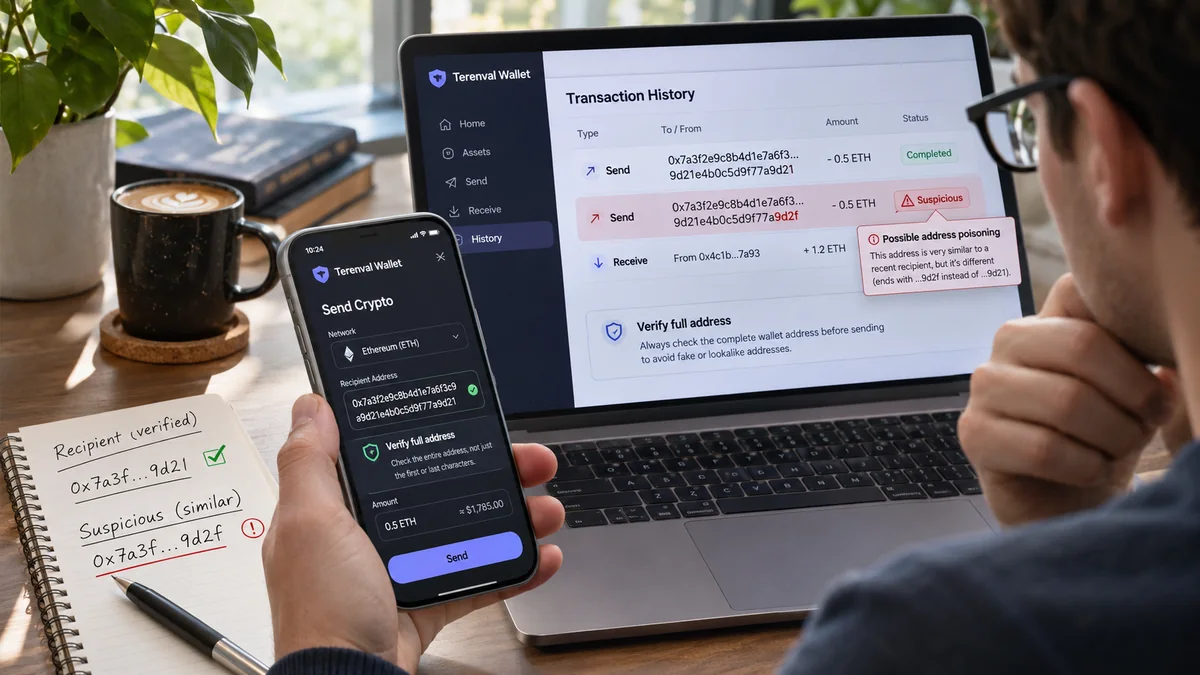
Crypto address poisoning is a social-engineering scam that tricks someone into sending cryptocurrency to an attacker-controlled address resembling a legitimate recipient. Attackers place their lookalike address where people expect familiar destinations to appear: a wallet's activity feed, an explorer's token-transfer log, or a recent-address suggestion. When the victim later copies that address and signs a genuine payment, the blockchain sends the funds to the attacker. The poisoning record alone normally does not steal funds or prove the wallet's private key was compromised.
The difference between a normal transaction and a catastrophic error can be a handful of characters hidden in the middle of a shortened address. This is particularly dangerous for people who regularly move USDT, USDC, ETH or other assets between a wallet and an exchange, or between two accounts they control. An apparently familiar 0x1234…ABCD is not proof of identity; two independent Ethereum addresses can display the same visible ends.
Short answer: Address poisoning works by placing a fake, similar-looking destination in your transaction history, often through a zero-value token transfer or tiny incoming payment. Do not reuse addresses merely because they appear in your activity feed. Retrieve the intended recipient from a separately verified source, compare the complete address, confirm the exact blockchain and asset, and verify the final transaction details before authorizing it. If you only received a suspicious zero-value entry and did not follow its address, your funds have not automatically been stolen.
Terenval's editorial assessment: A historical transaction is evidence that something appeared on-chain; it is not a certificate that the displayed recipient is trustworthy. A robust payment process must protect not only private keys but also the provenance of the destination address. This guide introduces the Terenval Source-of-Truth Transfer Protocol, Recipient Trust Ledger, Poisoned-History Triage Matrix and Transfer Risk Budget. These are original educational decision frameworks—not a wallet security certification, a deployed Terenval anti-poisoning feature, or a guarantee of reimbursement.
Key Takeaways
- Poisoning is primarily a recipient-selection attack. An attacker plants a deceptively familiar address and relies on the user to choose it later.
- You do not need to click the malicious entry to become a target. Attackers can send dust or create certain zero-value token events on public networks without your approval.
- A zero-value token-transfer log is not necessarily a signed outgoing payment. Some ERC-20 event records can be created without the supposed sender authorizing a real token transfer.
- The visible prefix and suffix are not an identity check. Lookalikes exploit truncated interfaces and human recognition shortcuts.
- The source of the address matters as much as its appearance. Copy the destination from a verified recipient, authenticated withdrawal/deposit page or independently confirmed address record—not from a recent-activity list.
- The asset and network are separate checks. USDT on Ethereum, Tron, Solana and other networks cannot be treated as an interchangeable route just because the token name is the same.
- Address poisoning and clipboard malware are different. One contaminates a list of candidate destinations; the other may alter the pasted destination on the user's device.
- A hardware wallet can add an independent display for transaction details. It cannot tell you whether you originally chose a fraudulent recipient; review the actual address shown on the device.
- An address book helps only if it was populated from a trusted source. Saving the attacker's address creates persistent risk rather than removing it.
- A test transfer is useful only after recipient verification. Sending a small amount to an unverified fake address merely proves you can pay the scammer.
- Suspected poisoning does not automatically mean seed exposure. Do not panic-import a seed phrase into an unfamiliar app or send funds to a supposed recovery expert.
- Successful on-chain transfers are generally irreversible. Act promptly to preserve transaction evidence and notify authentic exchange, provider or law-enforcement channels if funds were misdirected.
- Research numbers measure different populations and periods. Millions of flagged attempts do not mean millions of confirmed theft victims.
- Terenval Wallet should be evaluated by confirmed functionality. The verification principles apply when using Terenval or any other wallet, regardless of whether automatic lookalike detection is available.
What Is Crypto Address Poisoning?
Crypto address poisoning, also called wallet address poisoning, transaction-history poisoning or, in some variants, address spoofing, is a fraud method that places an attacker-controlled lookalike address in front of a potential sender. The attacker does not need to change Bitcoin's or Ethereum's consensus rules. They exploit the gap between an address being visible in a trustworthy-looking interface and an address being independently verified as belonging to the intended recipient.
A public blockchain preserves transaction records according to its own rules. An explorer generally reports real on-chain data, but a real data item can describe a deliberately misleading event. The explorer may faithfully display a token event that an attacker created to trick the user. The attack therefore does not require a fake block explorer or a forged blockchain. The trusted history becomes an untrusted address source.
MetaMask's explanation describes attackers using addresses that resemble genuine contacts and appearing in transaction history; Etherscan's investigation documents both lookalike-address placement and token event spoofing. The technical mechanism can differ, but the desired end state is the same: the victim signs a real transfer to the wrong account.
What is the difference between the recipient address and the wallet app?
A cryptocurrency address is a chain-specific identifier associated with an account or a spending condition. The wallet application is an interface used to inspect data, prepare transfers and authorize transactions. The app can show incoming transfers, outgoing transfers, token logs, suggested recipients and contacts; these entries do not all carry the same level of trust.
If a stranger sends a tiny transfer to your public address, they have not thereby gained your private key. Equally, if their address appears beside your genuine transactions, that does not mean you have approved it as a recipient. Visibility is not authority. Treat the activity feed as historical data, not as a vetted payment directory.
Why does this attack work despite blockchain transparency?
The blockchain can show a transaction hash, emitting contract, value, sender and destination. But a wallet often compresses this detail into a short line such as Sent · 0x2A8c…91F0. The sender remembers that prefix and suffix from a previous payment, believes the new row is the same contact, and taps Copy.
The attacker's success depends on a mismatch between what the interface makes easy to recognize and what the transaction will actually use. The chain will execute the complete address, not the abbreviated representation. Blockchain transparency can help investigate the manipulation after the fact, but it cannot undo the harm of signing the wrong destination.
How an Address Poisoning Scam Works: The Five-Stage Sequence
The familiar version of the attack follows five stages. These are defensive observations about the workflow, not a guide to constructing malicious addresses or generating fake events.
- A legitimate relationship exists. Someone pays a business, sends funds to an exchange deposit address or transfers crypto between personal accounts. The source and recipient become visible on-chain.
- An attacker observes public activity. A fraudster identifies a frequently used or valuable address relationship from transaction records. No breach of the victim's computer is necessary for this observation.
- A lookalike is introduced. The attacker uses a separate address with a deceptively similar visible prefix and suffix, then causes it to appear in activity through a small transfer or a misleading token event.
- A fake relationship gains apparent legitimacy. A wallet or explorer displays the attacker-controlled address near genuine entries, sometimes with a token symbol and direction that resemble normal activity.
- A real payment is misdirected. Days or months later, the user copies a historical or suggested address instead of retrieving a verified recipient, then signs a transaction to the attacker.
The critical security boundary is crossed at stage five, not stage three. This explains why users sometimes see several suspicious entries without losing funds, while one later act of address reuse can cause a major loss. Coinbase Unit 0x's technical analysis documents how these schemes exploit address copying and interface representation.
Why transaction history is a poor address book
History answers a narrow question: What has this wallet or token contract recorded? An address book should answer a different question: Which destination have I deliberately verified, for which asset, network and purpose? Copying from history conflates the two.
A recipient that was safe six months ago might have been a one-time deposit address, a bridge contract, a third-party payout account or an address retired by the recipient. Even without poisoning, historical address reuse can be dangerous. Poisoning adds an adversary who intentionally manufactures near-matches and misleading sequence information.
Can a zero-value transfer appear without my permission?
Yes, depending on the token contract and event semantics. The ERC-20 token standard specifically requires zero-value transfers to be treated as normal transfers that emit a Transfer event. Coinbase's 2023 investigation demonstrated how certain contract implementations could produce zero-value transfer records involving a victim's public address without that victim approving any meaningful token movement. That is different from an attacker spending the victim's tokens.
Do not assume that every zero-value event means an attack or that every suspicious event used the same contract behavior. Some zero transfers are legitimate operations; token implementations vary, and third-party interfaces may combine different transaction and event categories. The right response is to inspect the transaction initiator, contract, event value, actual balance change and intended counterparty, not infer private-key theft from a row marked “Sent.”
A Worked Example: Two Addresses That Look the Same
The following addresses are fictional demonstration strings, not real recommended destinations or evidence from any incident. They intentionally share their first and last characters while differing in the middle:
| Field | Illustrative display | Security meaning |
|---|---|---|
| Verified recipient, shortened | 0x8F1a…e72B |
A visual hint only; not a verified full identifier |
| Attacker's lookalike, shortened | 0x8F1a…e72B |
Appears identical in the abbreviated UI |
| Verified recipient, full | 0x8F1a3dC06bAE417952Dd6E8fA0c3012B45e7e72B |
Compare to an independently authenticated source |
| Lookalike, full | 0x8F1a9fB92dAC017e45628b3aC49D7821f9b0e72B |
Different address; can direct funds elsewhere |
These strings illustrate visual ambiguity, not necessarily valid mixed-case EIP-55 checksummed representations. Do not paste them into a live wallet or treat them as payment destinations.
The trap is not that hexadecimal addresses are invalid. Both a legitimate wallet and an attacker's wallet can have syntactically plausible addresses. The trap is the assumption that identical 0x8F1a…e72B snippets prove control by the same recipient. They do not.
Terenval's operational rule: For any irreversible transfer, compare the complete destination against a separate, trusted source. If the destination is supplied as a QR code, the decoded full address must still match the intended recipient. If the wallet cannot display the full address safely, use another trustworthy display or verification method before proceeding.
Zero-Value Transfer Attacks, Fake Tokens and Dusting: What Is Different?
The phrase address poisoning is often used for several related behaviors. They may appear similar in a wallet's activity list, but they do not create the same on-chain evidence or imply the same security event.
| Pattern | What is placed in the interface | Does the victim have to sign the incoming event? | Typical attacker objective | Appropriate response |
|---|---|---|---|---|
| Tiny legitimate transfer (dust) | A small incoming amount from an unknown address | No | Attention, tracking, address-history contamination or a lure | Do not interact with the source; independently verify intended recipients |
| Zero-value ERC-20 record | A Transfer event carrying zero units, potentially with misleading from/to fields |
Not necessarily, depending on implementation | Manufacture apparent outgoing or incoming history | Inspect the initiating transaction, event and balance delta |
| Counterfeit token event | A transfer or token name resembling USDT, USDC or another recognizable asset | Not necessarily | Make a fraudulent transfer look important or authentic | Verify the token contract address, not just its symbol |
| Lookalike address in recent activity | A recipient with the same abbreviated prefix/suffix as a genuine contact | No, to place an incoming lure | Be copied into a future outgoing transfer | Return to the recipient's original verified source |
| Clipboard hijacking malware | Wrong address appears after copy/paste, even when the source was correct | Malware acts on the local device | Replace a correct payment destination | Stop transfers; inspect device security and independently compare pasted address |
| Approval or signature phishing | A malicious spending permission or signed message | Usually requires a harmful authorization | Obtain authority to move tokens or use an unintended signature | Inspect approvals/signatures and use a tailored incident response |
Etherscan explains both address spoofing and event spoofing. Its separate zero-value transfer article shows why those records may be muted or flagged. MetaMask documents clipboard hacking as a different failure mode involving local device software.
Zero-value token transfer does not mean zero risk
The value carried by a fake event may be exactly zero, but its intended behavioral effect can be large. A suspicious event may exist for weeks while the target continues to receive normal payments. When a user later prepares a large transfer, the fraudulent address is already waiting in the recent-activity list. The attacker needs only one mistaken copy and one valid signature.
Because zero-value logs can also have benign causes, a blanket rule that “every zero transfer is criminal” is not evidence-based. A more useful rule is that zero-value history is not a trustworthy recipient source, especially when a new address closely resembles a previously used one.
Does dusting automatically compromise a wallet?
No. Receiving a small unsolicited token or coin amount generally does not disclose private keys, authorize a transfer or change who controls the address. Dusting can still create privacy risks, clutter a history feed or direct attention to fraudulent websites. The asset may also be a counterfeit token designed to lure users into signing dangerous interactions. You do not need to send the dust back or connect to a site to “clear” it.
If a wallet unexpectedly displays a token with a promotional name, website or promise of rewards, avoid following its link. Do not grant permissions to remove the token. The token balance and the recipient address must be evaluated independently.
How can an explorer display a transfer you did not make?
Block explorers can offer several views: top-level blockchain transactions, internal calls, token events and decoded contract actions. These are not interchangeable. The from field inside a contract's emitted token event is not, by itself, proof that the address holder signed the top-level transaction.
For an EVM transaction, investigate the actual transaction sender and the token contract that emitted the log. Compare the event's token value with real wallet balance movements. A misleading event is still a genuine log recorded on-chain; its story can be misleading even when its data are authentic. The Coinbase Unit 0x and Etherscan research notes above provide the technical basis for this distinction.
Address Poisoning vs. Clipboard Hijacking vs. Private-Key Theft
Confusing these threats can cause unnecessary and sometimes hazardous recovery actions. In pure address poisoning, the wallet's signing authority can remain intact. In clipboard hijacking, malware may be installed on the device and the integrity of the transaction preparation environment is in question. In a genuine private-key compromise, the attacker may authorize spends without your participation.
| Observable symptom | More consistent with | What it does not prove | First safe step |
|---|---|---|---|
| Tiny unsolicited transfer from a lookalike | History poisoning or dusting | Seed phrase stolen | Do not copy sender; check chain records |
| Zero-token “outgoing” event you never signed | Token-event spoofing | Your wallet signed a transfer | Inspect transaction initiator and token contract |
| Copied address changes upon paste | Clipboard manipulation or application error | Address poisoning alone | Stop payments and inspect the device |
| Unauthorized nonzero spending transaction signed by your account | Possible key, session or authorization compromise | Merely a poisoned history entry | Contain risk, preserve evidence and investigate signing permissions |
| Unexpected ERC-20 allowance or approval | Approval phishing or another permission event | That a dust transfer caused it | Review the approval and revoke where appropriate |
| Legitimate recipient confirms an address that differs from the wallet's candidate | Untrusted candidate or stale destination | Which party introduced the difference | Discard candidate and re-verify with the recipient |
Why this matters: Switching wallet apps does not fix an exposed private key, and rotating a seed phrase is not automatically necessary just because someone sent an unsolicited zero-value event. Conversely, dismissing unexplained nonzero outgoing transactions as “just poisoning” would be dangerous.
Terenval's separate guide on checking and revoking token approvals explains another risk class. Its compromised-wallet migration guide addresses cases involving actual loss of signing confidentiality. Neither should be confused with simple transaction-history contamination.
How Widespread Is Address Poisoning? What the Evidence Shows
Several independent investigations show that address poisoning is neither a hypothetical trick nor a one-off example. But the statistics must be read with their denominators and study windows intact.
| Research or disclosure | Reported observation | Period or scope | What the figure does not mean |
|---|---|---|---|
| Carnegie Mellon CyLab research summary | Approximately 270 million attempts, 17 million targeted addresses and at least $83.8 million in confirmed losses | Ethereum and BNB Smart Chain, July 2022–June 2024 | Not 270 million victims or a current running total |
| MetaMask citing Blockaid | 65.4 million flagged address-poisoning transactions | January 2025–February 2026 | Not 65.4 million successful thefts; overlaps conceptually but not in method with other studies |
| Chainalysis investigation | About $68 million in WBTC temporarily misdirected in a major 2024 incident; substantial funds were later returned | Specific campaign and May 2024 case | Not proof that the whole sum remained permanently lost |
| Blockaid's analysis | Escalating multi-chain activity, including attacks involving smart-contract wallet interfaces | Its documented 2025–2026 observations | Not a census of every network, provider or phishing attempt |
The Carnegie Mellon research summary describes the scale of activity and verified losses for its historical sample. MetaMask's June 17, 2026 announcement reports Blockaid's 65.4-million figure and describes a product warning feature. Chainalysis's case study provides a useful counterexample to simplistic loss reporting: the spectacular 2024 payment was subsequently returned in large part.
Terenval's analytical conclusion: The alarming figure is not only the number of fraudulent entries but the asymmetry between attacker effort and potential victim loss. An attacker can plant many low-cost lures and profit from very few successful large transfers. A security system that merely reduces the average mistake rate may still leave serious exposure to a rare, high-value event.
Why the counts cannot be added together
The Carnegie Mellon sample and Blockaid's counts cover different periods and methodologies; some services count attempted events, others unique targeted addresses, and others payments actually made to attacker-controlled recipients. Adding them into a single “335 million victims” total would be mathematically and editorially wrong. A single wallet may receive many poisoning attempts, and a single campaign may target thousands of addresses without succeeding.
When comparing any new statistic, ask: What unit is counted? Which chain? What dates? Are suspected and confirmed cases separated? Are returned funds netted out of losses? Those distinctions are more useful than a dramatic number stripped of its methodology.
A real incident: why a test payment did not prevent a catastrophic error
Chainalysis documented a May 2024 WBTC misdirection in which a victim made a small legitimate transfer and then sent a much larger transfer to a deceptively similar destination. The incident illustrates an important limitation: a test transfer protects you only if you keep using the exact, authenticated recipient from the verified test, not if you later select a lookalike from history.
The incident is not evidence that all test transfers are useless. It shows that destination continuity between the test and the main transfer is part of the safety process. If you independently verify destination A, test destination A, and later send the large amount to B because B looks similar, the test never validated B.
Why Are Similar-Looking Addresses Possible?
Ethereum and many EVM-compatible networks represent ordinary externally owned account addresses as 20-byte identifiers, conventionally written as 0x followed by 40 hexadecimal characters. Human interfaces often abbreviate them. Two different full addresses can share some visible characters. Address formats validate structure; they do not tell you whether the underlying account belongs to your intended friend, exchange or business.
For a purely illustrative uniform-hexadecimal model, the probability that one random address matches a specific set of eight designated hexadecimal characters is 1 / 16^8, or about one in 4.29 billion. That does not make a short displayed match a secure identity test. An adversary deliberately selects lookalikes, makes many attempts, and chooses what the target will see; this is not the same experiment as receiving one independent random address. Neither that toy probability nor a valid address checksum proves ownership of the name or account you intended.
Does EIP-55 checksum capitalization protect against poisoning?
Only partially, and for a different purpose. EIP-55 defines mixed-case checksum encoding for Ethereum addresses, helping detect certain accidental transcription errors. A valid checksummed address can still belong to a scammer. EIP-55 does not certify that an address corresponds to a known company, exchange deposit account or previous recipient.
If your interface displays all-lowercase addresses, case-based checks may not even be available as a visual aid. If it displays checksummed capitalization, do not mistake valid capitalization for a positive identity verdict. Checksum validation and recipient authentication solve different problems.
Does an ENS name solve the problem?
A human-readable name can reduce reliance on unreadable strings, but names are not automatically safe. Verify spelling, domain ownership, resolution status and the currently resolved full address through a trusted interface. Names can be spoofed with subtle character substitutions, changed by their controller or resolved differently under different circumstances. A saved name is useful only when its identity and resolution are trustworthy at the time of payment.
The same principle applies to QR codes and saved contacts. They are delivery formats for a destination, not independent evidence that the destination is correct.
Does Address Poisoning Affect Ethereum, Bitcoin, Solana and Other Networks?
The central deception—copying a forged lookalike destination—can cross chains, but the specific on-chain mechanisms differ. Do not assume an Ethereum ERC-20 event model exists unchanged on Bitcoin or Solana.
| Network / asset class | Relevant exposure | Technical caution | Safest operational habit |
|---|---|---|---|
| Ethereum and EVM chains (e.g., Base, Arbitrum, BNB Smart Chain) | Lookalike 0x recipients, dust and misleading token-event history |
ERC-20 event logs are not the same as the top-level transaction signer | Full recipient comparison from a separately trusted source |
| USDT / USDC on several networks | Sender may see the same ticker in multiple chain interfaces | Token symbol alone does not identify network or contract | Confirm network, token contract and destination together |
| Bitcoin | Lookalike payment addresses, dust and copying from history | UTXO records and Bitcoin script/address formats differ from ERC-20 event semantics | Request a fresh authenticated receive address and verify its complete text |
| Solana | Lookalike public keys, unsolicited assets and unfamiliar history entries | Solana transaction/token account model is not an ERC-20 clone | Verify exact public key, token mint and intended receiver |
| Hardware-wallet payments | A bad destination can be presented for device confirmation | Secure signing does not recognize a business relationship | Compare device-displayed destination with the trusted recipient |
| Exchange withdrawals | Wrong destination can be pasted into an authenticated withdrawal form | Exchange account security does not establish recipient ownership | Confirm address, token network and any memo/tag through the intended recipient's authenticated page |
Etherscan's technical report primarily analyzes EVM token event behavior. Bitcoin.org's scam guide separately warns about Bitcoin address poisoning and malware. Phantom's scam guidance likewise cautions users against copying destinations from transaction history.
Why reusing an EVM address across chains can be confusing
Many EVM networks share a familiar 0x address format, and the same wallet key may control the same-looking address on compatible chains. That does not mean every token, transfer route or contract behaves identically. A valid Ethereum address string can be a technically valid-looking destination on another chain where the recipient does not expect the transfer or cannot access the specific asset.
Poisoning is an identity error; choosing an incompatible blockchain is a routing and asset-support error. Both can happen simultaneously. Terenval's network-selection guide covers routing checks in detail; this article adds recipient-provenance checks that network selection alone cannot solve.
Are Bitcoin addresses protected by a checksum?
Bitcoin address encodings include error-detection properties, but those checks are designed to catch certain malformed or mistyped strings—not to identify a real-world payee. A syntactically valid Bitcoin address may still belong to an attacker. Even if your wallet rejects an invalid address, it may accept an entirely valid malicious one.
For high-value Bitcoin payments, confirm the exact address or other authenticated receiving instructions through a separate channel and follow established Bitcoin wallet security practices. Do not assume a familiar beginning such as bc1 authenticates a person, and do not automatically reuse a past address when a merchant or custodial service may issue new receiving instructions.
The Terenval Source-of-Truth Transfer Protocol: A Safer Way to Send Crypto
Original Terenval framework: The Source-of-Truth Transfer Protocol is a repeatable set of decisions for transfers in which the cost of a wrong recipient could be irreversible. It assumes that the user's interface, transaction history, clipboard and recent-address suggestions can all contain untrusted data. It is not a claim that Terenval Wallet automatically carries out the checks or can prevent every fraud.
The protocol has five gates. A transfer should not advance through a gate when the corresponding evidence is missing. For routine payments, the checks can be quick; for large or unusual transfers, they should be documented and independently confirmed.
Gate 1 — Establish the payment intent
Write down what you actually intend to do, independently of any candidate address. Identify who should receive the funds, which asset, which network, what purpose, and whether an extra memo or destination tag is required. For example: “Send 250 USDC on Ethereum mainnet to the verified Treasury address of Vendor A, invoice #1048.”
This prevents an address in the wallet's history from quietly defining the task. If the wallet shows a suggested recent destination before you have independently established the recipient, do not accept it as authority. The history is not the instruction.
Gate 2 — Authenticate the recipient's source
Obtain the address directly from a source you already trust: the recipient's verified wallet receive screen, an authenticated exchange deposit page, a business payment request validated through the company's established channel, or a contact record created after an earlier full verification.
For business payments, verify a changed address using a separate established communication channel, especially when the change appears in a new email, direct message or edited invoice. A compromised invoice or impersonated support conversation can defeat an otherwise meticulous hexadecimal comparison. The recipient's identity must be authenticated before an address is treated as theirs.
Never use an unexpected airdrop token description, a block explorer's “recently interacted” list or an unsolicited support message as the original source of recipient instructions.
Gate 3 — Compare the full destination, not its mask
Compare the complete address displayed in the final sending flow with the address from Gate 2. Use the supported full-address view, including the middle characters. This is particularly important when both candidates have matching prefixes and suffixes. Check the result after paste; a successful copy operation does not prove the clipboard or receiving field has preserved the intended text.
If a hardware signer is available and presents the recipient on its own trusted display, compare that display against the Gate 2 reference, not against a suspicious recent-history row. If the device cannot show the relevant transaction details clearly, do not interpret an opaque confirmation as full recipient verification.
A QR code can prevent some typing errors but is not proof of identity. Verify who supplied it and inspect the decoded address in a trusted interface. If the QR or address has changed since your last verification, establish why before signing.
Gate 4 — Verify the route and spending implications
Confirm the exact asset and network, its token contract where relevant, the recipient's ability to receive that asset, and any memo/tag rules. For ERC-20 transfers, ensure the contract you are sending is the intended genuine token and not a lookalike sharing a symbol. For exchange deposits, use the current authenticated deposit instructions, not an old outgoing transaction or a photograph of a past QR code.
Distinguish normal transfers from permission or contract interactions. A transaction that asks for an unlimited approval or an opaque signature is not the same operation as a straightforward coin transfer. If the request unexpectedly changes, stop and review what it actually authorizes.
Gate 5 — Authorize, reconcile and preserve the reference
For significant transfers, consider a small test amount to the fully verified recipient, where appropriate and economical. Confirm with the recipient that the test arrived on the intended network. Then reopen the intended recipient from the same verified source and confirm the main transfer's destination before authorizing it. Do not switch to “last used” merely because the test transaction appears in the activity feed.
After broadcast, inspect the actual on-chain transaction: destination, asset, amount, network and status. Keep the original trusted recipient reference and transaction hash. A successful blockchain confirmation proves that the recorded transaction occurred; it does not by itself prove that the payee was the one you meant to compensate.
A compact pre-send checklist
| Question | Required answer before signing |
|---|---|
| Who is the real recipient? | Identified via a known, independently authenticated channel |
| Where did this address come from? | Verified recipient source—not history, dust, token event or unsolicited message |
| Does the entire address match? | Yes, including middle characters and the final device/sending screen |
| Are asset, chain and contract correct? | Yes, all checked together |
| Does the recipient need a memo/tag? | Confirmed from current authenticated instructions |
| Did any warning, clipboard value or field unexpectedly change? | No; if yes, stop and investigate |
| Is the final signature exactly the intended action? | Yes; otherwise do not authorize |
Most important control: A verified address has to stay verified through the final signature. A correct address at the start of the process does not protect against a bad recipient selected from history later.
The Terenval Recipient Trust Ledger: A Better Address Book
Original editorial model: A conventional address book holds a label and a string. A Recipient Trust Ledger holds the verification evidence attached to that string. It is a conceptual workflow for individuals and treasury teams, not a claim about any existing address-book feature inside Terenval Wallet.
Keep a nonsecret record for frequently used payees with the following fields. Store it appropriately for the value and privacy of the payments; it should never contain seed phrases or private keys.
| Field | Example of useful nonsecret information | Why it matters |
|---|---|---|
| Recipient identity | “Vendor A treasury” | A name, not merely an address mask |
| Verified full address | Exact address obtained from authenticated instructions | Defines the identity string that must match |
| Chain and asset | “Ethereum mainnet / USDC” | Prevents accidental wrong-network reuse |
| Original source | “Vendor portal, signed invoice, independently verified support callback” | Establishes provenance |
| Verification date | “2026-11-03” | Makes stale records visible |
| Change history | “New account requested; independently reconfirmed” | Detects suspicious account replacement |
| Test evidence if needed | Test transaction hash and recipient acknowledgment | Shows that a particular destination worked |
| Allowed use | “Invoice settlement only; not exchange deposits” | Prevents treating a context-specific address as universal |
One notable design insight: A contact should be reverified when the recipient claims their address has changed, not simply when the wallet displays a similar-looking account. A good address book reduces unplanned address discovery. It does not eliminate the need to verify a new payee or protect against a compromised address book.
Example: a vendor asks to change the receiving address
Suppose a vendor's longstanding address ends in ...e72B. A new email says the vendor has upgraded its wallet and now uses another address also ending in ...e72B. The shared visible characters are irrelevant. Contact the vendor through an established number or portal, verify that a legitimate authorized person approved the change, confirm the complete new address and asset/network, and update the record only after that process succeeds.
Merely finding a matching recent on-chain transaction is weak evidence. An attacker can cause such entries to appear intentionally. Conversely, a genuine vendor may legitimately rotate addresses and have no matching transaction history at all. The procedure must accommodate both cases.
The Terenval Poisoned-History Triage Matrix
Original diagnostic framework: Before moving funds, determine whether the anomaly is a suspicious history entry, a transaction preparation issue or a real unauthorized spend. The response intensity should match the evidence, not the emotional impact of the interface warning.
| Observation | Risk classification | First action | Avoid |
|---|---|---|---|
| One unsolicited zero-value entry; balances unchanged | Possible poisoning attempt | Ignore source address and inspect event details if needed | Exporting seed or transferring all assets in panic |
| Several similar recent recipients after a genuine transfer | Elevated history-contamination risk | Stop selecting from recent history; reconstruct verified contact | Assuming the newest entry is the real payee |
| Different address appears immediately after paste | Device/UI integrity concern | Halt, compare against offline/independent source and check device | Sending a “test” before investigating |
| A verified saved address changed without authorization | Contact record integrity failure | Treat as potential compromise, verify through independent channel | Trusting the contact label over its full address |
| Actual unauthorized outgoing coin or token movement | Possible active compromise | Preserve evidence and follow containment/credential assessment | Dismissing it as harmless zero-value spam |
| Confirmed transfer to wrong lookalike already completed | Actual loss / misdirected payment | Document TX, alert providers and use official reporting channels | Paying third parties who promise guaranteed recovery |
The matrix is not forensic proof. For example, token approvals, smart-account execution, delegated sessions and compromised signing devices can create non-obvious loss paths. If there is an actual unauthorized nonzero movement, broaden the investigation beyond address poisoning.
A practical investigation worksheet
When reviewing a suspicious transaction, record only nonsecret facts:
- The affected public wallet address and relevant blockchain.
- The transaction hash, time and official explorer URL.
- Whether the entry represents a top-level transaction, internal operation or token event.
- The actual transaction initiator, the event's displayed
fromandto, and the relevant token contract. - Token amount in raw and displayed units, if applicable; any actual balance change.
- The independently verified intended recipient and the suspicious full address.
- Whether the suspicious entry was ever copied, saved, used in a test transfer or used in a completed payment.
- Whether there are any separate unauthorized approvals or nonzero outgoing transfers.
Do not publish private keys, wallet recovery phrases, authentication tokens or sensitive customer records alongside this worksheet. Public addresses and transaction hashes are already on-chain, but aggregating them may still create privacy risks for a business or individual.
The Transfer Risk Budget: Why Small Habits Matter for Large Balances
Terenval's Transfer Risk Budget is a decision model rather than a market statistic. It asks how much value is exposed to a preventable recipient-identification error in a particular workflow. A business sending many payments and a household making one transfer should not apply the same controls by habit alone; both should scale scrutiny with irreversibility, amount and confidence in recipient provenance.
Consider a deliberately simple hypothetical model:
- A treasury makes 100 transfers each month, each for $5,000, totaling $500,000 in monthly outbound value.
- Suppose, for illustration only, the probability of a wrong-destination event in that team's workflow were 0.02% per transfer. This is a made-up planning assumption, not a measured industry rate.
- Under independent-event assumptions, expected wrongly routed value would be
100 × $5,000 × 0.0002 = $100 per monthbefore considering partial or full recovery. - But the average is misleading when transfers are uneven: one $250,000 mistake can dominate years of low incident costs. For that reason, checks should be stricter for larger amounts and exceptional destination changes.
This model is not an estimate of actual address-poisoning loss rates. It illustrates why low-frequency, high-impact errors deserve process controls and why an apparently cheap security shortcut can have asymmetric consequences.
Defensive hierarchy: the controls that interrupt different stages
| Control | Prevents or reduces | Residual limitation |
|---|---|---|
| Never treat history as recipient directory | History-poisoning copy mistake | Does not stop a fraudulent invoice from a compromised account |
| Independently authenticate recipient instructions | Identity and payment-redirection fraud | Authenticated communication channel might itself be compromised |
| Full-address comparison on final screen | Truncation and some clipboard substitutions | Depends on a trustworthy display and source |
| Verified address-book record | Repeated untrusted searches for frequent payees | Incorrectly enrolled entries remain risky |
| Hardware signer with readable recipient display | Some compromised-host and blind-confirmation risks | Cannot decide whether the address actually belongs to the intended recipient |
| Wallet lookalike warning | Some recognized address collisions at send time | No detector can guarantee catching every variant |
| Recipient-confirmed test transaction | Wrong route or wrong destination when verification persists | Offers no protection if main transfer later uses a different address |
| Treasury approval policy / multisig review | Single-person operational error or compromise | Multiple reviewers can share the same bad source |
When a small test transfer helps—and when it does not
A test transaction is useful when confirming a fresh recipient, checking network support or verifying a merchant's account has received a small amount. It is not a substitute for verifying ownership of the address. If the payment is sent to a fraudulent destination, the test may succeed there too. If the operator then picks a different address from the activity log for the real payment, the test ceases to be relevant.
For large transfers, store the verified destination in the workflow, verify the device's final outgoing address, and use the same full authenticated recipient for both test and main amount. If a deposit address is one-time-use, do not assume reusing it is appropriate; follow the recipient's authenticated instructions.
How Wallets and Explorers Can Detect Address Poisoning
Modern wallet and explorer software can reduce exposure, but no warning feature should be treated as a replacement for recipient authentication.
In its June 17, 2026 product announcement, MetaMask reported introducing address-poisoning detection in the Mobile and Extension send flow for EVM networks. It described comparisons against previously interacted-with addresses, warnings for lookalike candidates and an alert for first-time recipients. This is a specific MetaMask feature as described by its developer, not a capability we can assume exists in every wallet.
Etherscan describes hiding or flagging certain suspicious zero-value events and warning when users copy addresses from risky token-transfer contexts. Filtering reduces clutter but cannot prove that every remaining row is safe. An attacker may use small nonzero amounts or other techniques.
Why perfect automatic detection is difficult
A detector may compare address masks, historical relationships and transaction semantics. It faces false positives—two legitimate addresses may share a prefix by coincidence—and false negatives—some malicious addresses may use different masks, brand-like labels or newly invented activity patterns. A first-time recipient has no safe historical reference against which to compare similarity.
Warnings work best as a deliberate pause for verification, not as an algorithmic permission slip. A missing alert is not evidence that the recipient is trustworthy, and an alert does not automatically prove fraud. What matters is whether the user can establish recipient provenance outside the suspicious data source.
What should developers and UX designers do?
The most valuable product improvements often happen before an irreversible send: show more of the complete recipient, prevent silent replacement of a trusted contact, mark unverified historical addresses, distinguish actual signed sends from token-event logs, and make suspicious-zero-value filters intelligible rather than invisible. A wallet should not overstate what it knows: “Seen on-chain”, “Previously paid” and “Verified contact” are materially different claims.
An interface may provide an address-copy shortcut, but it should not teach users that copying from their activity list is how to authenticate a payee. Prefer a clearly identified recipient source and a review flow that exposes asset, network and full destination before signing.
Practical Scenario 1: Moving USDT From an Exchange to Self-Custody
An investor holds USDT at an exchange and wants to transfer it to a wallet they control. They open the exchange's withdrawal form and need a receiving address. Last week's deposit shows in their wallet history; a zero-value entry also appears with almost identical first and last characters. The investor copies the latest entry and pastes it into the exchange.
Nothing in the exchange's authentication process necessarily proves that this address is the investor's. The exchange can securely authenticate the account owner and still accept an attacker-controlled recipient if the owner supplies it. An additional hazard is choosing the wrong withdrawal network because the destination format looks familiar.
Safer procedure: Open the actual receiving wallet, select the intended asset/network, obtain the receiving address directly from that wallet's authenticated receive interface, compare the full address against the exchange form, and check the final destination before authorizing the withdrawal. If the exchange or receiving wallet uses a memo/tag, confirm it on the current deposit screen. Do not recover the address from transaction history or from an unsolicited message.
The Terenval withdrawal-network explainer and memo/tag guide cover these different failure modes. Address poisoning adds the independent problem of who actually controls the destination.
Practical Scenario 2: Paying a Freelancer or Supplier Twice
A small business paid a contractor last month and now receives a new invoice. The employee preparing payment looks at the previous successful transaction, searches a blockchain explorer and copies the most recent address with the right visible prefix. Unknown to the employee, the history now includes a visually convincing lookalike.
Safer procedure: Match the contractor to a verified contact record, confirm any change of payment instructions through the established communication channel, compare the complete destination and require a second review for unusually large payments. If the address is newly supplied, do not claim it was approved solely because the first and last characters match historical records.
A second review only helps if the reviewers use independent evidence. Two employees can both be fooled if they look at the same shortened entry and repeat the same mistaken inference.
Practical Scenario 3: Sending a Large Amount After a Successful Test
A holder wants to move a substantial amount of ETH between two personal wallets. They perform a small test transfer to their correct destination. The test arrives. A fraudulent history entry appears afterward and looks similar to the test. The holder copies that new entry to send the remaining amount.
The failed link is not the test transfer, which may have been valid. It is the substitution of a different recipient after the test. The main transfer must use the exact address originally authenticated and tested. The safest operational record stores that full address independently of chronological history so it can be checked again at the moment of signing.
For a transfer large enough to affect personal financial security, the time spent on a deliberate second comparison is small relative to the possible loss. Consider keeping a contemporaneous nonsecret transaction plan rather than relying on memory or the previous activity row.
Practical Scenario 4: A Suspicious Token Appears in Your Wallet
A user sees a strange token transfer with a familiar symbol, perhaps even “USDT,” and a linked site promising a reward or transfer correction. The user has not sent any tokens, and balances in the genuine token contract remain unchanged.
Do not judge authenticity by the token's name. On EVM chains, token symbols are not a global identity registry; many contracts can advertise the same label. Confirm the actual contract address through a trusted reference and inspect whether the event represents real asset movement. Avoid visiting the unsolicited token's website or signing an approval to “claim” or “remove” it.
A fake token can be used in address poisoning, phishing or unrelated advertising spam. Receiving it does not automatically mean the wallet is compromised. Interacting with it may introduce new risks, which is why the first response should be careful observation rather than a hasty transaction.
Practical Scenario 5: A Hardware Wallet Shows a Different Destination
A user prepares a transfer on a desktop and expects to pay their savings account. A hardware signer displays a full recipient address that differs from the authenticated address in their secure record. The device is doing something important: it is revealing what the transaction actually proposes to sign.
Do not approve. Cancel the transaction, check the recipient source, inspect the computer's paste behavior and review whether a poisoned-history entry or malicious interface supplied the destination. Hardware devices can protect keys and give an independent display, but they cannot tell you which company owns the address or whether your business purpose is legitimate. You still need the source-of-truth check.
Ledger's hardware wallet guidance emphasizes verifying the transaction details on the device's trusted display. An unclear or unsupported transaction summary should be treated as insufficient information, not a reason to approve quickly.
Practical Scenario 6: A Wallet Flags a Lookalike Address
A wallet warns that a pasted destination closely resembles another address previously used. The warning may signal a real poisoning attempt, but similarity alone cannot prove malicious control. A legitimate service might have multiple addresses with similar patterns, and a new recipient may be unfamiliar because it is genuinely new.
A safe decision does not depend on dismissing or blindly obeying the warning. Return to the authenticated recipient instructions and compare the entire intended address. If the address is verified and supported for the payment, proceed only after understanding the transaction's implications; if provenance is uncertain, stop and obtain confirmation through another channel.
What to Do If You Have Already Sent Crypto to a Poisoned Address
There is no universal on-chain cancellation or guaranteed reversal after a cryptocurrency transfer is confirmed. Acting quickly may preserve evidence and create a chance that a service receiving the stolen funds can assist, but no article can promise recovery.
The first ten minutes: preserve facts and stop further payments
- Do not send another transfer to the suspect address. Avoid a “correction” transaction or a second test based on instructions from someone claiming to be the recipient.
- Record the transaction hash, chain, destination, token contract if applicable, amount and timestamp. Obtain the actual transaction from a recognized blockchain explorer rather than relying solely on a wallet notification.
- Preserve the trusted address that you meant to use. Capture the original verified payment instructions and the full differing destination, without exposing any recovery secrets.
- Determine whether the transaction is still pending or already confirmed. The sender's wallet and chain-specific rules govern whether a pending transfer can be replaced or canceled; a confirmed transfer is not ordinarily reversible by the wallet provider.
- Notify the intended recipient that the original invoice or transfer remains unpaid, so they do not assume settlement has occurred.
The next few hours: contact the right parties
If the source was a centralized exchange, contact its official authenticated support promptly with the transaction reference and explain that the withdrawal destination was fraudulent. If the recipient address appears connected to a particular custodial service, provide transaction evidence to that service through official channels; a provider may sometimes investigate or freeze assets, but is not obliged or able to do so in every case.
File a report with the appropriate law-enforcement or cybercrime authority where relevant. Preserve communications, suspicious contact details and on-chain evidence. The Ethereum.org scam support guide discusses incident documentation and available reporting routes.
Never pay an unknown “chain recovery agent” who claims they can decrypt a blockchain transfer, reverse a confirmed payment or unlock inaccessible tokens for an advance fee. Do not provide a seed phrase, private key or remote device access to anyone offering help.
Should you abandon or rotate your wallet after poisoning?
Not automatically. If the only evidence is a zero-value event or dust in transaction history, there is no proof that the secret keys have been disclosed. Creating a fresh wallet simply to escape visual spam may incur fees and introduce new operational risks; it also will not prevent someone from observing and sending to a public address again.
If evidence instead shows unauthorized nonzero spending, unexplained malicious signatures, compromised seed material or active malware, a separate compromise assessment is necessary. In that case follow verified incident-response guidance and, where appropriate, move assets using fresh, secure credentials generated in a trusted environment. Merely importing an exposed seed into another app does not protect it. See Terenval's compromised wallet migration guide.
Can stablecoin issuers freeze the fraudulent destination?
Some centrally issued tokens include administrative restrictions or freezing capabilities, subject to the issuer's rules and applicable law. This is not a universal recovery procedure. The existence of a freeze function does not guarantee that an issuer will act, that the transfer can be reversed, that the tokens have not already moved or that a claimant will receive reimbursement. An ordinary self-custody wallet cannot command another party's token contract to undo a completed payment.
Report accurately and promptly through official channels, and avoid treating anecdotal recoveries as promises for a different case.
Terenval Wallet: Applying These Principles to Everyday Self-Custody
A guide about recipient impersonation should make the user more capable of protecting funds, not pressure them into installing a product as an emergency “security fix.” Terenval Wallet is a self-custody-focused wallet in the Terenval educational ecosystem, and the practical lessons here apply when evaluating or using Terenval alongside any other compatible wallet.
For a user considering Terenval Wallet, the responsible workflow is to verify the actual network and asset support in the current application, obtain any receiving address from a trusted in-app screen, and compare the entire destination before every important send. A saved address or warning tool should be used only if its behavior is present and understood in the installed version. This article does not claim that Terenval has built-in lookalike-address detection, a specific hardware-wallet integration, automated scam reimbursement or universal cross-chain recovery.
Terenval's long-form guide to choosing the right network for exchange withdrawals addresses an adjacent cause of user loss; its seed phrase versus private key guide explains why the presence of fake entries is not equivalent to giving away control of an account.
Our editorial position: The most credible benefit any wallet can offer is to make safe choices understandable. Users should be able to tell which data came from the public chain, which contacts they verified themselves, and which details they are actually signing. Self-custody is not a substitute for secure payment habits; it makes those habits more consequential.
A Final Prevention Checklist for Individuals and Teams
- Obtain the destination from an authenticated recipient, not an unexplained history entry.
- Reconfirm recipient identity whenever payment instructions change.
- Compare all characters of the final destination with the independently verified reference.
- Inspect the decoded address if using a QR code, and check post-paste integrity.
- Confirm the exact asset, blockchain, token contract and memo/tag requirements.
- Understand whether the requested action is a transfer, token approval, contract call or signature.
- Treat unsolicited dust, zero-value transfers and unknown token descriptions as untrusted information.
- Use hardware signers and properly configured multisig approvals where suitable; independently verify what they display.
- Keep an address-book or Recipient Trust Ledger containing the full verified address and its source, never private keys.
- Make small test transfers when appropriate, and keep using the same independently verified destination for the full transfer.
- Stop if the address unexpectedly changes, a warning appears, the instructions become urgent, or the destination's provenance is uncertain.
- Preserve public evidence and use official channels if an error has already occurred.
One sentence to remember: Never let the last address you saw replace the address you actually verified.
Frequently Asked Questions About Crypto Address Poisoning
1. What is crypto address poisoning in simple terms?
It is a scam that puts a fake, similar-looking wallet address into the places you use to find previous recipients. The attacker hopes you will copy the imitation from transaction history and send real crypto to it. A poisoning event is not necessarily a hacked wallet or an unauthorized transfer of your funds.
2. Can someone poison my wallet without my permission?
Yes. Public blockchains normally allow third parties to send small transactions to a published address, and some token contracts can produce zero-value records without the supposed owner authorizing a meaningful transfer. The presence of a suspicious history entry does not, by itself, indicate that your seed or private key was disclosed.
3. Does a zero-value USDT transfer mean my USDT was stolen?
Not on its own. A zero-value event represents zero units in that event, and the wallet balance may be unchanged. Investigate the initiating transaction, the actual token contract and real balance changes. If there are separate unauthorized nonzero spends, treat those as a distinct security incident.
4. Why does my wallet show “Sent” for a transaction I never made?
A wallet may summarize a token's Transfer event using fields that are not equivalent to the signer of the top-level blockchain transaction. Some zero-value event patterns can create the appearance of a send. Examine the transaction initiator and contract logs before concluding that your account signed anything. Etherscan and Coinbase document these distinctions.
5. How can two different crypto addresses look identical?
Interfaces commonly shorten long addresses to a few characters at the beginning and end. Two different addresses can share that displayed prefix and suffix while the hidden middle differs. The actual blockchain transfer uses the complete address. Short visual matches are therefore insufficient to identify a recipient.
6. Is comparing the first four and last four characters enough?
No. Address-poisoning campaigns specifically target that habit. Compare the complete address with an independently authenticated recipient reference. Even a checksummed, syntactically valid or widely seen address may belong to an attacker. For high-value transfers, verify the final signing screen as well.
7. Is a crypto address safe if its EIP-55 checksum is valid?
Not necessarily. EIP-55 is designed to detect some address-encoding or transcription mistakes, not to prove ownership of an identity. An attacker-controlled Ethereum address can have a valid checksum. Recipient verification must still use a trusted source independent of transaction history.
8. Can address poisoning steal my seed phrase?
Not by itself. The basic attack lures you into sending funds to the wrong address; it does not require obtaining a recovery phrase. A separate phishing website or malware campaign may ask for secrets, so avoid following suspicious links. Never give your recovery words to a purported support agent.
9. Is address poisoning the same as a dusting attack?
No, though they can overlap. Dusting broadly describes sending tiny amounts to addresses, sometimes for surveillance or spam. Address poisoning specifically aims to substitute a lookalike recipient in a user's decision process. The dust amount may be zero or tiny, and the exact event mechanism varies by chain and token implementation.
10. Is address poisoning the same as clipboard hijacking?
No. Poisoning contaminates the set of addresses you might choose; clipboard hijacking modifies an address as you copy or paste it on a potentially infected device. Both can direct funds to an attacker. If copied text changes unexpectedly, stop transferring and inspect device security rather than assuming history poisoning explains it.
11. Can a fake USDT or USDC token appear in transaction history?
Yes. A counterfeit token contract can display a familiar ticker or name, and an explorer or wallet may initially show its events alongside genuine assets. Verify the exact token contract against a trustworthy source. A token label is not a secure identity registry and should not be used to authorize a payment.
12. Does an address poisoning attack affect Bitcoin too?
Address-copy deception can affect Bitcoin, but the mechanisms differ from ERC-20 token events. Attackers can create lookalike addresses and use small transactions or misleading activity to influence selection. Verify a Bitcoin recipient directly from authenticated receiving instructions. Do not infer Bitcoin's event semantics from Ethereum examples.
13. Can this happen on Base, Arbitrum or BNB Smart Chain?
Yes, similar risks exist on EVM-compatible chains. Public addresses and token histories can be used to present lookalike recipients. A matching 0x address format does not prove that the intended asset and network are compatible. Verify identity and routing independently, especially for USDC and USDT.
14. Does Solana have address poisoning attacks?
Solana users can face lookalike-address and unsolicited-asset deception, although transaction and token-account structures differ from Ethereum's ERC-20 system. Never copy a payment destination solely because it appears as a recent counterparty. Confirm the exact public key and any relevant token mint using a trusted source.
15. Can I trust the “Recent recipients” list in my wallet?
Not as proof of identity. Recent lists can include addresses derived from untrusted activity, and a previously used address may no longer be suitable for a new payment. Use a contact record that you originally verified, or obtain fresh authenticated receiving instructions from the intended party.
16. Are QR codes safer than copying wallet addresses?
They can reduce manual transcription but do not authenticate the payee. A malicious or substituted QR code can encode an attacker-controlled address. Validate the source of the QR code and examine the full decoded destination and network before signing. QR convenience is not a substitute for source verification.
17. Do hardware wallets stop address poisoning?
They can help, but do not eliminate the attack. A hardware signer can present the destination on an independent screen, which helps detect a mismatch with a trusted recipient. It does not know who owns that address. If you willingly approve a fraudulent destination after reading it, the device may still sign the transfer.
18. What if my wallet says an address resembles a previous one?
Pause and check provenance. Similarity may indicate a poisoning attempt, but it is not conclusive. Reopen the intended recipient's authenticated instructions, compare all characters and confirm the payment's asset and network. Do not dismiss a warning merely because the prefix and suffix look right.
19. Is a wallet with no address-poisoning warning unsafe?
Not necessarily, but users should not assume protection exists. Detection features and coverage differ across products, versions and networks. A wallet with warnings can also miss a novel technique. Independently verifying the full destination remains necessary, with or without an automated alert.
20. Should I send a small test transaction first?
Often, when appropriate—but only to a destination verified before the test. A test can confirm the receiving route and account availability. It cannot authenticate an address chosen from untrusted history. After the test, compare the main payment to the original authenticated recipient instead of copying the latest activity row.
21. Should I change my wallet address after receiving poisoned dust?
Not automatically. The suspicious entry alone normally does not mean the private key was exposed. Changing addresses may be useful for other privacy or operational reasons but can introduce cost and complexity. Address poisoning is primarily prevented by authenticated recipient selection, not by a universal address-rotation requirement.
22. Should I revoke all approvals after an address poisoning alert?
Not merely because a suspicious zero-value entry appeared. Token approval compromise is a separate risk and needs its own evidence. If you detect unauthorized allowances or harmful signatures, examine and revoke them as appropriate through verified interfaces. Avoid granting new permissions to “clean” a poisoned history.
23. Can scammers make it look like I sent USDC when I did not?
In certain ERC-20 or counterfeit-token event scenarios, yes. An event may use your address as a displayed source even when you did not authorize a nonzero token payment. Check the top-level transaction sender, emitted token contract, event value and actual balance changes before interpreting the row as a genuine outgoing spend.
24. How do I know whether a suspicious token transfer is real?
Review the blockchain transaction directly, identify the actual token contract, distinguish the caller from the fields inside emitted events, and compare balances before and after the transaction. A displayed ticker, image or familiar address mask is weak evidence. If unsure, avoid interacting with the token or linked sites.
25. Can an exchange reverse a withdrawal sent to an attacker?
Usually not once the blockchain transfer has been confirmed. The exchange may have its own pre-broadcast cancellation rules, and a recipient service might sometimes assist with tracing or restricting onward movement. None can guarantee recovery. Contact the exchange only through authenticated support and keep transaction evidence.
26. What should I do immediately after sending to a fake address?
Stop additional payments; preserve the full intended and fraudulent addresses, transaction hash, token/network and original instructions; tell the intended recipient the payment has not reached them; and notify relevant authentic providers or authorities promptly. Do not send fees or seed phrases to strangers who claim they can reverse the blockchain.
27. Can a scammer recover coins just because I clicked their address?
Merely viewing or copying a public address does not normally authorize an on-chain spend. The danger arises if you send funds to it, sign a malicious action or follow related phishing prompts. A copied address alone is not a private key; nevertheless, avoid connecting to unsolicited sites or authorizing unfamiliar contract interactions.
28. Is address poisoning possible when paying the same person regularly?
Yes. Frequent payments can make a recognizable destination pattern especially tempting to copy from history. Save a fully verified record with recipient identity, asset, chain, source and date. Reverify changes using a separate communication channel; do not let a new near-match silently replace the approved address.
29. Does Terenval Wallet automatically block poisoned addresses?
This article does not make that claim. The specific current features of Terenval Wallet should be verified in the installed product and official documentation. Independently of wallet brand, users should obtain verified recipient instructions, compare the full address, check the selected blockchain and review the final transaction before signing.
30. What is the single best habit for preventing address poisoning?
Never copy a recipient from transaction history merely because it looks familiar. Obtain the address from an independently verified source and confirm the complete destination at the moment of signing. This breaks the essential link between the attacker's fake history entry and your real payment authorization.
Related Terenval Reading
For transfer safety: Terenval's correct-network withdrawal guide and missing memo/destination tag guide explain routing mistakes that may resemble, but are not identical to, recipient spoofing.
For authorization and account control: See how to check and revoke token approvals and seed phrase versus private key versus wallet password. These help distinguish a poisoned history from an actual compromise of permissions or signing credentials.
For wallet continuity: Our guides on using the same wallet in two apps and recovering access if a wallet app shuts down explain why changing software interfaces is not the same as moving funds to a new blockchain address.
Sources and Research Notes
The research references below support technical explanations, documented security incidents and methodology statements. They are not endorsements of unrelated products. Where a researcher reports an estimate, it is attributed and identified by its original timeframe rather than stated as a current universal total.
- MetaMask, June 17, 2026 — Address Poisoning Detection Now Live. Developer's description of send-flow warnings and Blockaid's figure of 65.4 million flagged poisoning transactions from January 2025 through February 2026. https://metamask.com/news/address-poisoning-detection
- MetaMask Help Center — Address Poisoning Scams. Plain-language mechanics, history contamination, lookalike addresses, source verification and warning behavior. https://support.metamask.io/stay-safe/protect-yourself/wallet-and-hardware/address-poisoning-scams/
- MetaMask Help Center — Clipboard Hacking. Distinction between activity-history deception and address replacement on an infected device. https://support.metamask.io/stay-safe/protect-yourself/wallet-and-hardware/clipboard-hacking/
- Etherscan Information Center — Address Poisoning Attacks. Primary explorer explanation of lookalike-address and token-event spoofing, plus history display and filtering. https://info.etherscan.com/what-is-address-poisoning/
- Etherscan Information Center — Zero-Value Token Transfer Attack. Warnings and interpretation of zero-token event records. https://info.etherscan.com/zero-value-token-transfer-attack/
- Coinbase Unit 0x, February 14, 2023 — Zero Transfer Phishing, Part 1. Technical analysis of non-value ERC-20
Transferevents and their deceptive representation. https://www.coinbase.com/blog/zero-transfer-phishing-part-1-attack-analysis - Chainalysis — Anatomy of an Address Poisoning Scam. On-chain case reconstruction of the 2024 WBTC misdirection, campaign scale, test-payment limitations and return of a substantial amount. https://www.chainalysis.com/blog/address-poisoning-scam/
- Carnegie Mellon CyLab — Research on Crypto Address Poisoning. Summary of research covering approximately 270 million attack attempts, 17 million targeted addresses and at least $83.8 million confirmed loss in the July 2022–June 2024 Ethereum/BSC sample. https://www.cs.cmu.edu/news/2026/cylab-crypto-phishing
- Blockaid — Address Poisoning: The Growing Threat. Security-vendor observations about multi-chain campaigns and attack frequency; figures are provider-specific. https://blockaid.io/blog/address-poisoning-the-growing-threat-draining-millions-from-crypto-users
- Ethereum ERC-20 — Token Standard. Specification requiring
Transferevents for zero-value transfers; explains the interface expectations relevant to token logs. https://eips.ethereum.org/EIPS/eip-20 - Ethereum ERC-55 — Mixed-Case Checksum Address Encoding. Standard for Ethereum address checksum capitalization; not a recipient-identity standard. https://eips.ethereum.org/EIPS/eip-55
- Bitcoin.org — Avoid Scams. Bitcoin address-poisoning, fake support and malware guidance. https://bitcoin.org/en/scams
- Bitcoin.org — Securing Your Wallet. Backup, hardware wallet, online-service and general transaction-security principles. https://bitcoin.org/en/secure-your-wallet
- Ledger Academy — Address Poisoning Attacks. Hardware-wallet threat context, dusting distinctions and full-address verification guidance. https://www.ledger.com/academy/topics/security/what-are-address-poisoning-attacks-in-crypto-and-how-to-avoid-them
- Ledger Academy — Hardware Wallet Security Best Practices. Importance of checking device-displayed transaction and address details. https://www.ledger.com/academy/hardwarewallet/best-practices-when-using-a-hardware-wallet
- Phantom — Common Crypto Scams. Wallet-provider guidance against using addresses copied from transaction history. https://phantom.com/learn/crypto-101/common-crypto-scams
- Ethereum.org — Scam Help and Reporting. Guidance on preserving evidence, tracing assets and understanding the limits of transaction recovery. https://ethereum.org/community/support/scams/
- Bitquery — Address Poisoning On-Chain Investigation. An additional research perspective on Ethereum lookalike-address campaigns; do not add its counts to independent historical samples without methodological reconciliation. https://www.bitquery.io/investigations/address-poisoning-ethereum
Editorial Methodology, Scope and Original Analysis
Information cutoff: November 3, 2026. This is an Evergreen educational guide; examples are explanatory, and any attack-frequency figures or specific wallet-product security features reflect their stated original publication dates. The fact that a security feature existed at publication time does not guarantee identical behavior on every device, software release, token or blockchain. Confirm product behavior in its up-to-date official documentation before relying on it.
Source treatment: We distinguish the text of Ethereum token/address standards from the behavior of any particular nonstandard contract; a token event from the sender of the top-level transaction; a suspected poisoning attempt from a confirmed victim payment; and a confirmed misdirected payment from an irrecoverable net loss when money was later returned. Figures from Carnegie Mellon, Chainalysis, Blockaid and wallet-provider statements are not combined into fabricated ecosystem totals.
Original Terenval contributions: The Source-of-Truth Transfer Protocol, Recipient Trust Ledger, Poisoned-History Triage Matrix and Transfer Risk Budget are independently authored explanatory models. Their utility lies in making evidence and decision boundaries explicit, not in claiming an externally validated fraud-detection algorithm. The example addresses and treasury arithmetic are fictional, not real payment instructions, victim details or empirically established loss rates.
Product and editorial independence: Terenval Wallet is mentioned as a context for evaluating practical self-custody workflows, not as evidence that it includes a particular address-poisoning detector, hardware signer, verified address book or reimbursement program. The editorial conclusions do not depend on the reader choosing Terenval Wallet. This content does not constitute individualized legal, tax, investment or incident-response advice and cannot guarantee the safety or recovery of funds.