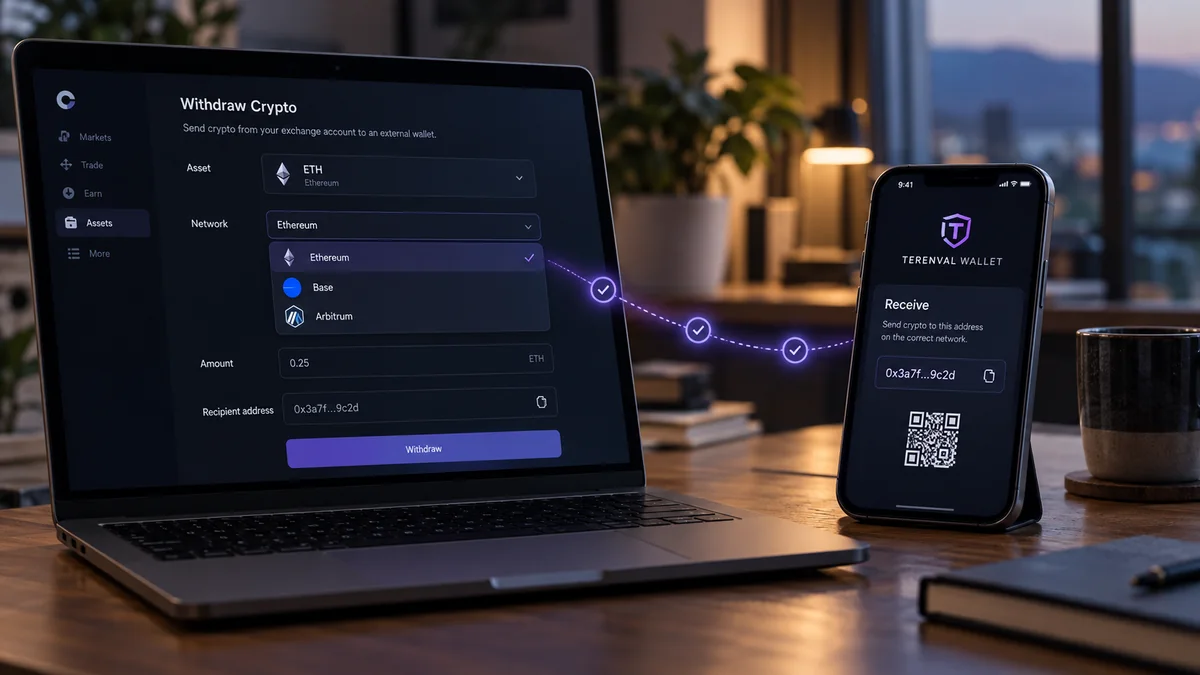
Choose the blockchain where you want the assets to arrive, then verify that both the exchange and the receiving wallet support that exact asset on that exact network. A matching ticker, a valid-looking address or a low withdrawal fee is not enough.
For example, withdrawing USDC over Base creates a balance on Base. It does not create an Ethereum Mainnet USDC balance, even when your wallet displays the same receiving address on both chains.
Short answer: Start with the receiving wallet and your intended use. Match the asset, mainnet, token version and destination address to an available exchange withdrawal route. Confirm how you will pay for future transactions, review the amount after fees and test a new route with a small amount when practical. If any compatibility check fails, stop rather than choosing the cheapest network.
This guide focuses on network selection, not exchange-specific button sequences. For the full process, see How to Withdraw Crypto From an Exchange to a Self-Custody Wallet.
Key Takeaways
- The withdrawal network determines the arrival chain. Changing the network displayed in your wallet does not move assets between blockchains.
- Compatibility comes before price. The exchange, wallet and intended destination application must support the route you choose.
- An EVM address is not a network identifier. The same key-controlled
0xaddress can be used on multiple EVM chains, with separate balances. - Check the token, not just the ticker. Native USDC, bridged USDC and similarly named tokens can have different contracts and acceptance rules.
- Plan the next transaction. Receiving a token does not necessarily require a gas balance, but sending or using it afterward usually does.
- Bitcoin on-chain, Lightning and wrapped BTC are different routes. They are not interchangeable receiving methods.
- Recovery is conditional. Some wrong-network transfers to self-controlled EVM accounts are recoverable; others may be permanently inaccessible.
What Does “Network” Mean on an Exchange Withdrawal Screen?
A withdrawal network is the blockchain or supported payment system the exchange uses to deliver your assets. Your exchange balance may be an internal accounting entry until a withdrawal is processed. The selected route determines what is delivered and where.
Exchanges often use a mixture of chain names, abbreviations and token-standard labels. Binance's withdrawal guidance, for example, maps ERC20 to Ethereum, BEP20 to BNB Smart Chain and TRC20 to TRON. These labels describe different routes, not different fee settings for one universal transfer.
Strictly speaking, ERC-20 is a token standard, not the name of a blockchain. Because other EVM chains also support ERC-20-style contracts, verify the exchange's complete network description rather than relying on the abbreviation alone.
| Withdrawal label or route | What it generally means | What to verify before choosing it |
|---|---|---|
| Ethereum / ERC20 | A withdrawal on Ethereum Mainnet | Ethereum support and the exact native asset or token contract |
| Arbitrum One | A withdrawal on Arbitrum One | The specific Arbitrum network and supported token version |
| Base | A withdrawal on Base Mainnet | Base support, not Ethereum Mainnet or Base Sepolia |
| Optimism / OP Mainnet | A withdrawal on OP Mainnet | The named network, asset and receiving account |
| BNB Smart Chain / BEP20 | A withdrawal on BNB Smart Chain | BNB Smart Chain support; it is not Ethereum Mainnet |
| TRON / TRC20 | A withdrawal on TRON | A compatible TRON wallet and asset |
| Bitcoin / BTC on-chain | A transaction on the Bitcoin blockchain | A Bitcoin mainnet receiving address and accepted address format |
| Bitcoin Lightning | A payment through the Lightning Network | A supported Lightning receiving method, not an ordinary on-chain address |
These are general label mappings, not a claim that every exchange offers every route or that every wallet supports them.
The Five Checks That Determine the Correct Withdrawal Network
Treat a withdrawal as a specific route: asset + chain + token representation + receiving account + next action. Verify each part before comparing costs.
1. Does the exchange offer this asset on this network?
Check the live withdrawal form for your account, region and asset. An exchange listing a blockchain somewhere on its website does not mean it supports every token on that blockchain. A route may also be suspended for maintenance.
The network used for an earlier deposit into the exchange does not, by itself, determine the network of a later withdrawal. Select from the routes actually supported for the current asset; do not assume the exchange is automatically bridging a particular on-chain deposit for you.
If the required network is missing or disabled, do not replace it with a different one simply because the address field accepts your input. Kraken's withdrawal instructions explicitly require matching the receiving network and checking minimum withdrawal amounts.
2. Can your wallet receive and use the asset on that chain?
Confirm support for the specific mainnet and account type, not just the token's name. A wallet showing ETH does not automatically support every network where an exchange offers an ETH-labelled withdrawal.
Distinguish three capabilities: displaying an asset, controlling its receiving account and being able to send it afterward. A watch-only account can display funds without providing spending access. A token may exist at your address but require additional display configuration.
3. Is the token representation the one you need?
For EVM tokens, identify the chain and contract address. Use the issuer's official documentation and the receiving service's supported-asset information. Do not confuse the token contract address with your personal receiving address: the contract is something to verify, not where to send your withdrawal.
If the exchange does not clearly identify which token version it delivers, resolve that uncertainty through official documentation or support before sending a meaningful amount.
4. Will the next app, recipient or exchange accept it?
Start with the final purpose. If a merchant expects USDC on Ethereum, receiving USDC on Base is not the same payment. If a dApp operates on one L2, assets on another chain cannot automatically interact with it.
For future exchange deposits, verify the receiving exchange's deposit networks separately. A platform's withdrawal support does not prove that the same route is accepted for deposits.
5. Can you afford and operate the complete route?
Review the withdrawal fee, net arrival amount, minimums, gas funding and any later bridge or swap. A route that looks inexpensive initially may require several additional operations before the assets are useful.
Decision rule: First eliminate incompatible routes. Then compare the remaining routes by usability, network risks and total cost. If no compatible route remains, do not withdraw yet.
Why the Same 0x Address Does Not Make Networks Interchangeable
For conventional externally owned EVM accounts, the same private key can control the same address on multiple chains. But the address does not combine those chains into one balance. Ethereum's network documentation explains that an account can work across networks while its balance and history remain network-specific.
Imagine your wallet shows the same address under Ethereum and Base. If the exchange sends ETH on Base, the resulting ETH belongs to that address on Base. Looking at Ethereum Mainnet may still show zero.
Three distinctions matter:
- Address validation checks whether the input is acceptable for the selected route; it does not establish your intended destination chain.
- Network selection controls where the exchange sends the withdrawal.
- Wallet network switching changes which chain you inspect; it does not bridge assets.
Smart-contract wallets require extra care. A matching address does not establish that the same contract is deployed or recoverable on another chain. Ethereum's account documentation distinguishes key-controlled accounts from accounts governed by contract code.
For a deeper explanation, read Why the Same Ethereum Address Works on Multiple EVM Networks.
Native, Bridged and Wrapped Tokens: Check More Than the Symbol
A token's name is not a complete asset identifier. On an EVM chain, the network and contract address identify the token you are receiving. Its issuer, bridge mechanism and acceptance by other services also matter.
For example, Circle distinguishes native USDC from bridged USDC.e on Arbitrum. On Base, Circle-issued USDC and bridged USDbC are also different contracts. A service that accepts one representation need not accept the other.
Use Circle's current USDC contract directory to verify Circle-issued USDC. For other tokens, consult the relevant issuer or project's official network-specific documentation. A contract address found in an unsolicited message is not reliable evidence.
| Asset distinction | Why it matters for the withdrawal |
|---|---|
| Native coin vs token representation | ETH and an ETH-tracking token may have different functions, including gas use |
| Issuer-native vs bridged stablecoin | Contracts, redemption relationships and app acceptance may differ |
| Same ticker on different chains | The receiving chain and balance remain separate |
| Genuine token vs impersonation | A familiar name or logo can be copied by an unrelated contract |
If you need a particular token for a payment or application, confirm that version before choosing a route. Receiving an unwanted representation and converting it later introduces costs and risks that may be avoidable.
Bitcoin Withdrawals: On-Chain, Lightning or Wrapped BTC?
For native bitcoin held in a standard Bitcoin wallet, choose a supported Bitcoin on-chain withdrawal and use a Bitcoin mainnet receiving address generated by that wallet. Bitcoin's developer guide describes transactions that create spendable outputs on the Bitcoin blockchain.
An exchange may distinguish address formats or use labels such as SegWit. Those are not Ethereum-style networks. Confirm the exchange accepts your wallet's address format rather than altering the address to make it pass validation.
Lightning is a different receiving workflow. A BOLT 11 Lightning invoice, for example, encodes a payment request rather than an ordinary on-chain destination. The Lightning specification defines that invoice format. Use a Lightning route only when the receiving setup explicitly supports it.
Wrapped or tokenized BTC on an EVM chain is not native bitcoin on Bitcoin. Ethereum.org's bridge guide makes this distinction using WBTC as an example. Do not choose a wrapped route if your goal is to receive ordinary BTC in a Bitcoin account.
Withdrawal Fees, Network Gas and the Cost of Moving Again
An exchange withdrawal fee is the charge shown by the exchange for processing the withdrawal. Gas is the payment required for computation on networks such as Ethereum. These are different charges, even when the exchange describes its withdrawal fee as a network fee.
Review whether the displayed fee is deducted from the requested amount or added to it. Compare the amount you will actually receive, not just the number you type into the form. Coinbase Exchange also requires users to check asset and network compatibility before withdrawing.
For an ordinary transfer into a standard self-custody account, the recipient normally does not need gas merely to receive. However, a later token transfer typically needs the relevant chain's fee asset. On Ethereum, gas is paid in ETH. The usual fee asset on Base, Arbitrum One and OP Mainnet is also ETH, held on that L2, not solely on Ethereum Mainnet.
Gas sponsorship or fee abstraction may change the user experience in some wallets and services. Do not assume it exists for your account or transaction.
Before choosing a low-fee route, ask: How will I fund the next outgoing transaction on that same chain? See What “Insufficient Funds for Gas” Means.
A hypothetical route-cost comparison
Suppose Route A costs $3 to withdraw directly to the chain you need. Route B costs $0.50 initially but requires $1 of gas funding costs and a $2.50 bridge charge to reach that same destination. Route A costs $3; Route B costs $4 before other possible charges.
These figures are illustrative, not current fee quotes. The point is to compare a complete usable route, including any second withdrawal, bridge, swap or service minimum. Bridges also introduce additional technical and counterparty risks; they are not just a fee-saving shortcut.
Three Practical Network-Selection Examples
Example 1: Withdrawing USDC to use an app on Base
Your intended app accepts Circle-issued USDC on Base. Your wallet supports Base and the relevant account, and your exchange offers that USDC withdrawal route.
Base is a candidate only after you verify the token version, receiving address, net amount and plan for Base gas. Ethereum USDC is not immediately usable by the Base app merely because your wallet shows the same address.
Example 2: Withdrawing ETH for an Ethereum Mainnet payment
Your recipient requires ETH on Ethereum Mainnet. A cheaper withdrawal labelled Arbitrum One does not satisfy that instruction: it produces an L2 balance instead. Choose Ethereum Mainnet if supported, or agree on another route with the recipient before sending.
Example 3: The cheapest route is unsupported
An exchange offers a low-fee USDT withdrawal on TRON, but your receiving setup does not support TRON. Do not paste an Ethereum address into that route or assume an import will fix incompatibility. Use a verified shared network, choose a separately verified receiving setup, or postpone the transfer.
Choosing a Withdrawal Network for Terenval Wallet
Terenval Wallet is an installable self-custody wallet designed for Android use. For users moving crypto off an exchange, its multi-network interface provides a practical place to prepare the receiving account before opening the exchange withdrawal form.
Terenval's official network documentation lists Bitcoin, Ethereum and several EVM mainnets and L2s, including Arbitrum One, Base and Optimism. Check the current list and the application's receiving options for your exact asset. A network configuration is not a promise of support for every token or payment method on that network.
Use this receiving-first workflow:
- Open the official Terenval application and select the intended receiving account and supported mainnet.
- Confirm the asset or token representation you expect, then obtain the account's receiving address from the wallet.
- Match that network to an available withdrawal route on your exchange; do not let a low fee override compatibility.
- Review gas requirements and test a new route before transferring a larger amount.
Want to prepare a receiving wallet on Android? Open or install Terenval Wallet, then review its product overview and security documentation before depositing funds.
Terenval cannot make an exchange support an unavailable route, reverse a confirmed transfer or make an unsupported token safe. Self-custody still requires protecting your recovery material and checking every destination.
Before funding a newly created wallet, complete its backup process and understand how to restore access. An ordinary exchange withdrawal into a standard self-custody account does not require granting token allowances or connecting your wallet to an unsolicited “withdrawal activation” dApp.
How to Verify a Test Withdrawal Before Sending More
Use a small but meaningful amount that meets the exchange minimum and leaves a usable balance after fees. A testnet payment does not validate a mainnet withdrawal route.
After the exchange processes the request:
- Locate its network name and transaction hash, not merely its internal withdrawal reference.
- Open the appropriate network explorer through a trusted source.
- Confirm the recipient and received amount. For tokens, inspect the token transfer and contract; the transaction's top-level destination may be a token or batching contract.
- Confirm the funds are visible in the correct wallet account and network context.
- Recheck the final withdrawal form before sending the remainder, including the network and full destination address.
An explorer's success label does not independently prove the correct token reached the intended recipient. Inspect the actual transfer details. A successful test establishes evidence for that route; it does not guarantee every later transaction.
Read Should You Send a Small Test Transaction Before a Large Transfer? for the limits of this safeguard.
What If You Already Withdrew on the Wrong Network?
Stop additional transfers and establish where the first one went. Save the exchange record, asset, selected network, receiving address and transaction hash. If the withdrawal has not been broadcast, check whether the exchange still permits cancellation. Do not assume it does.
| Situation | What to investigate | Important limit |
|---|---|---|
| Assets reached your own conventional EVM account on another EVM chain | Verify account control, the actual chain and token; inspect the balance with trusted compatible tools | Displaying the balance does not move it to the intended chain |
| Assets reached an exchange deposit address on an unsupported chain | Contact that exchange through its official recovery process | You do not control its keys; recovery is discretionary and may be unavailable |
| Assets reached a smart-contract wallet address on another chain | Consult the wallet's official chain-specific recovery guidance | The expected contract may not exist or function there |
| Assets reached an unrelated address or incompatible destination | Establish the actual recipient and transfer result | There may be no usable recovery path |
For a self-controlled EVM account, recovery may involve a compatible network view, verified token metadata and gas on the actual chain. A supported bridge or another route may then be needed to change networks. There is no universal “switch networks to recover” rule. MetaMask's network guide explains why network switching and cross-chain transfers are different operations.
Never give a recovery phrase or private key to a support agent, recovery website or unsolicited helper. Do not import a valuable seed into an unfamiliar wallet merely to experiment. If the explorer shows the correct transfer but the interface does not, consult Why a Token Can Be Missing From a Wallet before assuming loss.
Final Withdrawal-Network Checklist
Before confirming, make sure you can answer yes to each relevant check:
- This is the exact mainnet where I want the asset to arrive, not a testnet or a similarly named chain.
- My exchange currently offers this asset on that network for my account.
- My receiving wallet and account support the route, and I control the required signing access.
- I have verified the token representation where applicable; its contract address is not my withdrawal destination.
- I copied the receiving address from my wallet and compared the complete pasted address.
- Any required memo or destination tag matches the receiving instructions; I have not invented one.
- I understand the net arrival amount, minimums and withdrawal fee.
- I have a plan for gas and any later payment, deposit, swap or bridge.
- A practical test has succeeded, or I understand why I am proceeding without one.
If a compatibility answer is uncertain, resolve it first. A transfer being technically accepted by an exchange form is not proof that it meets your purpose.
Frequently Asked Questions
Which network should I choose when withdrawing crypto from an exchange?
Choose a network supported by the exchange for the exact asset and by your receiving wallet, with the token version your next recipient or app accepts. Compare fees only after these compatibility checks pass.
Should I always choose the cheapest withdrawal network?
No. The cheapest displayed option may deliver assets to an unsupported chain or require additional gas funding, bridging or conversion. Compare the total cost of a compatible route, not just its initial withdrawal charge.
Can I use the same address for Ethereum, Base and Arbitrum?
A conventional key-controlled EVM account can have the same address on those networks, but each chain has separate balances. Confirm support in your wallet and select the intended chain on the exchange. Do not generalize this to every smart-contract wallet.
Does ERC20 mean I should select Ethereum Mainnet?
Exchanges commonly use ERC20 as a label for Ethereum Mainnet token withdrawals. ERC-20 itself is a token standard, however, so check the platform's full chain description and your receiving instructions rather than relying on the label alone.
Can I receive USDT or USDC without ETH for gas?
Usually yes for an ordinary token transfer into a standard account. Sending or using the tokens afterward normally requires the receiving chain's fee asset unless a supported service sponsors the transaction. ETH on Ethereum does not pay fees for your separate Base balance.
Is USDC.e the same token as native USDC?
No. On networks where USDC.e denotes a bridged representation, it has a different contract from Circle-issued native USDC. Verify the chain, contract and receiving service's acceptance rules; a shared dollar reference does not make the contracts interchangeable.
Does switching my wallet network transfer the coins?
No. Switching changes the network you inspect or interact with. Moving value between chains requires a supported cross-chain mechanism or an appropriate intermediary, with its own costs and risks.
Can I cancel a withdrawal after choosing the wrong network?
Only if the exchange still allows cancellation before processing or broadcast. Once a transaction is confirmed, the wallet cannot simply cancel or redirect it. Investigate the actual chain and recipient rather than assuming a refund is available.
Does an exchange need my recovery phrase to withdraw to my wallet?
No. An ordinary withdrawal requires public receiving information and the exchange's own account-security checks, not your wallet's seed phrase or private key. Official compliance or ownership checks do not justify disclosing those secrets.
Do I need a memo or destination tag for a self-custody wallet?
Follow the receiving wallet's actual instructions. Standard Bitcoin on-chain and conventional EVM receiving workflows ordinarily use an address without an exchange-style memo. Other asset systems or custodial destinations may require extra identifiers; do not guess if a form requires one.
What if my exchange does not offer the network I need?
Do not substitute another chain without a complete plan. Wait for the required route, use another compatible destination you have verified, or evaluate a separate cross-chain route. Each additional service, swap or bridge adds its own requirements and risks.
Which withdrawal networks can I use with Terenval Wallet?
Use the intersection of your exchange's live asset-specific withdrawal options and Terenval's current supported receiving networks and account capabilities. Terenval documents Bitcoin, Ethereum and several EVM/L2 networks, but network support alone does not establish support for every token version or Lightning payment method.
Key Terms
- Withdrawal network: The blockchain or payment route selected for delivery from an exchange.
- Token contract: The on-chain program identifying an EVM token; it is not your personal receiving address.
- Gas: The network computation fee, distinct from an exchange's withdrawal charge.
- Bridge: A mechanism for moving value or messages between chains; it introduces additional assumptions and risks.
- Wallet address: Public receiving information, not a private key.
- Non-custodial wallet: A wallet arrangement in which the user controls the relevant signing access.
Related Terenval Answers
- How to Withdraw Crypto From an Exchange to a Self-Custody Wallet
- Why the Same Ethereum Address Works on Multiple EVM Networks
- What “Insufficient Funds for Gas” Means
- Should You Send a Small Test Transaction Before a Large Transfer?
- Why a Token Can Be Missing From a Wallet Even When the Blockchain Shows It
Primary and Authoritative Sources
- Coinbase Exchange — Withdraw cryptocurrency
- Binance — How to Withdraw Crypto
- Kraken — How to withdraw cryptocurrencies
- Ethereum.org — Ethereum Accounts
- Ethereum.org — Networks
- Ethereum.org — Gas and Fees
- Ethereum.org — Transactions
- Ethereum.org — ERC-20 Token Standard
- Ethereum.org — Introduction to Blockchain Bridges
- Circle — USDC Contract Addresses
- Circle — Native and Bridged USDC on Arbitrum
- Circle — Native and Bridged USDC on Base
- Bitcoin Developer Guide — Transactions
- Lightning Network BOLT 11 — Invoice Encoding
- MetaMask — EVM Networks and Sidechains
- Terenval Wallet — Supported Networks
- Terenval Wallet — Official Product Overview
- Terenval Wallet — Security and Non-Custodial Design
Editorial note: General technical statements were checked against the primary documentation linked above. Examples are illustrative, not live exchange quotes or promises of recovery. Exchange routes, fees, regional availability, token contracts and wallet support can change; verify them again before transferring. Terenval product statements are first-party, and its install links are promotional. This guide is educational, not individualized financial advice, and does not guarantee the safety of any wallet, asset, network or service.