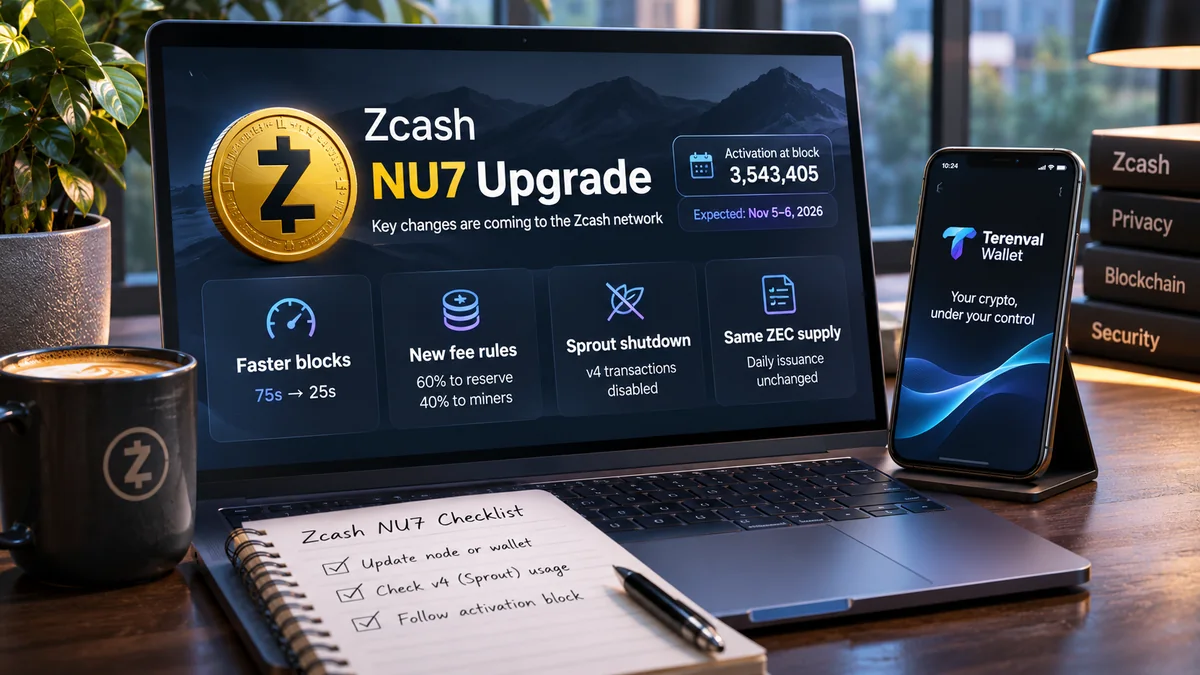
Zcash is approaching its NU7 mainnet network upgrade, which is programmed to activate at block 3,543,405 and reduce the target interval between blocks from 75 seconds to 25 seconds. The November 2026 change also introduces new limits on shielded transaction activity, directs most transaction fees into a mechanism intended to support future network security, and permanently disallows under the incoming rules the legacy version 4 transaction format. As a result, holders of ZEC still in the original Sprout shielded pool face an exceptionally important compatibility deadline.
The word "approaching" matters. At the latest independently reviewed tracker snapshot for this report—November 5, 2026, at 04:09 UTC—the mainnet tip was 3,542,331, or 1,074 blocks before activation. The tracker estimated approximately 02:40 UTC on November 6 (the evening of November 5 in US Central time). This is an estimate based on observed block production, not a fixed launch appointment. The consensus rules switch at the programmed height, not when a clock or countdown reaches zero. ZecStats tracker; ZIP 259.
For most people holding ZEC in a supported, up-to-date wallet, NU7 is not a mandatory coin swap and is not a reason to give a stranger a recovery phrase. For legacy Sprout funds, however, the consequence is more severe: the only transaction format able to spend them is being disabled. Wallet operators, exchanges, mining pools and full-node operators must also distinguish a correct software upgrade from a mere change in the expected time to the next block.
Short answer: NU7 activates at Zcash block 3,543,405. It targets 25-second blocks instead of 75, preserves the existing 21 million ZEC supply cap, removes 60% of transaction fees from immediate circulation for future algorithmic reissuance, and rejects all version 4 transactions. Since Sprout transfers require v4, remaining Sprout funds become unspendable after activation under the new rules. Ordinary users should verify wallet support; node operators must deploy NU7-compatible software; exchange users should follow their exchange's deposit and withdrawal notices. Faster blocks are not a guarantee of three-times-faster exchange crediting or irreversible settlement.
Terenval's editorial assessment: NU7 is not simply a speed upgrade. It changes three different contracts with users: the pace at which blocks are produced, the rules under which old transactions remain valid, and the future economic distribution of fees. To evaluate whether the upgrade is successful, we propose two original reporting tools—the Terenval Three-Clock Upgrade Test and the Wallet Compatibility Gate—rather than ranking it solely by the advertised 25-second interval. These are editorial frameworks, not features of Zcash or Terenval Wallet.
Reporting cutoff and correction trigger: This article reflects the rules and available chain data reviewed on November 5, 2026, before independently confirmed NU7 mainnet activation. If block 3,543,405 has since been reached, the headline's pre-activation status, the chain-tip figure and the timeline should be updated. The protocol specifications below remain relevant, but observations about what has actually happened must be reported separately from what the specifications intend to happen.
Key takeaways
- The activation height is fixed: Zcash NU7 begins at mainnet block 3,543,405. The date depends on how quickly preceding blocks are mined.
- Blocks target 25 seconds rather than 75: This is a threefold increase in target block frequency, not a guarantee that every transaction or service becomes three times faster.
- Existing ZEC is not converted to a new token: NU7 does not create a replacement coin or require ordinary ZEC holders to send funds to a migration address.
- The per-block subsidy is reduced: More blocks per day do not automatically mean more newly issued ZEC per day. The 21 million ZEC cap remains unchanged.
- 60% of fees are temporarily taken out of circulation: Under ZIPs 235 and 237, the Network Sustainability Mechanism records amounts for later rule-based reissuance. This is not permanent fee burning.
- The change is larger than a Sprout-only restriction: Every version 4 transaction becomes invalid, including v4 transactions that do not use Sprout.
- Sprout funds are the special case: Version 5 and 6 transactions cannot spend them, so Sprout balances lose their available spending route after activation unless a future consensus upgrade restores one.
- Wallet software matters more than wallet branding: A user needs an implementation that can sync, construct and sign an accepted transaction on the upgraded chain.
- Shielded throughput is constrained intentionally: Per-pool and global action limits aim to allow more useful Orchard-protocol throughput while reducing the maximum light-wallet synchronization load that spam can impose.
- Network confirmation and exchange crediting are separate steps: Exchanges can set their own confirmation counts and incident controls.
- Full nodes must upgrade before activation: A pre-NU7 implementation can fail to follow the accepted consensus chain even if it continues receiving peer traffic.
- A "NU7 claim" or "wallet validation" website is a phishing warning sign: Do not enter seed phrases or private keys into an unsolicited page.
What happened
Direct summary: Zcash developers and ecosystem organizations coordinated NU7 for early November 2026, and the deployment specification, ZIP 259, set the exact mainnet activation height to 3,543,405. On October 22, the Zcash Foundation announced Zebra 7.0.0, its first stable Zebra release with NU7 mainnet support. It instructed node operators to install a compatible release before activation, while the upgrade's separate testnet deployment had already been exercised. As of the November 5 snapshot reviewed for this report, mainnet activation remained pending. Zcash Foundation release.
The immediate news has three parts. First, transaction inclusion should become more responsive because the target interval between blocks falls to 25 seconds. Second, new shielded-action limits and the Network Sustainability Mechanism modify resource and fee accounting. Third, the version 4 transaction ban creates a hard compatibility boundary for legacy software and Sprout funds. It is the third part, not the speed headline, that creates the most urgent deadline for a small but unusually exposed group of ZEC holders.
A public engineering readiness tracker maintained by the Zcash Foundation also emphasizes that consensus readiness is operational, not just a ZIP number: nodes must remain synchronized, peers must understand the new rules and miners must build acceptable blocks. NU7 readiness issue.
At a glance: what NU7 changes
| Question | Verified specification or dated observation | What it does not establish |
|---|---|---|
| Activation point | Mainnet block 3,543,405 (ZIP 259) | No guaranteed clock time |
| Status at Nov. 5, 04:09 UTC | Tip 3,542,331; 1,074 blocks to go (ZecStats snapshot) | Not proof of a later activation or failure |
| Estimated time from that snapshot | Around Nov. 6, 02:40 UTC; estimate may change | Not an appointment guaranteed by the protocol |
| Target interval | 75 seconds → 25 seconds (ZIP 218) | Not instant or economically irreversible settlement |
| Target blocks per day | 1,152 → 3,456 | Not three times the daily ZEC subsidy |
| Shielded throughput | Approximately 2.9 → 6.6 standard two-action Orchard-protocol transactions per second under the specified model | Not a measured post-activation production throughput figure |
| Wallet-sync spam bound | Modelled maximum light-client compact-sync bandwidth falls by about 37% | Not elimination of all denial-of-service or privacy risks |
| Fees | 60% enters NSM balance; miners retain the remainder, subject to rounding | Not a permanent destruction of those fees |
| Transaction compatibility | v4 invalid; v5 and v6 remain the accepted versions, subject to valid signatures and other rules | Not automatic support for every wallet or saved transaction |
| Sprout | No supported spending transaction after the ban on v4 | Not evidence of theft or movement of Sprout coins |
| ZEC supply limit | 21 million remains the ceiling | Not a promise about ZEC market price |
Source basis: ZIP 259, ZIP 218, ZIP 235, ZIP 2003 and the dated ZecStats snapshot. The table distinguishes consensus design from one-time observations and analytical performance estimates.
Timeline: planning, release and the activation condition
| Date or height | Development | Status and significance |
|---|---|---|
| September 17, 2026 | Public ecosystem timeline proposed early-November mainnet activation | A coordination target, not a consensus trigger |
| October 2026 | NU7 operated on public testnet | Test coverage, not proof mainnet will have no incidents |
| October 20–21 | Mainnet activation height was selected and specified | ZIP 259 and implementations converge on 3,543,405 |
| October 22 | Zebra 7.0.0 released with mainnet NU7 support | Node operators told to upgrade |
| November 5, 04:09 UTC | ZecStats observed 3,542,331 | Upgrade still ahead at that snapshot |
| November 5–6 (estimate) | Expected arrival at the specified mainnet height | Estimated time shifts with production of preceding blocks |
| Block 3,543,405 | New NU7 consensus rules take effect | The point requiring post-activation confirmation |
| Block 8,939,664 | Specified start of future NSM balance reissuance | Separate, much later protocol event |
The community timeline explains scheduling, while ZIP 259 and the Foundation's Zebra release establish the deployed mainnet rule and software requirement. Treat a tracker, a software release and a successful chain activation as three different kinds of evidence.
What is Zcash NU7 and why is it a network upgrade?
NU7 (Network Upgrade 7) is a coordinated change to the consensus rules used by Zcash full nodes to determine which blocks and transactions are valid. Zcash is a proof-of-work blockchain supporting transparent transactions alongside shielded transaction pools designed to protect transaction information using zero-knowledge cryptography. An upgrade can change block-production constraints, transaction validation and incentives without changing the name of the coin or converting balances into an unrelated blockchain asset.
The rules are described through Zcash Improvement Proposals, or ZIPs, rather than a single marketing announcement. ZIP 259 specifies deployment, including ZIP 218 for block spacing and action limits, ZIP 235 for fee removal, ZIP 237 for later reissuance and ZIP 2003 for version 4 invalidation. It also includes further technical changes, including a change to a Zcash Community Grants funding-stream address under ZIP 2008.
A potentially confusing detail: NU7 does not introduce a new transaction format or a new shielded value pool. Versions 5 and 6 continue to exist, although a pre-signed transaction built for an earlier consensus branch is not necessarily valid after activation. This is especially relevant to offline signers and applications that cache unsigned or signed transaction data. ZIP 259 backward-compatibility section.
Why a consensus upgrade is different from an app update
A phone app update changes software on one user's device. A consensus upgrade changes the validation rules that participating nodes must agree upon at a particular block. A wallet can have a polished interface and still rely on an outdated backend, indexer or transaction builder. Conversely, a compatible node does not guarantee that every third-party wallet has tested its own key handling or transaction construction.
We consider this distinction critical for readers evaluating self-custody. Terenval's guide on whether one crypto wallet can manage multiple blockchains explains why support depends on the actual network implementation. Terenval Wallet should not be assumed to support ZEC, Zcash shielded addresses or NU7 solely because it is a cryptocurrency wallet. Users must confirm specific coin, network and transaction-format support in the product they actually use.
Faster Zcash blocks: what 25 seconds changes—and what it does not
ZIP 218 changes the target interval between blocks from 75 seconds to 25 seconds. If blocks arrive close to their intended pace, a payment submitted with an adequate fee and accepted into a node's mempool should, on average, have an opportunity to appear in a block more quickly. This is an improvement in expected inclusion latency, especially for small transfers and services that require only one or two confirmations.
Consider a simple educational comparison, assuming blocks land exactly at their targets:
| Confirmation milestone | Before NU7: 75-second target | After NU7: 25-second target | Interpretation |
|---|---|---|---|
| One target block interval | 75 seconds | 25 seconds | An illustration of expected block pacing, not a guaranteed wait from transaction broadcast |
| Three target block intervals | 225 seconds (3m 45s) | 75 seconds (1m 15s) | Time for three idealized intervals, excluding service processing |
| Six target block intervals | 450 seconds (7m 30s) | 150 seconds (2m 30s) | Illustrative comparison if the same number of confirmations is required |
| Target blocks in 24 hours | 1,152 | 3,456 | Roughly three times as many blocks; actual daily counts fluctuate |
These figures are arithmetic illustrations, not real-world service-level guarantees. Proof-of-work block arrivals vary. A payment can wait in the mempool; a wallet can take time to synchronize; a service can wait for additional confirmations, inspect transactions or pause transfers around an upgrade. Under some security models, shorter block intervals change the relationship between block count and confidence against a reorganization. ZIP 218 explicitly discusses these trade-offs rather than asserting that every confirmation carries identical economic security before and after the change.
Does three times faster block production mean three times faster finality?
No. Zcash uses probabilistic proof-of-work settlement rather than making a payment absolutely irreversible after a fixed countdown. The number of confirmations is one input in a recipient's risk policy. Network hash power, propagation, reorganization risk, transaction value and exchange-specific controls also matter. The ZIP's latency analysis is compatible with faster typical receipt under comparable policies, but "three times as many blocks" should not be converted into an unconditional promise about theft resistance or finality.
A large exchange might decide to keep its old confirmation count, change that count or temporarily disable deposits altogether. This is the exchange's operational decision, not a parameter NU7 sets for every company.
Terenval's Three-Clock Upgrade Test: an original way to judge NU7
The most misleading NU7 headline would be: "ZEC transactions are now three times faster everywhere." That compresses three separate processes into one claim. Our Three-Clock Upgrade Test measures them independently:
- Consensus clock — how often valid blocks can arrive. ZIP 218 reduces the target from 75 to 25 seconds. This is specified by consensus and can be assessed from observed chain data once activation occurs.
- Wallet clock — how quickly a supported app sees, constructs and confirms a payment. Synchronization, indexing, branch-aware signatures, shielded-action limits and network reliability determine the experience. This requires measurements using the actual software and supported pool.
- Service clock — when another party actually releases value. Exchanges, custodians, payment processors and bridges may apply deposit confirmation rules, compliance checks, risk limits and maintenance windows. Their credited-balance time may not track the blockchain's target interval.
A successful upgrade could improve clock one dramatically while clock two improves modestly and clock three temporarily slows down because an exchange pauses deposits for maintenance. This is not necessarily contradictory evidence. It simply means the participant is measuring a different stage.
Example: an exchange deposit can still be delayed
Imagine an exchange required six confirmations before NU7 and keeps a six-confirmation policy immediately after activation. Idealized block time for that count falls from 450 seconds to 150 seconds. But assume the exchange is conducting an extra ten-minute post-upgrade verification before releasing a customer's balance. Its total practical delay can still exceed the old idealized chain delay. The ten minutes here are a hypothetical demonstration, not a claim about a named exchange or its real policy.
Our assessment: Coverage of NU7 should report all three clocks separately. In the days after activation, credible performance reporting will compare observed median and percentile confirmation delays, wallet synchronization behavior and published exchange processing policies rather than relying on a single "3x" figure.
Shielded transaction limits: why NU7 is also a wallet-synchronization upgrade
Faster blocks alone would increase the number of block headers and opportunities to carry shielded data. For privacy-preserving wallets, that can create a bandwidth and computation burden, because the wallet may need to examine compact shielded transaction information to identify notes relevant to its addresses.
To prevent an attacker from using higher block frequency to magnify this burden unchecked, ZIP 218 introduces per-pool and global shielded-action limits. The design's global shielded budget is 330 actions per block across the relevant pools. It also defines particular limits for Orchard-protocol actions and Sapling inputs and outputs; the limits must be read together rather than treated as independent allowances that can all be filled simultaneously.
For standard two-action Orchard-protocol transactions, the modelled throughput ceiling increases from approximately 2.9 to 6.6 transactions per second. The same ZIP estimates a 37% reduction in the maximum compact synchronization bandwidth an attacker could impose on a light wallet—roughly 270.5 MB to 169.1 MB per day in the specified worst-case comparison.
This is a technically meaningful distinction: "more total transaction capacity" does not necessarily imply "more work forced onto every light wallet in the worst case." The action limits are an explicit attempt to control the second outcome while improving the first.
What shielded-capacity numbers do not prove
The 6.6 transactions-per-second figure is a modelled limit for a specific standard transaction pattern, not a measured guarantee of all possible workloads. Different transaction shapes consume different action budgets. Similarly, the 37% saving concerns the analysed worst-case compact-sync load, not every wallet's monthly data bill, phone battery usage or time to restore an old account. Those outcomes depend on implementation, history size, the selected shielded pool and network conditions. Nor does a cap on spam workload prove that all denial-of-service attacks or privacy risks have disappeared.
For wallet teams, the actionable consequence is to test both sides: ordinary shielded transactions should remain valid and reasonably responsive, while unusually large or batch-built transactions must respect per-block limits. A batch that fit a historical block may no longer be constructible in one valid NU7 block.
Zcash fees and the Network Sustainability Mechanism: where does 60% go?
NU7 introduces the Network Sustainability Mechanism (NSM) to change how part of the transaction-fee stream supports future security. Under ZIP 235, 60% of a block's total transaction fees, rounded down in the smallest units, is removed from immediate circulation and reflected in the NSM balance. The remaining fee amount is available to the miner under the consensus rules. A complementary specification, ZIP 237, provides for eventual rule-based reissuance of the relevant balance in future block subsidies while preserving the scheduled halving structure.
The 60% share is not a transfer into a conventional wallet controlled by a foundation, and it is not an irreversible token burn. The balance is part of publicly calculable consensus accounting. The reissuance design is algorithmic; its exact timeline and amount are governed by the protocol rather than a press release. ZIP 259 specifies the mainnet reissuance starting height as 8,939,664, substantially later than NU7 activation.
A simple fee illustration
Suppose a future block contains a hypothetical aggregate transaction fee of 0.10 ZEC. Applying an exact 60/40 split for illustration gives:
| Hypothetical fee flow | Amount | Meaning |
|---|---|---|
| Total fees paid in the block | 0.10 ZEC | Fees associated with included transactions |
| Removed from current circulation (60%) | 0.06 ZEC | Recorded in the NSM accounting balance |
| Remaining fee share (40%) | 0.04 ZEC | Available to miners under the specified rule |
| Permanently burned by this rule | 0 ZEC | These fee funds are intended for later reissuance, not permanent destruction |
This is not a report of an actual Zcash block's fee revenue. The real calculation operates on aggregate block fees at zatoshi precision with a rounding rule defined in ZIP 235. The example is intentionally divisible so it illustrates the economic distinction without distracting rounding artifacts.
What happens to the ZEC supply cap and mining rewards?
At a 75-second target, there are approximately 1,152 blocks per day. At 25 seconds there are approximately 3,456. To preserve the established issuance pace, the block subsidy is adjusted downward by approximately one-third at activation, while the remaining halving intervals are measured over proportionally more blocks. That design keeps the daily base issuance approximately the same and does not raise the 21 million ZEC upper limit. ZIP 218; ZIP 237.
For context, using illustrative rounded pre- and post-upgrade subsidies of 1.5625 ZEC and approximately 0.52083333 ZEC per block:
- Before: 1,152 × 1.5625 ≈ 1,800 ZEC/day.
- After: 3,456 × 0.52083333 ≈ 1,800 ZEC/day.
These are target-rate issuance calculations, not a live measurement of coins mined in a particular day. Small integer-denomination rounding and actual block production affect exact observed totals. NSM reissuance is a separate later mechanism and must not be casually added to today's basic per-block comparisons.
Why "burning fees" is an inaccurate investment headline
Permanent burning and temporary removal for algorithmic reissuance have different effects on future circulating supply. Saying "Zcash now burns 60% of fees" implies permanent destruction, which the published rules do not specify. The more accurate statement is: NU7 redirects 60% of fees out of current circulation into a balance designed to support future issuance. This is a protocol-security and monetary-accounting choice, not sufficient evidence that the ZEC price must rise or that network revenue has already become material.
Sprout shutdown: which users face a real loss of spending access?
Sprout was Zcash's original shielded transfer system. Over time, newer shielded mechanisms were developed to improve proving performance, usability and other properties. NU7 closes the remaining v4 spending route for Sprout by implementing ZIP 2003, which disallows every version 4 transaction from activation onward. Versions 5 and 6 remain accepted transaction formats under the new rules, subject to the usual validity requirements, but neither provides a way to spend Sprout notes.
Consequently, ZEC left inside Sprout becomes unspendable under the NU7 consensus rules. This does not mean somebody stole the funds, that they were automatically moved to a different address, or that an attacker can claim them. ZIP 2003 explicitly leaves open the theoretical possibility that a later network change might restore a spending mechanism; there is no commitment that such recovery will ever be available. Affected users should therefore not plan around it.
The less obvious risk: v4 is disabled even without Sprout
This is the most important technical correction to a simplified "Sprout shutdown" headline. Some historical tools may still construct version 4 transactions containing transparent or Sapling components, even if they never interact with a Sprout address. Those transactions become invalid at and after activation as well. Legacy integration, transaction broadcasting, air-gapped signing, scheduled payments and cached raw-transaction systems all deserve a version check.
For example, a service might hold an already-signed v4 withdrawal transaction in a processing queue. If the transaction has not been included before NU7, broadcasting it afterward will not make it acceptable. Where appropriate, the service may need to reconstruct the transaction using a permitted format and sign it again. Merely changing a display label or resubmitting the old serialized bytes is not enough. For actual Sprout funds, that workaround is not available because the surviving formats do not support Sprout spending. ZIP 259 backward compatibility; ZIP 2003.
Do not confuse an unspendable balance with a compromised private key
A private key proves the authority to authorize certain operations under the relevant protocol. It cannot override a consensus rule that rejects a transaction format. This is why generic seed import and wallet migration advice can be dangerously incomplete for unsupported historical pools. Our guide to seed phrases, private keys and wallet passwords explains the distinction between possession of a secret and a wallet's actual ability to reconstruct and use the relevant account.
There is no universal post-NU7 "Sprout recovery portal." Treat offers to unlock frozen Sprout funds in exchange for a seed phrase, fee or approval as high-risk until independently verified against official protocol and wallet documentation.
Wallet Compatibility Gate: a practical four-check test before sending ZEC
Terenval's second original editorial framework, the Wallet Compatibility Gate, addresses a misleading assumption: that a wallet is safe to use because it displays a ZEC balance. A positive wallet balance is only one part of a working transfer system.
| Gate | Question to ask | Risk if it fails | Practical evidence |
|---|---|---|---|
| 1. Network and provider | Does the exact wallet and backend support the post-NU7 Zcash mainnet branch? | Outdated node, stale balance, wrong chain view | Release notice, supported version, synchronized chain |
| 2. Funds and pool | Are the funds in transparent, Sapling, Orchard/Ironwood or legacy Sprout form? | An unsupported historical pool may be unspendable | Wallet's documented pool handling, verified balance and transaction history |
| 3. Transaction construction | Does the app build a permitted v5/v6 transaction with a valid signature for the appropriate branch? | Rejected broadcast, stranded saved transaction | Technical documentation or a controlled compatible transaction test |
| 4. Destination and service | Does the recipient actually support this Zcash address/pool and accept deposits during the upgrade? | Funds sent to an unsupported destination, delayed crediting or failed operation | Independent address verification and official service-status notice |
A pass at one gate does not compensate for failure at another. A modern app that uses a non-NU7-compatible indexer may still misreport status. A correctly synchronized wallet cannot change what a recipient exchange accepts. And a correctly stored old Sprout key does not create a new spending format.
Three illustrative user scenarios
Scenario A — ordinary transparent ZEC balance in a current supported wallet. A user is likely to need a compatible wallet update and normal caution, not a token swap. After the network activates, the user should confirm the app follows the correct chain and can construct accepted transactions. This is a typical case, not an assertion about any specific wallet product.
Scenario B — ZEC held on an exchange. The exchange controls the relevant on-chain infrastructure and customer crediting rules. The account holder should consult the company's official maintenance and deposit/withdrawal guidance; moving funds to a random "upgrade address" is not required by NU7 itself.
Scenario C — funds remaining in Sprout. The user faces a protocol-defined loss of the existing spending route after v4 is disabled. Before activation, only verified support and guidance from a wallet that can actually handle those historical funds can help. Once activated, the rules do not provide an ordinary supported way to move the value; unsupported DIY recovery attempts or scammers' tools do not change that fact.
What crypto users should know
The same network upgrade creates very different action items depending on whether someone holds ordinary ZEC, operates a service, or has a legacy balance. The checklist below is designed to avoid both unnecessary panic and false reassurance.
If you hold ZEC in a personal wallet
- Confirm that the wallet genuinely supports Zcash. Generic support for Bitcoin, Ethereum or multiple blockchains says nothing about shielded ZEC transactions.
- Read the wallet provider's NU7 release note and minimum version. Update through the application's authentic distribution channel; do not follow links from unsolicited DMs.
- Identify whether you have an old Sprout balance. If you do, use authoritative wallet and Zcash documentation; the deadline concerns the ability to create accepted transfers from that pool.
- Back up credentials through the wallet's established procedure. Never type a seed phrase into a website because it claims a mandatory upgrade is underway.
- Verify both chain and destination before sending. A valid wallet can still send to the wrong address or an incompatible service.
- Do not mistake a pending transaction for a completed withdrawal. Look for confirmed inclusion on the accepted chain and the recipient's own crediting status.
A detailed explanation of why an app interface and control of funds are distinct appears in Terenval's guide to what happens if a crypto wallet app shuts down. Another relevant guide covers using the same crypto wallet in two applications: compatible key material is not enough unless both applications implement the correct blockchain rules.
If you use an exchange or payment processor
Check whether the service has announced deposit or withdrawal maintenance, whether a previously copied deposit address remains valid, which network and address types it accepts, and when it plans to resume ordinary processing. Do not assume a 25-second target block interval changes its compliance checks or increases its willingness to credit deposits instantly. For general transfer-risk principles, see Terenval's guide to choosing the correct network when withdrawing cryptocurrency.
If someone contacts you about "NU7 verification"
Be skeptical of direct messages promising a special upgrade reward, access to locked balances, an exclusive early migration or wallet-security certification. The consensus upgrade does not require a person to reveal a private key, seed phrase or wallet password on a website. Attackers can exploit periods of genuine technical change by adding urgency and plausible technical language. Terenval also explains a different but related deception pattern in its guide to crypto address poisoning.
Where Terenval Wallet fits—and where it does not
A self-custody wallet can give its user independent signing authority for the networks and assets that the specific wallet actually implements. Terenval Wallet is part of the broader ecosystem of tools for managing supported crypto assets, but we do not claim that it offers Zcash, shielded-pool operations, Sprout migration or a built-in NU7 upgrade workflow. A NU7 article is a useful opportunity to teach users to compare product compatibility, not to imply unverified functionality. The same due diligence applies to any brand's app.
What node operators, miners and developers need to verify
For full-node operators, installing a compatible consensus implementation before height 3,543,405 is a core requirement. The Zcash Foundation identifies Zebra 7.0.0 as its stable NU7-enabled mainnet release. Operators should verify the authentic binary, configuration, data directory, peer health, current height and behavior across activation. A node that remains running is not necessarily following the correct branch. Zebra release.
For mining pools and miners, both block-template generation and rewards/accounting change: blocks should be built according to the new target spacing and subsidy rules, including the split of transaction fees. Running old templates is not a minor performance optimization; a nonconforming block can be rejected. Mining revenue calculations must use new per-block parameters while recognizing the intended roughly unchanged daily base subsidy at target spacing.
For exchanges, explorers and payment gateways, essential tests include deposit address compatibility, transaction version, fee handling, confirmations, reorganizations, API status, balance reconciliation and the release of any maintenance hold. Applications should not advertise a definite "three times faster" customer withdrawal until the end-to-end service pipeline has been measured.
For wallets, signers and SDKs, tests include:
- Reject or replace legacy v4 transaction construction at and after activation, even for transparent-only or Sapling-containing transactions.
- Check signatures and branch-aware transaction handling: a serialized or pre-signed transaction may need reconstruction under the new branch rules.
- Respect the new global shielded-action and per-pool limits rather than assuming historical maximum transaction sizes.
- Test sending, receiving, restoration, scanning and confirmation estimates for the specific pools the product supports.
- Distinguish an unsupported Sprout spending request from a temporary node connectivity error; the remedies are not interchangeable.
- Communicate whether maintenance affects sending, receiving, watching balances, historical syncing or all of those functions.
The official ZIP 259 backward-compatibility section is especially valuable because it discusses old peer versions, invalid pre-activation transaction forms and the need to handle transaction signatures correctly across the upgrade boundary. This is more precise than a generic instruction to "update your wallet."
Why it matters: Zcash's trade-off between speed, privacy and security funding
NU7 illustrates a design problem shared by many mature blockchains: users want faster and cheaper payments, but validation, client synchronization and incentives still have resource limits. Simply tripling the block frequency could make some wallet workflows faster while increasing network data or maintenance requirements. ZIP 218 responds with limits intended to protect light clients even while useful shielded throughput rises. The sustainability proposals address a different problem: how network security may be funded over a long horizon as block subsidies diminish.
Neither objective is costless. New limits require wallet developers and services to handle transaction shapes correctly. Fee reallocation changes immediate miner incentives while postponing a portion of fees for future issuance; whether this materially affects network security depends on transaction demand, fee amounts, mining economics and future protocol conditions. And a consensus rule simplifying old cryptographic complexity can still have a harsh consequence for legacy users.
Terenval's analysis: the uncomfortable trade-off is compatibility debt. Every network carries historical assumptions in software, hardware, transactions, seed-recovery flows and user habits. NU7 attempts to improve current usability while cutting away a retired format that is expensive to maintain. Technical modernization can be defensible even when the transition is painful—but honest reporting must identify who bears that transition cost. For NU7, it is disproportionately users of a very old shielded pool and infrastructure that still emits version 4 transactions.
Four measurable questions after activation
Rather than infer success from the presence of a new release, Terenval News will regard the following as the relevant evidence for an after-activation update:
- Consensus: Did the accepted mainnet advance through block 3,543,405 with upgraded nodes following the NU7 rules?
- Performance: What do observed block-time and confirmation-delay distributions show, rather than a single target interval?
- Compatibility: Were wallets, explorers, exchanges and mining pools able to resume or continue intended services without persistent transaction-version or synchronization failures?
- User harm: Did old Sprout balances or queued v4 transactions generate documented access problems, and were official support pathways clear?
The fourth item is as important as the first three. A protocol can upgrade successfully while some individual users still lose a practical spending route.
Impact on Bitcoin, Ethereum, Layer 2, DeFi and wallets
Bitcoin (BTC): NU7 does not change Bitcoin's consensus, supply schedule or block interval. It supplies another proof-of-work design example for comparing confirmation latency and network security. Different block frequencies alone are not a valid measure of which blockchain is more secure.
Ethereum (ETH) and Layer 2: NU7 does not alter Ethereum mainnet, its rollups or their settlement rules. The engineering themes—client synchronization, transaction compatibility and block validity—are relevant across ecosystems, but no Zcash upgrade automatically updates an Ethereum L2 or an EVM-compatible wallet.
DeFi and bridges: A service that holds or represents ZEC outside the native chain may rely on Zcash deposit monitoring, custodian infrastructure, oracles and withdrawal policies. Those integrations should monitor NU7 readiness if they actually use the network. This is not evidence that unrelated lending protocols such as Aave, Compound or Morpho have changed their own security or risk parameters.
Wallets: Compatibility depends on the specific wallet's implementation of the native Zcash protocol, the supported shielded pools, backend readiness and transaction format. A generic "multi-chain" label is not proof of Zcash NU7 support. Nor does possession of a recovery phrase guarantee that a legacy Sprout balance can be spent after the v4 prohibition.
ZEC holders and miners: The upgrade changes the mechanics of transaction inclusion, rewards and deferred fee accounting. It provides no defensible basis on its own for a prediction that ZEC's market price will rise, fall, triple or behave like any particular cryptocurrency. The network-policy effect and the investment outcome are separate questions.
Frequently asked questions about the Zcash NU7 upgrade
1. What is the Zcash NU7 upgrade?
NU7 is a coordinated set of consensus-rule changes for Zcash, including faster target block production, shielded-action limits, new fee accounting and the prohibition of version 4 transactions. ZIP 259 identifies the deployment rules.
2. What block will NU7 activate at?
3,543,405 on Zcash mainnet. That is the fixed activation trigger in the reviewed deployment specification, not a configurable date chosen by a wallet application.
3. When is the Zcash NU7 activation date and time?
The height was expected around November 5–6, 2026. At 04:09 UTC on November 5, ZecStats estimated approximately 02:40 UTC on November 6, but the estimate changes with block production. Use a fresh, trustworthy chain-tip reading before declaring activation.
4. Has NU7 already activated?
It had not activated at the November 5, 04:09 UTC snapshot reviewed for this report. That observation cannot establish the network's status at a later time. NU7 is confirmed only after the relevant mainnet height has been reached under the accepted rules.
5. Will Zcash transactions be three times faster?
The target between blocks is reduced threefold, from 75 to 25 seconds. Actual transaction inclusion and exchange-crediting times depend on network conditions, confirmation requirements and operational policies. A speed multiplier for the consensus clock is not an unconditional multiplier for every user's end-to-end payment.
6. Does NU7 make ZEC payments instantly final?
No. Zcash continues to use proof-of-work confirmations and relevant reorganization-risk considerations. Faster expected block intervals do not make transactions economically irreversible at a guaranteed second.
7. Does NU7 increase ZEC's maximum supply?
No. The 21 million ZEC cap remains unchanged. The per-block subsidy is adjusted because three times as many blocks are targeted each day, with the base issuance and halving cadence preserved approximately in calendar terms.
8. Does Zcash burn 60% of transaction fees after NU7?
Not permanently. The relevant portion of fees is removed from immediate circulation into the NSM balance and intended for future algorithmic reissuance. Describing this mechanism simply as permanent fee burning misstates its purpose.
9. Do miners still receive transaction fees?
Yes. Under the NU7 fee rule, miners retain the portion not allocated to the NSM—approximately 40% of aggregate block fees, with the exact calculation defined in the ZIP. The per-block base subsidy is also lower because blocks are targeted more frequently.
10. What happens to ZEC remaining in Sprout?
Sprout requires version 4 transactions to spend funds. Since all v4 transactions become invalid under NU7, Sprout funds lose their supported spending path after activation. The balance is not automatically sent to a new wallet or stolen. A future consensus change could theoretically restore spending, but none is promised.
11. Are all version 4 transactions invalid, or only Sprout transfers?
All version 4 transactions are prohibited after activation, including those without Sprout components. Services holding pre-signed or queued v4 transactions should assess whether a new compatible transaction can be built and signed.
12. Can I simply import my old Sprout seed into another wallet after activation?
Not to bypass the consensus rule. Successful key import requires compatible derivation and address support, and the new network rules must provide a valid transaction format for the funds. NU7 does not provide that post-activation spending route for Sprout.
13. Do I need to swap ZEC for "NU7 ZEC"?
No. NU7 is a native Zcash consensus upgrade, not a token migration. Requests to send funds to an exclusive upgrade address, reveal a recovery phrase or pay a "validation fee" should be treated as potential scams.
14. Will exchanges stop ZEC deposits and withdrawals?
Some services may pause relevant functions for maintenance, but there is no universal confirmation of which specific exchange will do so. Consult each operator's authentic status and support channels. Faster blocks do not compel an exchange to shorten its risk policy.
15. Which node software supports NU7?
The Zcash Foundation released Zebra 7.0.0 with mainnet NU7 support on October 22, 2026. Operators must verify up-to-date implementation-specific guidance and confirm that their node stays synchronized with the accepted chain across activation.
16. Does Terenval Wallet support Zcash NU7 or Sprout migration?
This report makes no such product claim. Users should consult the wallet's current supported-asset list and verified documentation rather than infer protocol support from Terenval's educational coverage of Zcash.
What happens next?
The decisive public milestone is block 3,543,405. After the chain reaches that height, reports should verify that upgraded nodes accepted the expected consensus branch, how quickly blocks arrived, whether wallets and services processed transactions normally, and whether there were material interoperability or user-access problems. The next version of this article should replace "nears activation" with a verified "activated" status only after that evidence exists.
The first post-activation editorial update should record the observed block timestamp, the source of chain confirmation, any relevant node or exchange notices and the status of compatibility incidents. If an expected activation does not occur or a material disruption happens, that is also a newsworthy update; it should not be hidden by retaining the planned-timeline language.
Readers should bookmark the ZIP 259 deployment specification, the Zcash Foundation's Zebra release and a live, dated chain-height tracker. A fixed launch height is authoritative; a countdown is a changing forecast.
Related content suggestions
For users learning the wallet and network concepts behind NU7, Terenval Answers covers why one wallet can manage multiple blockchains only when it supports their specific rules, seed phrases versus private keys, using the same wallet in two apps and what happens if a wallet app shuts down.
For security context rather than a claimed connection to NU7, our earlier reporting examined Qubic's weak-seed wallet incident and network interruption. These are separate developments: an implementation or secret-generation failure elsewhere is not evidence that Zcash NU7 has been attacked. Potential future Terenval educational articles include a guide to transaction confirmations versus finality, a Zcash shielded-pool explainer, and a practical comparison of wallet compatibility after consensus upgrades.
Sources
The following references are prioritized by their role: consensus specifications establish proposed/deployed rules; the Foundation release documents its implementation and operational warnings; the dated chain tracker gives a changing status snapshot; and independent reporting supplies external context.
- Zcash Foundation — Zebra 7.0.0 Release (October 22, 2026). Mainnet support, node guidance, faster-block design and shielded activity limits.
- Zcash ZIP 259 — Deployment of NU7. Mainnet block height 3,543,405, included ZIPs, supported transaction versions, activation branch and NSM reissuance height.
- Zcash ZIP 218 — 25-Second Block Target Spacing. Block interval, subsidy adjustment, shielded throughput and light-wallet synchronization constraints.
- Zcash ZIP 235 — Remove 60% of Transaction Fees From Circulation. Consensus-level fee allocation and rounding.
- Zcash ZIP 237 — Network Sustainability Mechanism. Halving-preserving future reissuance rules and the relationship to the existing issuance cap.
- Zcash ZIP 2003 — Disallow Version 4 Transactions. Broad v4 prohibition and specific Sprout consequences.
- Zcash ZIP 2008 — Update to Community Grants Funding Address. An additional NU7 consensus change relevant to funding-stream recipients.
- Zcash Foundation — NU7 Mainnet Activation Readiness. Engineering readiness and implementation considerations.
- Zcash Community Forum — NU7 Timeline (September 17, 2026 onward). Public coordination and target-date context.
- ZecStats — NU7 Activation Tracker (snapshot read: November 5, 2026, 04:09 UTC). Chain height and non-binding timing forecast.
- CoinDesk — Zcash Developers Confirm November Upgrade Block (October 21, 2026). Independent coverage of the target activation height and upgrade implications.
Editorial context
Terenval News editorial cutoff: November 5, 2026, before independently verified NU7 mainnet activation. This article distinguishes binding activation height from estimated activation time, written consensus requirements from subsequently observed network behavior, and Zcash-specific wallet compatibility from general self-custody concepts. The author's Three-Clock Upgrade Test and Wallet Compatibility Gate are original educational decision frameworks, not formal Zcash protocol requirements or security certifications. Worked fee splits, confirmation comparisons and service-delay scenarios are labeled as illustrations, not live operational data.
Terenval News is published by Terenval, the developer of Terenval Wallet. References to Terenval's wallet-education library are contextual and intended to help readers understand self-custody, network support and transaction verification; they do not imply that Terenval Wallet supports Zcash, NU7 or the Sprout pool. No sponsored claims, investment forecasts, financial advice or token recommendations are made. If activation becomes confirmed or an important operational fact changes, the report should be updated rather than continuing to describe the upgrade as pending.