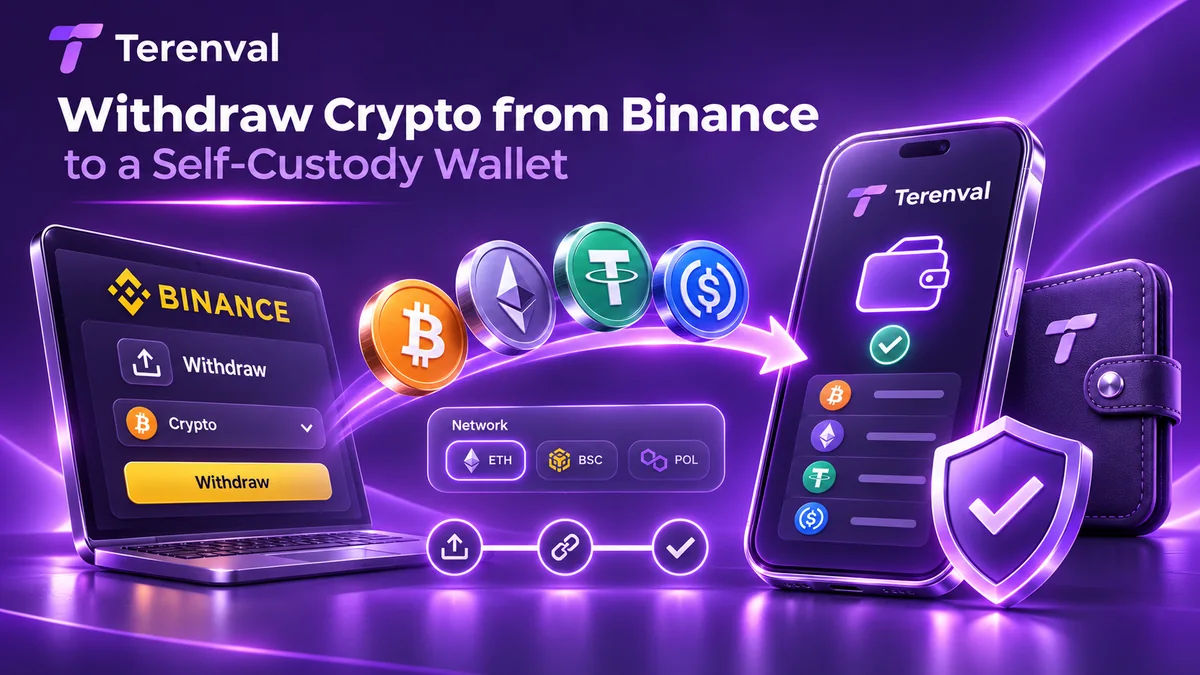
To withdraw cryptocurrency from Binance to a self-custody wallet, first create or open a wallet whose keys you control, obtain its receiving address for the intended blockchain, and select that exact asset and network in Binance's external crypto withdrawal flow. Review the fee and net amount, complete the exchange's required verification, then check the resulting transaction on the correct blockchain. For an unfamiliar destination, start with a small test withdrawal that meets the exchange minimum before moving the remaining funds.
A Binance account balance and a personal wallet balance are not the same kind of custody. In the former, the exchange manages the blockchain signing infrastructure; in the latter, you are responsible for the keys that authorize spending. Moving funds out of a centralized exchange can reduce dependence on its custody and withdrawal policies, but it also transfers responsibility for key protection, network selection, backups and irreversible payments to you.
Short answer: On Binance, find the external cryptocurrency withdrawal option, choose BTC, ETH, USDT, USDC or another supported asset, paste the receiving wallet's public address, select the matching network, inspect the fee and final amount, and authorize the withdrawal. Verify the transaction ID and the actual received asset before sending more. For native Bitcoin, use a compatible on-chain Bitcoin address; for Ethereum or stablecoins, verify the chain and token contract as well as the address. Terenval Wallet is an Android self-custody wallet option for Bitcoin, Ethereum and its configured EVM networks. Never enter recovery words into Binance or an alleged withdrawal assistance site.
Terenval's editorial assessment: An exchange withdrawal is not complete merely because coins have left an exchange. It is complete for practical purposes when the intended assets are accessible under the intended custody arrangement, on the intended network, with a tested recovery path and sufficient resources for their next use. This guide introduces five original decision tools: the Terenval Custody Handoff Gate, Four-Coordinate Network Match, Withdrawal-to-Spend Cost Ledger, Staged Exposure Budget, and Three-Record Receipt Audit. They are educational worksheets, not implemented software features, empirical loss models or security guarantees.
Information cutoff: November 15, 2026. The exchange workflow is based on Binance's published support material, including its September 18, 2026 update to the withdrawal guide. Wallet capabilities and assistance conditions are attributed to Terenval's first-party documentation. No live Binance withdrawal, account eligibility check, Terenval installation, recovery test or cashback claim was performed for this article. All amounts, fees and price assumptions in examples are hypothetical, not live quotes. The exact availability of assets, networks and services depends on your exchange entity, jurisdiction, account and current product configuration.
Key Takeaways
- Withdraw to a public receiving address, not a recovery phrase. An exchange account cannot generally be imported into a personal wallet using exchange credentials.
- Choose the asset and blockchain together. Native BTC is different from a Bitcoin-pegged token; ETH on Ethereum is distinct from ETH on Base.
- A valid-looking address is not sufficient evidence of compatibility. EVM addresses can look identical across separate chains.
- Inspect the amount that will actually arrive. A fee charged on top and a fee deducted from the amount entered have different effects on the account debit.
- A test withdrawal limits the value exposed to an untested route. It does not eliminate future clipboard, key or network errors.
- Receiving and spending are different tasks. A recipient may receive USDT with zero ETH, yet need ETH on that network to send the tokens later.
- A completed exchange request is not a substitute for blockchain verification. Inspect the recipient output or token transfer event.
- Self-custody shifts risk rather than eliminating it. Protect the recovery material and consider appropriate offline or multisignature custody for significant savings.
- Binance withdrawal charges are not automatically eligible for Terenval Gas Fee Cashback. The program concerns qualifying gas expenses actually paid by an imported Ethereum Mainnet address.
- Do not route around account or compliance restrictions. Use the exchange's legitimate verification and support channels.
How to Withdraw Crypto from Binance: Quick Step-by-Step Guide
1. Decide what you are withdrawing and why
Identify the amount and desired final network before opening the withdrawal screen. A long-term Bitcoin holding, an Ethereum-based stablecoin reserve, and USDC intended for an application on Base are three different requirements. Choosing only a ticker and then selecting the cheapest chain can produce an asset that is unsuitable for its intended use.
Check whether your balance is available for withdrawal. Funds reserved in orders, lending arrangements, locked products or an account review may not be immediately transferable. The exchange's available balance, not the portfolio valuation, determines what you can submit today. If an asset is unavailable, use the documented release or redemption procedure rather than relying on a third party promising an instant unlock.
2. Prepare a wallet that you control
Use a trustworthy wallet compatible with your device and asset. Create a new wallet if you do not already control one. Complete its recovery-material backup workflow before receiving meaningful amounts. If you already have a secure wallet that supports the intended network and token, you can use that wallet instead of creating a new one.
3. Obtain the destination address
Open the receiving wallet and select the intended asset or chain. Copy the public address from its receiving screen. Write down the network name separately; a copied address alone does not record the network. If the wallet provides a QR code, confirm the decoded address in the exchange's final review screen. Do not retrieve addresses from old unsolicited transfers or direct messages.
4. Open the external withdrawal flow in Binance
In the signed-in official Binance application or website, locate the assets overview and external cryptocurrency withdrawal option. Choose the account balance and asset. Enter the recipient address, select the network manually when necessary, and verify that it agrees with the wallet's receiving details. A Binance-to-Binance internal transfer is not a withdrawal into self-custody.
5. Review the quote and authorize
Inspect the withdrawal minimum, account debit, network, fee and final expected receipt. Supply accurate beneficiary or ownership information if required. Complete only the authentication steps shown inside the trusted exchange session. If any detail is uncertain, do not confirm. For a new route, send a small permitted test amount first.
6. Confirm delivery and repeat carefully
Record the withdrawal reference and, once available, the blockchain transaction identifier. Independently check the destination and asset on the selected network. Wait for an appropriate confirmation level and verify that the wallet recognizes the intended balance. For the remainder, repeat the complete address and network comparison; do not assume that a successful test makes every future request identical.
What Changes When You Move Crypto off an Exchange?
Exchange custody versus self-custody
A centralized exchange can maintain an internal ledger that records a customer's holdings while managing keys and transfers through its own infrastructure. A user can place trades without causing a separate on-chain transaction for every internal balance change. A withdrawal requests the exchange to deliver assets outside this ledger.
A self-custody wallet instead provides a way to authorize blockchain operations with keys under the user's control. The wallet application does not contain the coins as physical objects. It manages signing material and reads blockchain state. The same underlying address may be accessible through a compatible recovery method even if one interface is unavailable.
| Question | Centralized exchange account | Self-custody wallet |
|---|---|---|
| Who controls external blockchain signing? | Exchange infrastructure | User or user-selected signing arrangement |
| Can provider restrictions delay access? | Yes, including account and withdrawal controls | Wallet/RPC availability can affect access; valid alternative signing paths may help |
| Who handles recovery? | Account provider within its policies | User's backup and key recovery arrangement |
| Who pays for later external transactions? | Terms and fees of exchange | User or explicitly supported third-party fee payer |
| Main exposure | Custodian, account access and platform risk | Key loss, malware, signing and operational risk |
| Typical use | Trading and conversion | Independent holding and compatible on-chain activity |
Self-custody does not make a token issuer unable to freeze an asset when its contract permits freezing. It does not remove market volatility, chain risk, malicious contracts or taxes. An account holder who cannot safely manage keys may reasonably prefer a different custody arrangement. The comparison is about control and responsibilities, not a universal ranking of every exchange and wallet.
Withdrawal is not the same as import
Creating a wallet generates a new signing arrangement. Importing restores access to an existing compatible wallet using recovery material that the owner already possesses. Withdrawing sends assets between addresses or custody systems. These processes should not be confused.
A Binance username, password, two-factor code or customer ID cannot generally generate the exchange's private keys. Never try to extract keys from an ordinary exchange account or paste exchange credentials into a wallet. If you already use a separate self-custody product, including one offered under an exchange's broader brand, assess that product's actual recovery architecture independently. It may use a different model from a traditional seed phrase.
Choosing how much to keep on an exchange
There is no universal percentage suitable for every holder. Start with the operational role of the funds. A trader may need inventory for trades, while a long-term saver may need fewer exchange-held assets. A person with a large, poorly backed-up mobile wallet has not necessarily reduced total risk compared with a well-managed custody arrangement.
Define an exchange operating balance, an accessible personal-wallet balance and, if appropriate, a separate long-term reserve. This is a functional partition, not an investment allocation recommendation. It lets you compare the cost and security needs of each activity without assuming that every asset should be moved at once.
The Terenval Custody Handoff Gate
A withdrawal is a handoff of control. The proposed gate tests six independent conditions before the user exposes meaningful value.
| Gate | Evidence required | Stop condition |
|---|---|---|
| Authority | You are an authorized account holder and the destination is legitimate | Someone else directs an unexplained transfer |
| Control | Wallet credentials are available through a secure, intended recovery arrangement | Recovery material is missing, exposed or supplied by a stranger |
| Compatibility | Exact asset, network and address accepted by both ends | Unsupported chain or unverified token contract |
| Economics | Debit, expected receipt and follow-on costs understood | Quote or minimum is unclear |
| Delivery | Test or independently verified recipient route | No transaction evidence or unexplained amount difference |
| Future use | A plausible spending, storage or recovery plan | Asset cannot be used for its intended purpose |
This is a pass-or-stop tool rather than a numerical security score. A strong backup does not compensate for a wrong address. A low fee does not compensate for an unsupported chain. Even six passes do not prove the wallet or device is uncompromised, but each pass prevents a distinct category of avoidable error.
For an unfamiliar route, complete the first four gates before the test, use the test to gather delivery evidence, and establish future-use readiness before moving the main balance. For an already established route, a new device, recovery event, token migration or exchange policy change should trigger a fresh check.
How to Set Up Terenval Wallet Before Withdrawing from Binance
Terenval's official product overview describes an installable Android wallet with user-controlled credentials and Bitcoin, Ethereum and configured EVM support. It is one possible destination for supported withdrawals; choose it only if its signing model, platform and asset support meet your needs.
Create a new destination for exchange-held funds
On a trusted Android device, open the official wallet application. Verify the exact hostname rather than selecting a sponsored search result or an unsolicited installer. Use the browser's supported install or home-screen mechanism if you want an app-like installation. Follow the wallet's create-wallet and secure backup flow. The current product is described as an installable web app, not as a required Binance integration or browser extension.
Keep recovery information private. Record it in a secure manner appropriate to the wallet's own instructions; do not send it through email, cloud notes, chats or a support ticket. A device unlock password and a recovery backup have different functions. If a phone is lost, the local password alone may not restore access.
Only proceed after you understand how recovery works. For a large intended allocation, consider a stronger custody arrangement, such as a properly configured hardware wallet or multisignature system, rather than moving all savings into an everyday signing device. Bitcoin.org's wallet security guide explains backup and offline-signing considerations.
Choose the receiving network in the wallet
Select Bitcoin for an on-chain BTC withdrawal or the precise supported EVM network for ETH and tokens. Use the wallet's receive function to obtain the address. Confirm asset support in the current installed release; an underlying chain being accessible does not necessarily mean every token or operation is integrated.
If the same address appears on Ethereum and Base, still record two distinct chain labels. Your Binance withdrawal request must name the intended chain. Never infer support for TRON, Solana, Lightning or another network from a generic cryptocurrency logo or from the presence of the same ticker.
Existing wallet owners: when import is appropriate
When you already control a compatible non-custodial wallet, importing may be a legitimate way to use another interface with the existing addresses. It does not itself move coins. Check the derived addresses, account positions, chain support and wallet's recovery compatibility before relying on the imported view. A new mobile interface can increase the exposure of an existing recovery phrase. Do not import a hardware wallet seed into ordinary software merely for convenience or a fee promotion.
For a Binance-only holder, creating a fresh self-custody wallet and withdrawing to it is usually the relevant workflow. No Binance credentials are needed inside Terenval. No exchange affiliation is implied.
How to Withdraw Crypto on the Binance App and Website
The official Binance withdrawal guide describes the asset overview, sending and withdrawal functions. Menu names may change or differ by local entity. The following is an independent condensed workflow rather than a reproduction of the interface or screenshots.
| Stage | Android/iOS Binance app | Binance website |
|---|---|---|
| Start | Open assets and locate the send/withdraw action | Open the account assets overview and withdrawal page |
| Specify payment | Choose the source balance and currency | Select the external crypto withdrawal and currency |
| Destination | Enter the wallet address and matching chain | Enter the same receiving details and check the network |
| Quote | Review the amount and resulting fee | Compare total debit and net receipt |
| Confirmation | Complete required account verification | Complete required account verification |
| Evidence | Find the request in asset history | Find the request in withdrawal history |
Avoid browser extensions or copy tools that claim to automate withdrawals by asking for full trading or withdrawal access. A normal external withdrawal can be requested through the official account interface. It does not require connecting the receiving wallet to an unknown dApp, granting token approval or supplying its private keys.
If the interface does not offer the route, do not use a different network without evaluating the destination anew. The absence of a network might reflect maintenance, regional policy, a token migration or an account restriction. It does not establish that a similarly named route is equivalent.
Which Withdrawal Network Should You Choose?
The Terenval Four-Coordinate Network Match
For every proposed withdrawal record four coordinates: asset representation, blockchain, receiving address and recipient capability. For tokens, asset representation includes the contract or issuer-recognized version. For native assets, use the native coin. Recipient capability covers recognition, signing and future spending, not merely syntactic validity.
Write each coordinate on both sides of the handoff: what the exchange will deliver and what the wallet can manage. Approve the route only if they agree. For recipient addresses that require an additional tag or memo, include that field in the address coordinate. A mismatch in one coordinate is enough to reject the route.
Network comparison for common withdrawals
The table is a compatibility framework, not a live Binance availability list. Terenval's published multi-network guide lists Bitcoin, Ethereum, BNB Smart Chain, Optimism, Arbitrum One, Base, Polygon, ZKsync Era, Linea and Scroll as built-in real networks. Check the actual installed version and individual asset capabilities before withdrawing. Ethereum, Arbitrum One and Base are emphasized here as common candidate routes; presence in the list does not establish that Binance currently offers every token/network combination.
| Network | Example intended asset | Native resource for subsequent ordinary spending | What to verify |
|---|---|---|---|
| Bitcoin mainnet | Native BTC | BTC, from available transaction inputs | Accepted on-chain address type; no wrapped substitute |
| Ethereum Mainnet | ETH, ERC-20 USDT or USDC | ETH on Ethereum Mainnet | Exact token contract and recipient support |
| Arbitrum One | ETH or supported stablecoin | ETH on Arbitrum One | Correct rollup, contract variant and exit route |
| Base | ETH or supported USDC | ETH on Base | Correct chain, exact token and destination capability |
| OP Mainnet | ETH or supported stablecoin | ETH on OP Mainnet | Network and contract compatibility |
| BNB Smart Chain | BNB or supported BEP-20 asset | BNB on BNB Smart Chain | Token issuer/bridge representation and fee reserve |
| Polygon PoS | Supported asset | POL on Polygon PoS | Token version, network and current wallet configuration |
| TRON | TRC-20 USDT | TRON resources or TRX | Separate compatible wallet required unless explicitly supported |
| Solana | Supported SPL token | SOL under ordinary fee-payment arrangements | Different account/token model and wallet compatibility |
| Bitcoin Lightning | Lightning payment | Channel/payment routing arrangement | A supported invoice and Lightning integration, not a normal BTC address |
TRON, Solana and Lightning are not established Terenval receiving routes by the cited product documentation. They appear only for comparison. Use a different compatible destination if those networks are the intended result. A BTC-like or EVM-like label is not evidence of support.
Why the same 0x address can be misleading
Many conventional EVM wallets derive identical addresses from the same key on different chains. Each chain nevertheless has its own balances, contract instances and transaction history. An ETH balance on Base does not appear in the Mainnet ledger. A contract at an identical-looking address on two chains need not behave identically.
This is especially important for contract wallets and delegated or smart accounts. Controlling an address in one context does not prove that an account contract exists or is controllable on another chain. Never plan a wrong-network transfer on the assumption that it can always be recovered.
Direct withdrawal versus bridging later
If the final destination is an application on a supported L2 and Binance offers the exact desired asset there, a direct withdrawal can avoid an additional bridge. However, the direct route may deliver a different token representation than the application accepts. Conversely, withdrawing to Ethereum first and bridging later adds transactions and possibly protocol risks. Compare both routes only after confirming technical compatibility. Read the Terenval crypto bridge guide for the source/destination distinction.
How to Withdraw Bitcoin (BTC) from Binance Safely
Native Bitcoin route
If the goal is native Bitcoin self-custody, choose the wallet's on-chain Bitcoin receiving address and Binance's compatible Bitcoin network option. Some interfaces distinguish address formats, such as native SegWit. Address families and the exchange's accepted format must agree. Do not replace the actual receiving address with a sample address from an article.
A Bitcoin-pegged asset on an EVM chain is not the same as native BTC under Bitcoin consensus. Such a token may add issuer, custody, bridge or redemption dependencies. It might suit a specific DeFi use, but it does not fulfill a native Bitcoin storage objective merely because its price tracks BTC.
Test and verify the Bitcoin output
A Bitcoin exchange transaction may pay many customers at once. Find the output that corresponds to your own receiving address rather than interpreting the whole transaction total as your payment. The withdrawal amount may be smaller than the transaction's aggregate output value.
Bitcoin confirmations accumulate with subsequent blocks. Timing is variable, and a specific number of confirmations is not a guarantee against every reorganization. Choose a confirmation threshold appropriate to the amount and risk. For native Bitcoin, see Bitcoin.org's transaction and confirmation guidance.
Avoid excessive fragmentation
Each on-chain receipt creates an output that may later need to be spent. With multiple receipts, the eventual payment may require multiple inputs. Fees depend on transaction size and fee rate, not just BTC value. A wallet holding many small outputs can be more expensive to spend than a wallet holding fewer comparable outputs. This does not mean every holder should consolidate immediately: consolidation itself costs fees and can link addresses publicly.
Hypothetical example: if a future transaction takes 140 virtual bytes with one input and 412 virtual bytes with several inputs, at 20 sat/vB the fees are 2,800 and 8,240 satoshis. The difference is 5,440 satoshis. At an assumed BTC value of $100,000, that is $5.44. These sizes are teaching inputs, not wallet estimates. Actual input and output scripts determine transaction size.
A useful balance is to test a new route with a sensible amount, then avoid needless repeated withdrawals that generate many tiny outputs. Security, privacy and actual fees should determine the policy.
How to Withdraw Ethereum (ETH) from Binance
Choose native ETH on the intended chain
If the destination is Ethereum Mainnet, select the wallet's Ethereum receiving address and the exchange's Ethereum network. If the destination is a compatible application on Arbitrum One or Base, use that exact network only if both parties support native ETH on it.
Ethereum Mainnet and rollups may all show ETH, but their ledgers are distinct. The same ticker does not make balances transferable without a cross-chain mechanism. When holding ETH to fund future token payments, select the network where those tokens reside.
Understand the fee payer
For an ordinary exchange withdrawal, the exchange sends the external transaction. You pay the exchange's displayed charge through the account debit or net receipt. You do not usually need an existing ETH balance in the receiving wallet just to receive ETH or a standard ERC-20 token. A later transaction from your own conventional Mainnet address uses ETH held there.
For example, assume the exchange deducts 0.001 ETH from a requested 0.1 ETH withdrawal. The expected receipt is 0.099 ETH. If a later transaction costs 0.0004 ETH, the remaining spendable ETH after that fee alone is 0.0986 ETH. It is incorrect to count 0.001 ETH as an eligible self-paid gas receipt merely because the destination address received the net 0.099 ETH.
How to Withdraw USDT or USDC from Binance
Verify token identity as well as the network
USDT and USDC are issued or represented on multiple blockchains. A ticker alone cannot distinguish native issuer tokens, bridged variants or counterfeit contracts. Begin with the exact token your intended recipient or application accepts. For canonical issuer documentation, consult Tether's supported protocols and Circle's supported chains and currencies. Circle Mint support is not proof that a particular retail wallet or exchange supports the same version.
On Ethereum, an ERC-20 transfer is a contract operation, not an ordinary ETH payment. The receiving address must be compatible with the asset. On L2s, do not infer that the name USDC or USDT uniquely identifies a contract. A bridged USDC representation may differ from issuer-native USDC; redemption and application support may differ too.
Keep the destination usable after receiving tokens
Consider a user who withdraws 2,000 USDC to a new Ethereum address with no ETH. The transfer can succeed because the exchange pays for its sending transaction. When the user later wants to send USDC, their own ordinary wallet transaction may fail for insufficient ETH. Receiving has succeeded; spending readiness has not.
Plan the native balance for the next intended action. A DEX swap, approval or bridge may require more than one transaction. Do not extrapolate a basic ETH transfer cost to all contract interactions. The Terenval guide to sending USDT or USDC without ETH covers legitimate funding and compatible sponsored alternatives in more detail.
Avoid confusing transfer with redemption
Withdrawing USDC or USDT to a wallet does not redeem it for bank dollars. The holder remains exposed to the issuer, the token contract and its market value. If your purpose is fiat settlement, evaluate the recipient's legal and operational ability to accept or convert the asset before moving it. A token's target value of one dollar is not a promise that every transaction can be converted at that price.
Binance Withdrawal Fees, Minimums and Net Amounts
Binance publishes withdrawal fee and minimum guidance. These are route-specific, dynamic conditions; check the actual quote shown in your account rather than treating the examples below as Binance pricing. Do not infer a fee for a future withdrawal from a historical transaction.
Gross withdrawal versus desired receipt
Let W be the amount entered, F the fee in the asset, D the exchange account debit, and R the net received amount. For a common fee-deducted quote, D = W and R = W − F. For a net-receipt quote where the same fee is charged on top, R = W and D = W + F. This arithmetic assumes the fee is denominated in the same asset and no extra deduction occurs; use the platform's displayed fields if another arrangement applies.
| Hypothetical request | Fee | Debit | Net receipt |
|---|---|---|---|
| Withdraw 1,000 USDC, fee deducted | 3 USDC | 1,000 USDC | 997 USDC |
| Receive exactly 1,000 USDC, fee added | 3 USDC | 1,003 USDC | 1,000 USDC |
| Withdraw 0.01 BTC, fee deducted | 0.0001 BTC | 0.01 BTC | 0.0099 BTC |
| Receive exactly 0.01 BTC, fee added | 0.0001 BTC | 0.0101 BTC | 0.01 BTC |
To compare fees across assets, convert quoted charges to a common accounting currency at a single explicitly recorded rate. An assumed rate is useful for a worksheet, but a live rate is necessary for a real decision. Keep the cryptocurrency units in the transaction record even if you also record a fiat equivalent.
Fixed fees change the burden on small amounts
If a hypothetical route costs $3 per withdrawal, its relative burden is fee / gross debit × 100%. For an amount of $50, the burden is 6%; for $500, 0.6%; and for $5,000, 0.06%. These are not measured Binance prices. The example illustrates why withdrawing a balance in many small parcels may increase costs even when the same network is used.
| Gross amount | Assumed fee | Fee as share of debit |
|---|---|---|
| $50 | $3 | 6.00% |
| $100 | $3 | 3.00% |
| $500 | $3 | 0.60% |
| $1,000 | $3 | 0.30% |
| $5,000 | $3 | 0.06% |
A minimum can make a route impossible even if the user is willing to pay the fee. A test amount must satisfy the exchange's actual minimum and leave a meaningful destination receipt. If it does not, stop and evaluate a different compatible route or defer the transfer. Never deposit more into a restricted account merely because an unofficial agent promises to unlock an outgoing withdrawal.
The Terenval Withdrawal-to-Spend Cost Ledger
Measure the entire intended journey
A cheap withdrawal is not necessarily a cheap usable payment route. Our proposed ledger totals costs from the exchange account to the holder's next intended use. Compare routes only if they deliver the same economic asset representation and acceptable security outcome, or explicitly account for differences.
Define the total route cost as withdrawal charge + conversion costs + gas funding overhead + future execution fees + bridge costs + other non-overlapping route charges. Do not count the same cost twice. For example, the fee incurred withdrawing ETH to fund gas is overhead; the ETH that arrives and remains available is an asset, not a fee. Expected cashback is not guaranteed and belongs in a separately labeled scenario, not the baseline.
| Ledger field | What belongs here | What does not |
|---|---|---|
| Exchange withdrawal | Quoted charge attributable to the request | Entire value withdrawn |
| Conversion | Actual commission and execution shortfall against a stated benchmark | Unrelated price movement after withdrawal |
| Gas funding overhead | Fee to acquire or deliver native fee asset | Remaining native asset balance |
| Own-network activity | Fee paid for later transfer, approval or other action | Exchange's blockchain fee counted again |
| Cross-chain route | Additional bridge and execution costs | Cost already included in a quoted net amount |
| Potential recovery | Separately estimated eligible cashback, if applicable | Assumed full refund of withdrawal or principal |
Worked example: direct L2 withdrawal versus Mainnet followed by bridging
Assume a holder intends to use 2,000 units of an accepted stablecoin in a Base application. Both routes are assumed to deliver the same contract version on Base. For illustration, direct Base withdrawal costs $1, gas funding overhead is $0.70 and the next execution costs $0.20. Total cost is $1.90.
In a second route, withdrawal to Ethereum costs $4, native funding overhead costs $1.50, bridge-related Mainnet execution and service costs total $8, final Base gas funding overhead is $0.70 and the next Base execution costs $0.20. Total cost is $14.40. The hypothetical difference is $12.50, or 0.625% of the initial $2,000 value. This is not a recommendation to use a particular bridge.
| Cost component | Direct Base route | Mainnet then bridge |
|---|---|---|
| Exchange withdrawal | $1.00 | $4.00 |
| Mainnet native funding overhead | $0.00 | $1.50 |
| Bridge execution and service | $0.00 | $8.00 |
| Base native funding overhead | $0.70 | $0.70 |
| Next Base execution | $0.20 | $0.20 |
| Total | $1.90 | $14.40 |
If the future use is on Ethereum Mainnet instead, the comparison must be rebuilt with the destination reversed. L2 may introduce a return path, time delay, liquidity costs or a different asset representation. Arbitrum and Base fee calculations can include parent-chain data costs; consult chain-specific estimation documentation rather than copying Ethereum Mainnet gas arithmetic directly to a rollup. See Arbitrum's gas estimation guide.
Break-even analysis for repeated activity
Suppose a verified Mainnet route starts at $3 and each later payment costs $2.50. An alternative verified L2 route starts at $6 and each payment costs $0.20, with equivalent final economic use assumed and no future exit costs. The break-even condition is 3 + 2.50n = 6 + 0.20n; solving gives n ≈ 1.30. In this toy model the L2 route becomes cheaper at two payments.
| Later payments | Mainnet total | Alternative L2 total |
|---|---|---|
| 0 | $3.00 | $6.00 |
| 1 | $5.50 | $6.20 |
| 2 | $8.00 | $6.40 |
| 5 | $15.50 | $7.00 |
| 10 | $28.00 | $8.00 |
If an eventual return to Mainnet adds $10, the L2 starting cost for the full journey becomes $16, shifting the crossing to six payments. The result depends on the user's actual actions. A person storing assets for a long period without transacting may make a different decision from a frequent payer.
Fee reserve is not the same as fee expense
For a hypothetical ordinary Ethereum Mainnet ERC-20 transfer, assume 65,000 gas units used at an effective price of 12 gwei. The actual fee is 65,000 × 12 × 10^-9 ETH = 0.00078 ETH. At an assumed $3,000 per ETH, the cost is $2.34. If the gas cap requires a reservation of 80,000 units at 25 gwei, the maximum fee reservation is 0.002 ETH, or $6 at the same price. The difference is not automatically consumed. The Ethereum gas documentation explains execution fees and gas limits.
Use actual live estimates to prepare the wallet. Maintain a suitable buffer for changes and additional actions. Do not drain the native balance to zero while retaining tokens that you still expect to spend.
The Terenval Staged Exposure Budget: How Much Should You Test?
A test withdrawal is a practical way to limit the assets exposed to a new destination before evidence of delivery exists. It is not proof that the signing environment is secure, and it does not replace address verification.
Define the amount at risk before testing
Let B denote the total amount you intend to withdraw, T the gross amount of a first test and F the charge per withdrawal. Under a hypothetical fixed fee and fee-deducted arrangement, one withdrawal delivers B − F. Two withdrawals that divide the same gross amount deliver B − 2F. The additional cost of the staged procedure is F, assuming fees do not change. If the test is lost because the route is invalid and the main withdrawal is stopped, the direct amount exposed was T rather than B. This is a conditional illustration, not an estimate of the probability of loss.
Consider an intended $10,000 withdrawal with a $3 charge. A single withdrawal delivers $9,997. A $50 test followed by a $9,950 final withdrawal delivers $47 and $9,947 respectively, totaling $9,994. Staging costs $3 more than the single request. The first gross exposure is $50, or 0.5% of the planned amount, before the remaining request is considered.
| Gross planned amount | Test amount | Assumed per-request fee | Test net receipt | Initial gross exposure |
|---|---|---|---|---|
| $500 | $25 | $3 | $22 | 5.00% |
| $2,000 | $40 | $3 | $37 | 2.00% |
| $10,000 | $50 | $3 | $47 | 0.50% |
| $50,000 | $100 | $3 | $97 | 0.20% |
These figures are hypothetical, not prescribed test sizes. The actual minimums, charges and a user's tolerated exposure determine the test. If there is no test size that meets the minimum while providing acceptable exposure, reconsider the route or custody procedure. In high-value situations, stronger signing and independent address verification may be more important than increasing the test amount.
What a test validates and what it does not
A confirmed test establishes that a particular asset arrived at a particular destination at that time. It can help verify the chain selection, address format and wallet visibility. It does not prove that a future clipboard value is correct, that device malware is absent, that recovery works, or that the asset can be sent to every future recipient.
Where the next use matters, obtain separate readiness evidence. For example, check fee estimation and native balance before a second large stablecoin withdrawal. If appropriate, perform a small ordinary onward transfer under the intended custody setup, understanding that it consumes gas. Never sign an unnecessary token approval or send money to an unfamiliar address just for a wallet test. A proof-of-control check required by Binance is a distinct procedure: follow its official reviewed flow, not a request from a stranger.
Revalidate the main withdrawal
Keep a record of the tested address and network through a trusted channel. On a second request, compare the complete destination again, including any last-minute changes, confirm the live quote, and check the eventual receipt independently. If any coordinate differs from the original test, treat it as a new route. Do not send the main amount while the first operation remains unexplained.
Withdrawal Security: Address Poisoning, Whitelists and Account Verification
Start from the wallet, not the transaction history
Obtain the address directly from a trusted receiving interface. Address poisoning exploits people who copy a familiar-looking address from recent history. A malicious lookalike can share the visible beginning and ending of a legitimate address. Compare all characters, not only the first and last four. A blockchain confirmation cannot repair a recipient-selection error.
If a clipboard or QR workflow produces a different address, abandon the request until the device and destination have been verified. A wallet-generated address should never change to an unrelated third-party destination during the handoff. See Crypto Address Poisoning for more practical defenses.
Whitelisting helps, but does not establish ownership
Binance documents withdrawal settings and address whitelisting. A whitelist can narrow the addresses to which withdrawals are allowed; policy changes or new entries may involve a waiting period. Never switch off protective controls just because an unsolicited support agent wants the transfer completed quickly.
A whitelist preserves an address that somebody entered earlier. If it was wrong at the time of entry, a whitelist can preserve the error. Before saving a new address, establish its provenance, chain and intended owner. Name entries with a recognizable custody purpose and chain, not a generic label such as Wallet 1. A meaningful label reduces confusion but is not itself an authentication mechanism.
Know what a legitimate withdrawal does not require
The receiving wallet's public address is sufficient for routing a normal external transfer, together with any applicable network-specific destination fields. Compliance checks may additionally require identity and ownership information. They do not require disclosure of wallet private keys or recovery words.
| Request or situation | Appropriate response |
|---|---|
| Exchange prompts for account verification in its authenticated interface | Check origin and transaction details; follow legitimate process |
| Unsolicited caller asks for a one-time code or password | End the interaction and open official support independently |
| Website requests a recovery phrase to release a withdrawal | Do not disclose the phrase; treat as a security incident |
| Social-media agent asks for a crypto deposit to unlock funds | Do not pay; investigate through official channels |
| Wallet asks for approval of an unfamiliar contract just to receive funds | Reject the request and verify what action is actually being requested |
| Destination address unexpectedly changes in the review screen | Cancel the request before authorization and investigate |
The permission boundary is useful: an ordinary incoming crypto transfer does not require the recipient to grant a stranger authority over existing token holdings. A recovery phrase, spending allowance or account delegation has a broader role than providing an address.
Travel Rule, Verification and Regional Restrictions
Why a personal wallet may require additional details
Binance's Travel Rule explanation describes jurisdiction-dependent information requirements. A withdrawal may require information about the receiving person or custody arrangement. Some self-hosted wallet routes may involve proof of control. Provide truthful information about the actual beneficiary and ownership; the correct answers depend on the facts of your transfer.
Binance also describes a Satoshi Test and address verification workflow. A legitimate test may involve a small on-chain transfer through the prescribed procedure. Always initiate it from an authenticated exchange screen, verify the exact instructions and understand how it affects balances and fees. Do not confuse it with a self-directed test withdrawal, and never accept purported verification instructions from unsolicited messages.
A wallet is not a way to bypass exchange obligations
Self-custody concerns the authorization of on-chain assets after receipt. It is not a method of avoiding an exchange's identity checks, regional availability, legal restrictions or account reviews. If the route is not available in your country or through your particular Binance entity, contact the exchange or use a lawful compatible provider where appropriate. Binance.com instructions do not establish that Binance.US, a local affiliate or every jurisdiction offers identical services.
Preserve exchange statements and withdrawal records. In many situations a transfer between accounts under the same ownership may be treated differently from a sale or exchange, but fees, conversions, business use and reporting obligations can have jurisdiction-specific consequences. Consult an appropriate professional for personal tax or legal questions. The guide does not claim that withdrawals are tax-free.
How Long Does a Binance Withdrawal Take?
There is no reliable universal countdown. A withdrawal passes through exchange-side approval and processing, network inclusion and confirmation, then wallet recognition. Congestion, maintenance, account security controls and the receiving software can affect different stages.
A long wait without a transaction ID is not necessarily a pending Ethereum transaction. If no on-chain submission is established, changing gas settings in the receiving wallet cannot solve the exchange's processing issue. If a transaction ID is present, inspect the relevant blockchain. Binance's withdrawal troubleshooting guide distinguishes exchange processing from network and destination-side issues.
The Terenval Three-Record Receipt Audit
Treat the following records as independent evidence. The exchange record establishes the request and charged amount. The blockchain establishes what was included and delivered. The destination wallet establishes what the software displays and which signing arrangement the user intends to control.
| Record | Fields to collect | Question answered |
|---|---|---|
| Exchange | Request ID, chain, asset, address, fee, net amount, status, time | What was requested and charged? |
| Blockchain | TxID, network, inclusion, execution result, recipient output/event, amount | What was delivered on-chain? |
| Wallet | Own receiving address, selected network, token identity, recognized balance, recovery readiness | Can the intended destination recognize and manage it? |
For Ethereum and related EVM networks, a transfer event can be more relevant than the top-level To field. An ERC-20 transaction may target a token contract or batching contract, while its logs record payments to individual recipients. Verify the exact token contract and intended recipient. For Bitcoin, examine the individual transaction output. Do not assume a batch transaction's fee or total value belongs entirely to a single recipient.
For EVM chain evidence, Ethereum.org's block explorer overview explains public transaction and account information. Etherscan is a Mainnet explorer; it is not the ledger for Bitcoin or every EVM network. Start from an independently trusted explorer on the actual network. An explorer does not need your private keys to display a public transaction.
Set a simple reconciliation rule: if the exchange debited 1,000 units and quoted a 3-unit charge, the expected delivered amount under a fee-deducted model is 997 units. The actual recipient's movement should reconcile to that expectation, subject to documented token mechanics. If it does not, do not mark the payment complete merely because the exchange says Completed. Investigate the difference with the relevant provider. Do not publicly post your entire wallet history when only a transaction reference is necessary.
Binance Withdrawal Pending, Completed but Not Received, or Failed: What to Do
Diagnostic matrix
| Observed state | What it establishes | Next action |
|---|---|---|
| Request exists; no TxID | Exchange record exists; on-chain submission not established | Check authenticated exchange status and support guidance |
| TxID visible; not confirmed | A transaction is reported; final delivery not established | Track the correct network, check whether it remains pending |
| Included but reverted/failed | An execution attempt occurred but did not produce the intended result | Contact exchange support; do not assume a refund has already occurred |
| Confirmed, correct address and asset | On-chain delivery evidence exists | Check destination network, token display and wallet synchronization |
| Confirmed, wrong chain | Delivery occurred on an unintended ledger | Assess control and compatibility before attempting recovery |
| Confirmed, wrong recipient | Funds appear to have reached another destination | Contact official support and legitimate recipient if possible; no reversal guarantee |
| Request rejected or cancelled | Exchange did not complete the request as expected | Check balance release and stated reason before another request |
Status labels are interface terms, not universal protocol states. A transfer shown as pending on one explorer may not be visible to another. If the exchange replaces an outgoing transaction, use its current reference rather than relying on an outdated hash. See Binance's blockchain status guide.
Why the recipient cannot normally speed up an exchange withdrawal
When Binance originates the blockchain transaction, it generally controls the sender's signing keys. The recipient does not thereby gain permission to replace that transaction. A receiving wallet's Speed Up or Cancel button for the user's own outgoing Ethereum transaction is not a replacement mechanism for Binance's outgoing transaction. In Bitcoin, some recipients may have advanced child-transaction fee options for certain unconfirmed outputs, but this depends on the wallet, transaction structure and policies; it is not a general remedy and can introduce extra cost. Use the exchange's official support process first.
Do not submit a second withdrawal to compensate for an uncertain first one. The first may still execute. Determine the initial request's state and whether its debit was reversed. Read the Ethereum pending transaction guide for the separate case in which you control the original sender.
If the wallet does not show a confirmed transfer
Check the exact receiving address, chosen account and blockchain. Then verify the authentic token contract against trusted documentation. Some interfaces may not display every valid token automatically. Use a supported token discovery or display workflow where available; do not enter a recovery phrase into an unfamiliar website to make a token appear. Switching the visible network can help locate a balance on that network, but cannot move it.
If the address was generated by a different account or the destination is a contract wallet, verify the intended recovery and network capabilities. A watch-only view does not prove that you have signing access. If the transfer went to an unsupported chain, consult the wallet's documented recovery boundaries and official exchange support. Preserve evidence and avoid unverified recovery services. Recovery is not guaranteed. Our wrong-network recovery guide explains why the ownership and chain conditions matter.
Terenval Gas Fee Cashback: Can You Recover Binance Withdrawal Fees?
No, a Binance withdrawal charge should not automatically be treated as an eligible Terenval cashback expense. The exchange can charge a user for the withdrawal while paying the underlying blockchain fee from its own sending infrastructure. The wallet receiving the assets is not thereby the payer of that on-chain fee.
Terenval's published Gas Fee Cashback terms describe a separate program for qualifying fees actually paid by an imported address on Ethereum Mainnet during the preceding 30 days. The stated rate is 90% of qualifying expenses, not of the deposited balance or an exchange's withdrawal fee. Eligible activity can predate the import, and a transaction already reimbursed cannot be counted again. A request and eligibility assessment are required; a calculated estimate does not establish an approved payment.
Separate the exchange expense ledger from the wallet gas ledger
Assume a person withdraws ERC-20 tokens and later operates their own Ethereum address. They also have prior activity on another wallet they control. Treat each address and receipt separately. The following hypothetical history belongs to a single imported address except the explicitly excluded third-party transaction.
| Expense or event within the stated window | Amount | Potential Mainnet cashback basis |
|---|---|---|
| Binance withdrawal charge | 4 USDT | No, exchange charge rather than self-paid Mainnet gas |
| Exchange batch transaction gas | 0.006 ETH | No, exchange sender paid it |
| User's own confirmed Mainnet token transfer | 0.00078 ETH | Candidate, subject to eligibility |
| User's own included reverted Mainnet transaction | 0.00120 ETH | Candidate if it qualifies and consumed gas |
| User's own Mainnet approval | 0.00050 ETH | Candidate if it qualifies |
| User's Base transaction | 0.00008 ETH | No, not Mainnet |
| Previously reimbursed Mainnet transaction | 0.00060 ETH | No, already reimbursed |
| Mainnet fee paid by another address | 0.00100 ETH | No, not this address's paid fee |
The candidate sum is 0.00248 ETH. At 90%, the estimated reimbursement is 0.002232 ETH. At the hypothetical price of $3,000 per ETH, that equals $6.696, approximately $6.70. Candidate expenditure at the same valuation is $7.44. If all candidates qualify and the full calculated amount is actually received, the remaining eligible expense is 0.000248 ETH, or about $0.74. The separate exchange charge, Base fee and other excluded entries do not disappear. The example contains no real customer transaction, current ETH price or approval forecast.
How a current wallet owner can evaluate the service
Open the official terms, check the address and recent Mainnet receipts, identify the sender and actual fee, and evaluate whether importing a compatible wallet into Terenval is appropriate given its existing security setup. For an ordinary Binance account, there is no personal Binance seed phrase to import. A newly created Terenval destination has no historical self-paid fees until it conducts its own fee-paying activity; merely receiving a withdrawal does not generate a cashback claim. Follow the product's actual eligibility pathway rather than assuming newly created wallets qualify on the same basis as imported addresses.
Do not import another person's wallet, consolidate accounts solely to create a claim, or deliberately generate pointless transactions to obtain cashback. A 90% reimbursement, if paid, still leaves 10% of the eligible expenditure before other costs. The program's conditions and security boundaries matter more than a promotional percentage.
Terenval Gas Sponsorship: Received Tokens but No ETH
A holder might successfully withdraw 1,000 USDT to their Ethereum address and discover that the Send action requires ETH. Their tokens may be intact, even though their ordinary spending route lacks the native gas asset. First establish the chain, token identity, and a current transaction estimate.
The Terenval Wallet Gas Sponsorship page describes an assistance request for qualifying imported Mainnet addresses holding tokens but lacking sufficient ETH. The described model concerns possible native ETH funding to that same address for an ordinary transaction; it is not a universal Paymaster integration, an exchange withdrawal discount or guaranteed financial assistance. An application can be evaluated independently of Cashback, which concerns past fees.
| Situation | Relevant next step |
|---|---|
| Planning Binance withdrawal to a new wallet | Plan the appropriate native fee reserve along with the tokens |
| Own imported Mainnet address holds tokens but insufficient ETH | Check live gas needs and review Sponsorship terms if appropriate |
| Own address has prior qualifying Mainnet fees | Evaluate Cashback separately |
| Tokens reside on Base, Arbitrum or another chain | Obtain that chain's required fee asset or compatible fee arrangement; Mainnet ETH is not enough |
| Someone requests tokens or recovery words to unlock assistance | Stop and verify via official channels |
An ordinary exchange withdrawal to a personal wallet needs no special Terenval gas sponsorship; the exchange is responsible for originating the transfer. For future spending on a fresh destination, build a fee reserve without assuming promotional eligibility. Never weaken a hardware wallet's custody arrangement in order to obtain a small financial benefit. See the previous stablecoin gas guide for a detailed comparison of funding and sponsored transaction options.
Seven Worked Withdrawal Scenarios
Scenario 1: A long-term Bitcoin saver wants native BTC
A holder has 0.2 BTC in an exchange account and wants independent long-term custody. The correct first decision is the custody setup, not which network has the lowest exchange fee. For native Bitcoin, an EVM representation is not an equivalent endpoint. Establish a compatible receiving address, verify backup and recovery, send a permitted test, and inspect the specific Bitcoin output. If the proposed balance is significant relative to the holder's financial situation, consider offline signing rather than assuming an everyday mobile wallet is optimal.
Scenario 2: A recipient wants exactly 1,000 USDC
The recipient accepts the specific Mainnet USDC contract. Suppose a fee quote deducts 3 USDC. A gross withdrawal of 1,000 would deliver 997, potentially leaving an invoice short. With a fee-added quote of the same amount, total debit would be 1,003. Verify the quote mode, available balance and recipient policy before confirming. Do not substitute Base USDC simply because the recipient has a similar-looking address. Record whether the invoice includes or excludes network charges.
Scenario 3: A DeFi user wants ETH on Arbitrum One
The user plans to interact with an Arbitrum application and Binance offers a compatible native ETH route. Direct delivery can avoid funding and bridging from Mainnet. Confirm the chain, recipient control, token identity and future exit options. After receipt, reserve native ETH for application transactions instead of committing the entire balance to a contract. The exchange's fee is only the first cost component.
Scenario 4: A stablecoin transfer arrives, but the new wallet cannot send
The user receives USDT successfully on Mainnet with zero ETH. Do not attempt to pay an unlocking address. Check the current gas estimate and acquire sufficient native ETH through a compatible route. If the account is an eligible imported address, Terenval's assistance pathway may be relevant, but a new address should not presume automatic approval. A successful incoming token transfer and an unavailable outgoing transaction can coexist without evidence of theft.
Scenario 5: Binance says completed, wallet shows zero
The withdrawal reference links to a transaction on Base, while the wallet is displaying Ethereum Mainnet. Inspect the Base recipient and authentic token contract using the correct explorer. If the correct account is controllable and the wallet supports that asset, a display change or supported token configuration may reveal the balance. If support is missing, evaluate compatible recovery options without disclosing keys to strangers. Do not resend until the original transfer is reconciled.
Scenario 6: An existing wallet owner wants lower ongoing Mainnet expenses
A person already controls a compatible Ethereum account and has receipts from ordinary Mainnet activity. Unlike a Binance-only account, this wallet may be eligible for a legitimate import. The person can review Terenval's published Cashback conditions and evaluate the security trade-off before deciding. A separate Binance withdrawal fee does not increase the qualifying gas total. Keep the historical fee ledger address-specific and time-bounded.
Scenario 7: A high-value withdrawal requires additional verification
The holder has an unfamiliar destination, a large proposed transfer and an exchange request for ownership information. Do not let urgency drive a change to weaker security settings. Review the destination with independent evidence, complete any lawful verification accurately, and use an appropriately secure custody arrangement. If a test is feasible, reconcile the test rather than assuming a green check mark authenticates everything. If the exchange cannot complete the request, stop and resolve the restriction through official support rather than following instructions to split amounts to evade checks.
After Your First Withdrawal: Build a Sustainable Self-Custody Routine
Separate daily access from long-term savings
An everyday wallet is convenient for payments and dApps, but frequent signing increases the number of situations in which a malicious request can appear. Consider segregating long-term holdings from active experimentation. A hardware or multisignature arrangement may be appropriate for large or shared balances; implementation quality and recovery readiness matter. Do not assume that any particular mobile app or hardware product guarantees safety.
Keep a minimal private receipt register
Record the exchange reference, asset, chain, gross debit, fee, net receipt, destination label, transaction ID and timestamp. Keep public blockchain identifiers separate from recovery backups. Protect this record, since public addresses linked to a person's identity can expose financial history. Review native fee balances on the networks you actually use. Verify a new recipient before sending, even if the asset is already familiar.
Plan the next and the last transaction
For a stablecoin reserve, retain a plan for how it would be spent or moved in an emergency. For Bitcoin, understand the wallet's recovery and fee model. For DeFi funds, understand approvals, liquidity and withdrawal conditions. Terenval's support for compatible WalletConnect sessions is not evidence that every dApp or signing operation is safe; verify each request. Moving off an exchange is the beginning of self-custody operations, not their end.
FAQ: Withdrawing Crypto from Binance to Your Own Wallet
1. Can I withdraw cryptocurrency from Binance to a private wallet?
Yes, where the exchange offers the relevant external withdrawal and your account is eligible. Use an address and network accepted by the destination wallet, check the exact asset version and review the net receipt before authorizing.
2. Do I need to create a wallet before withdrawing?
You need a valid destination that you or the intended recipient control. Create and securely back up a compatible wallet if you do not already have one. An existing secure wallet may be sufficient.
3. Can I import my Binance account into Terenval Wallet?
An ordinary centralized Binance account cannot generally be imported as a private-key wallet. Create a personal wallet and withdraw to its address. A separately held self-custody wallet can potentially be restored if its recovery format is compatible.
4. How do I transfer BTC from Binance without receiving wrapped Bitcoin?
Choose the native on-chain Bitcoin route and a compatible Bitcoin receiving address. Do not choose an EVM token version solely because its price is linked to BTC.
5. Can I withdraw Ethereum directly to Base or Arbitrum?
Potentially, if the exchange currently offers the exact native ETH route and your destination supports that chain. An L2 balance is separate from Ethereum Mainnet and does not automatically appear there.
6. Which network should I select for USDT?
Choose the network and token representation accepted by the intended recipient. Ethereum USDT, TRON USDT and other representations are not interchangeable spendable balances. The cheapest available route may not be compatible.
7. Can I send USDC to the same address as ETH?
On a conventional EVM account, a supported ERC-20 token and native ETH can use the same recipient address on the same network. The wallet must still support the exact token and chain.
8. Can I choose BEP-20 for any Ethereum address?
No. A syntactically valid EVM address does not establish BNB Smart Chain support or the desired token contract. Use BEP-20 only when the destination and intended asset actually require that route.
9. Does Terenval support TRC-20 USDT or Lightning withdrawals?
The cited Terenval product documentation does not establish TRON or Lightning support. Do not select those routes unless the current wallet explicitly supports the required asset and mechanism. Use a compatible alternative destination if needed.
10. Do I need ETH before receiving USDT from Binance?
Normally not for an ordinary Ethereum token transfer: the exchange originates the transaction. For a later self-paid transfer of those tokens, you normally need ETH on the same network.
11. Is withdrawing crypto from Binance free?
Not necessarily. External crypto withdrawals may incur route-specific charges. Inspect the current quote and minimum for the exact asset and chain.
12. How do I know the amount my wallet will receive?
Use the final net amount shown in the withdrawal review. Distinguish a gross amount from a requested net receipt, and verify the actual amount on the relevant blockchain.
13. What is the minimum Binance withdrawal?
It varies by asset, network and current exchange conditions. The live withdrawal interface provides the relevant minimum; a universal number would be misleading.
14. Should I send a test withdrawal first?
For a new destination or route, a permitted small test can limit initial exposure. Verify delivery before moving more. A test adds costs and cannot prove that all future transfers or backups are safe.
15. What is a TxID?
A transaction ID or hash identifies a blockchain transaction on its network. It can help reconcile exchange records with recipient outputs or events, but does not by itself prove a successful payment.
16. How long should I wait for a withdrawal?
There is no guaranteed duration. Separate exchange processing, network confirmation and destination display. Use authenticated status information and the actual blockchain reference when available.
17. Why is my Binance withdrawal still processing without a TxID?
The exchange may still be handling the request, security checks or submission. An empty TxID does not establish a network pending transaction. Use official exchange support if the delay remains unresolved.
18. Can I speed up a Binance withdrawal from my receiving wallet?
Normally you cannot replace a transaction originated by the exchange because you do not control its sender keys. Contact the exchange about its transaction or current reference.
19. Can I cancel a completed Binance withdrawal?
Do not assume so. Once an on-chain transfer has been confirmed, a recipient-side cancellation button generally cannot reverse it. Check official support and the actual on-chain state.
20. What if I chose the wrong withdrawal network?
Recovery depends on whether the destination can be controlled on the actual chain, asset compatibility and any provider limitations. Preserve the transaction details and use legitimate recovery guidance. Never assume recovery is guaranteed.
21. What if I sent funds to the wrong address?
Stop further withdrawals. Verify the actual transaction, contact legitimate support or the recipient where possible, and avoid anyone promising a guaranteed reversal in exchange for money or keys.
22. What if Binance says completed but I see no balance?
Inspect the transaction on the correct network; verify the recipient, exact asset and amount. If they match, check the wallet's current account, network and token display. Do not repeat the withdrawal blindly.
23. Does Binance need my wallet recovery phrase?
No for an ordinary external withdrawal. A public receiving address and any legitimate verification information are different from secret signing material. Never disclose your private keys or recovery phrase to exchange support or an alleged payout page.
24. What is a withdrawal whitelist?
It restricts withdrawals to addresses selected in the exchange account's settings. It can reduce exposure to an unauthorized destination change but cannot authenticate an incorrectly saved address.
25. Why is Binance asking whether I own the receiving wallet?
Some jurisdictions and routes require beneficiary or custody information or proof of control. Answer accurately through the official interface. A requirement does not imply that self-custody is prohibited everywhere.
26. Are Binance withdrawal fees eligible for Terenval's 90% Cashback?
Not automatically. The published program pertains to qualifying recent Ethereum Mainnet fees actually paid by the imported address, not exchange withdrawal charges or gas paid by the exchange itself.
27. Can gas fees I paid before importing a wallet qualify?
Terenval's published conditions permit qualifying pre-import activity from the same imported Mainnet address within the preceding 30 days, excluding previously reimbursed fees. Actual eligibility and payment depend on verification.
28. Can Terenval Gas Sponsorship help if I received USDT but have no ETH?
It may be relevant to eligible imported Ethereum Mainnet addresses with tokens but insufficient ETH. Review the official request conditions. It is not a guaranteed service for every newly created wallet, network or transfer.
29. Is self-custody always safer than holding crypto on Binance?
No. It changes custody risks. Key loss, device compromise, malicious signatures and inadequate recovery can cause significant losses. The best arrangement depends on the holder's operational needs and ability to secure assets.
30. Does withdrawing crypto to my own wallet create a tax obligation?
That depends on jurisdiction and the transaction's facts, including any preceding conversion and applicable fee treatment. Keep records and consult a qualified adviser where necessary. Self-custody is not a tax exemption.
Practical Checklist: Before and After Withdrawing from Binance
- [ ] Decide the intended asset, custody setup, final chain and next use.
- [ ] Verify lawful account access and the exchange's current withdrawal availability.
- [ ] Verify the official wallet application and complete an appropriate backup procedure.
- [ ] Obtain the public receiving address on the correct network directly from the wallet.
- [ ] Confirm the token contract or native asset identity, not only its ticker.
- [ ] Compare the complete destination and any required additional destination field.
- [ ] Review the quote, minimum, gross debit and expected net receipt.
- [ ] Complete required account verification only through official channels.
- [ ] Test an unfamiliar route with a permitted amount and verify delivery.
- [ ] Reverify the entire request before the remaining withdrawal.
- [ ] Save the exchange record, TxID and matching recipient evidence privately.
- [ ] Plan native fee resources and long-term recovery; review cashback separately if eligible.
Related Terenval Guides and Services
For network planning, read Can One Crypto Wallet Manage Multiple Blockchains? and What Is a Crypto Bridge?. For recipient safety, use Crypto Address Poisoning and the wrong-network recovery guide. For spending after withdrawal, consult What Are Gas Fees in Crypto?, Ethereum Transaction Pending and How to Send USDT and USDC Without ETH for Gas.
If you are looking for an Android self-custody destination, review Terenval Wallet and open the official wallet application only if it supports your actual route. Create a wallet for an exchange withdrawal or import a compatible personal wallet you already control. For an existing address, the separately published Gas Fee Cashback and Wallet Gas Sponsorship conditions explain which gas-related situations may be eligible. These links contain first-party product information; no Binance partnership or independent security recommendation is implied.
Sources and Verification Method
The source list separates procedural exchange documentation, network mechanics and first-party product disclosures. The original models and numerical scenarios in this article are editorial constructions, not reproduced provider quotes or measured performance. No private exchange session or user wallet was accessed for verification.
- Binance — How to withdraw crypto from Binance: Official app and website workflow, network selection, fee review and test withdrawal.
- Binance — Crypto withdrawal fees: Dynamic charges and minimum withdrawal conditions; not current account-specific fee quotes.
- Binance — Why has my withdrawal not arrived?: Exchange-side processing, transaction reference and recipient troubleshooting.
- Binance — Checking blockchain transaction status: Execution status and network-specific transaction evidence.
- Binance — Withdrawal settings and whitelist: Address restrictions and possible waiting periods.
- Binance — Travel Rule: Jurisdiction-dependent counterparty and self-hosted wallet verification.
- Binance — Satoshi Test and address verification: Official proof-of-control context.
- Bitcoin.org — Securing your wallet: Recovery backups, offline signing and custody boundaries.
- Bitcoin.org — Things you need to know: Bitcoin transaction confirmations and risk.
- Ethereum.org — Gas and fees: Native gas accounting, fee units and maximum reservation.
- Ethereum.org — Block explorers: Transaction, network and account evidence.
- Circle — Supported chains and currencies: Issuer service support by blockchain; not a retail-wallet compatibility list.
- Tether — Supported protocols: Token deployment and protocol distinctions.
- Arbitrum — How to estimate gas: Rollup execution and parent-chain fee components.
- Etherscan — Ethereum Mainnet explorer: Public Mainnet transaction reference tool.
- Terenval Wallet — Official product overview: First-party platform, custody and product capability description.
- Terenval — Multi-blockchain wallet guide: First-party list of built-in networks, not a live installation or token support test.
- Terenval — Gas Fee Cashback terms: First-party retrospective fee reimbursement criteria.
- Terenval — Wallet Gas Sponsorship terms: First-party native ETH assistance request criteria.
Editorial Context, Limitations and Disclosure
This is a first-party Terenval educational guide and includes relevant mentions of its wallet and gas services. It is not an independent wallet ranking, a Binance endorsement, an affiliated exchange withdrawal facility or individualized financial advice. Team attribution identifies the intended publisher; independent human editorial sign-off and product security testing are not asserted by this draft. No claimed savings are based on live customer data. The five Terenval decision worksheets are original explanatory tools for this article, not automated product features or promises about withdrawal outcomes.
Exchange policies, networks, asset representations, fees and wallet features can change. Check the authenticated Binance quote and the current receiving wallet's documented capabilities. The illustrative BTC and ETH prices are arithmetic assumptions, not forecasts. The stablecoin examples use a one-dollar accounting assumption, not a guarantee of parity or redemption. The screenshots and menus in official exchange references can change independently of this guide. No guarantee of fund recovery, successful withdrawal, assistance approval or cashback is made.
Final takeaway: The lowest displayed withdrawal fee is not the objective. A successful move from Binance is a verified handoff of the right asset, on the right blockchain, to a custody arrangement you understand and can recover. Keep enough native resources for later spending, reconcile the receipts and treat any eligible gas reimbursement as a separate opportunity rather than a reason to compromise wallet security.