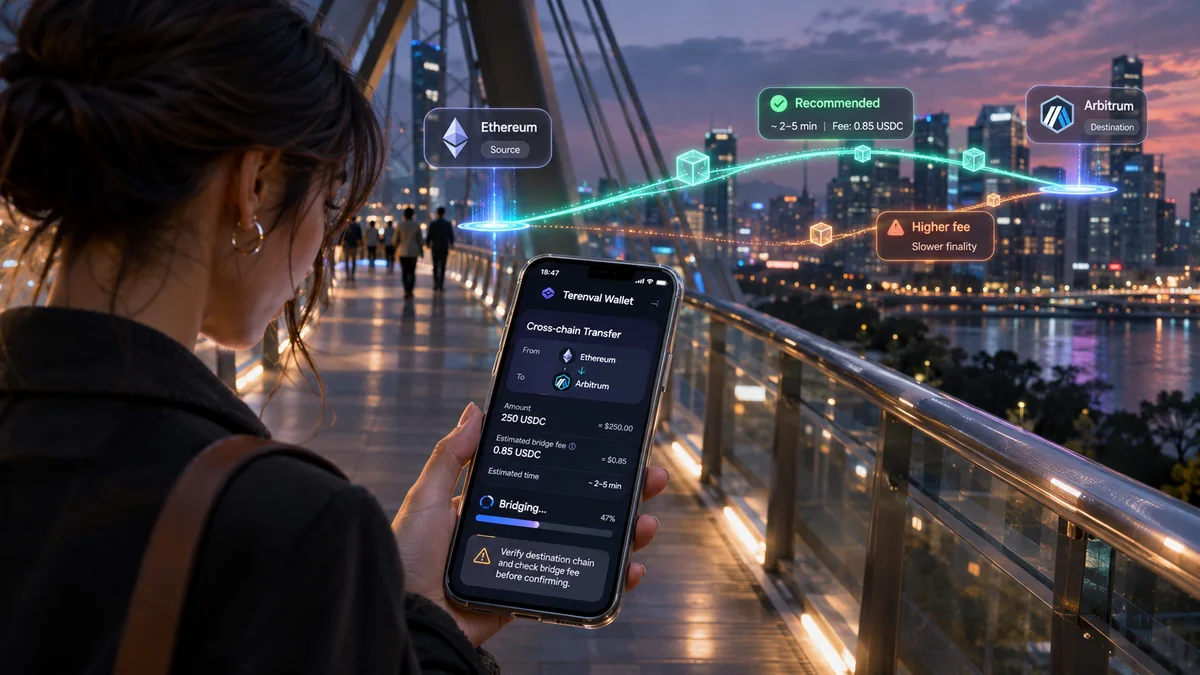
A crypto bridge is a system that coordinates a transfer of value or messages between two blockchain networks that do not share the same transaction ledger. If you hold ETH on Ethereum and want to use ETH on Arbitrum, you cannot simply change the network selector and expect your Ethereum balance to move. A bridge must coordinate a source-chain action with a destination-chain action. Depending on its design, your original asset may be locked, a corresponding token may be minted or released, or a liquidity provider may deliver the desired asset and settle the obligation later.
The most important practical distinction is between a transfer being confirmed on the source chain and the correct asset becoming spendable on the destination chain. They are different events. A successful source transaction does not by itself prove that a destination mint, release, relayer fill or withdrawal claim has completed. A bridge user must also verify which token contract was delivered: two balances called “USDC” may represent two economically and technically different assets. These distinctions affect costs, risk, recovery and whether a receiving app will accept the funds.
Short answer: A cryptocurrency bridge connects otherwise separate blockchain systems. Common designs include lock-and-mint, burn-and-mint, lock-and-release and liquidity-based/intent settlement. An official L1-to-L2 bridge can have different security and waiting periods from a fast third-party bridge, while an issuer-operated native-asset route such as Circle's CCTP has its own attestations and issuer assumptions. Before bridging, verify the source chain, destination chain, exact token addresses, recipient, minimum amount received, all fees, expected completion state and return path. Never give a bridge website or supposed support agent your recovery phrase.
Terenval's editorial view: A bridge should be evaluated as a combination of an asset-identity decision, a security-trust decision, a settlement workflow and a reversible-or-irreversible timing decision—not as a single “send” button. A comparison limited to “$1 fee versus $3 fee” can hide a different destination token, a week-long official exit, a new multisignature trust assumption, a swap embedded in the route or additional gas needed to claim funds. This guide develops five original, independently explainable educational tools: the Terenval Destination Asset Identity Ledger, Bridge Trust Boundary Map, All-In Cost & Delay Worksheet, Settlement State Ladder and Return-Path Readiness Gate. These are editorial decision frameworks, not deployed Terenval Wallet bridge features, certification marks, or promises of safety.
Information cutoff: November 8, 2026. Technical descriptions are checked against the primary documentation linked below, including Ethereum.org's bridge guide, Arbitrum's official bridge documentation, Circle's CCTP documentation and the OP Stack withdrawal specification. All dollar fees, transfer quotes, rates, times used as examples and portfolio sizes in this article are explicitly hypothetical unless a protocol documentation quote is attributed. There is no live bridge API integration or up-to-the-minute price feed behind this article. Always verify the currently supported route, network, token, contract and quoted fee before signing.
Key Takeaways
- A bridge coordinates two ledgers; it does not teleport the same on-chain record. One source event and one destination event—or a sequence of claims and proofs—must be considered separately.
- Bridging is not the same as a same-chain transfer. Switching the network view in your wallet does not move tokens between chains.
- Bridge mechanisms have different trust assumptions. An official rollup bridge, a multisignature-backed wrapper, an issuer attest-and-mint path and a liquidity-filled fast route are not interchangeable security products.
- Source confirmation is not proof of destination receipt. Check the destination explorer, recipient and exact token contract before treating the transfer as complete.
- Native USDC and bridged USDC.e are distinct on Arbitrum One. The contract, issuer redemption rights and receiving-app support matter more than the familiar ticker.
- Bridge quotes need an asset-identity check. Comparing 995 units of a wrapped asset with 995 units of issuer-native USDC as though they were always equivalent may be materially misleading.
- Official optimistic-rollup withdrawals can be slow by design. A canonical return from Arbitrum One to Ethereum may involve a roughly seven-day-class waiting period; OP Stack withdrawals generally involve proving and finalizing after a configured challenge/proof delay. Verify the current chain-specific rules.
- Fast bridges buy time through liquidity and extra coordination. A relayer may pre-fund the destination payment before the protocol finishes its own settlement, introducing availability, incentive and implementation considerations.
- Bridge fees have more than one layer. Source gas, bridge or relayer fees, destination execution, exchange slippage, claim gas and price differences can all contribute; do not count the same fee twice.
- Dollar fees and percentage fees scale differently. A route that is cheaper for $100 might not be cheaper for $10,000.
- Two route screenshots are not comparable unless destination assets, recipients, timing and settlement protections match. A lower headline fee alone cannot establish the better route.
- Most EVM wallets need destination-chain visibility. The same EOA address may appear on multiple EVM networks, but balances, contracts and fees belong to separate chains; smart-account addresses are an additional compatibility question.
- A failed, slow or unclaimed transfer is not automatically a theft. Identify the last verifiable stage before attempting recovery actions.
- Token approvals and signatures can authorize future spending. They are separate from the bridge's apparent cost and should be reviewed independently.
- Terenval Wallet is discussed as a self-custody context, not as a proven built-in bridge. No direct CCTP, Arbitrum, Base, Across or cross-chain aggregator integration is claimed here.
What Is a Crypto Bridge in Simple Terms?
Blockchains such as Ethereum and Arbitrum One maintain different records of account balances and contract activity. Ethereum validators cannot simply edit an Arbitrum account balance, and an Arbitrum transaction does not automatically become an Ethereum transaction. A bridge coordinates evidence and actions between those environments. That evidence may be validated by the rollup protocol, a set of external validators, an issuer's signature, message-verification software, smart-contract proofs or a relayer-settlement procedure.
Does the same coin actually move from one blockchain to another?
Not in the literal ledger sense. In a lock-and-mint model, an asset is held in a contract on the source chain and a redeemable representation is issued on the other side. A burn-and-mint model destroys units on one supported chain and creates corresponding units on another, preserving intended aggregate supply under the protocol's rules. A liquidity route may deliver tokens that already exist on the destination chain; a relayer receives later reimbursement or compensation. The end-user experience can look identical—press a button, wait, see a balance—but the underlying economic claim is different.
This is why Ethereum.org describes bridges using several mechanisms rather than one universal standard. Its developer overview identifies lock/mint, burn/mint and atomic-swap approaches, and separates native bridges, validator-mediated systems and liquidity networks.
What can a bridge transfer besides cryptocurrency?
Some cross-chain systems relay messages, application data or instructions to call a destination contract. Chainlink CCIP, for example, describes token transfers, messages and programmable token transfers in which value is paired with instructions. A cross-chain DeFi deposit can therefore involve more than moving an ERC-20 token: it might authorize a follow-up action on another network. That adds application-level execution risk and makes checking the destination contract particularly important.
Is a bridge the same as a swap or a crypto exchange withdrawal?
No. A swap changes assets, usually within one chain or exchange, and depends on an executable price. A bridge changes the network or coordinates a cross-network claim, which may preserve the asset type but can change its representation. A centralized exchange withdrawal is a service operation: the exchange controls its custody, network choices and crediting rules. Some cross-chain aggregators combine a bridge and one or more swaps, so an interface labeled “bridge” may actually execute both operations. Identify the output token and output chain, not just the button label.
For a more detailed breakdown of execution prices and route risk, see the Terenval guide to crypto slippage. Price impact is typically already reflected in an executable swap quote; it should not be automatically added again as a separate loss when calculating bridge costs.
How Do Crypto Bridges Work? The Four Main Designs
The simplest way to understand a cross-chain service is to ask what happens to the source asset, what constitutes valid delivery evidence, and who must act on the destination. The bridge's marketing name rarely supplies all three answers.
| Mechanism | Source-chain action | Destination-chain action | Principal exposure to examine |
|---|---|---|---|
| Lock and mint | Asset is deposited into a contract or custodian | Representation or wrapped asset is minted | Collateral integrity, contract security, validator control and redemption rights |
| Burn and mint | Supported token units are burned | Authorized units are minted after verification | Mint authority, issuer/protocol attestation, token identity and supported-chain constraints |
| Lock and release | Asset or liquidity is reserved/locked | Existing asset or liquidity is released | Reserve availability, settlement rules, validator and liquidity management |
| Liquidity / intent fill | User locks or pays the input, or signs a bounded intent | Relayer or solver supplies destination assets, then settles separately | Relayer availability, fill/refund conditions, liquidity, verifier and settlement contracts |
These are conceptual families, not a claim that every protocol supports every mechanism, nor that any one design is automatically secure. The Chainlink Cross-Chain Token specification demonstrates how even one interoperability platform can configure multiple token supply mechanisms.
Lock and mint: when a bridge creates a wrapped asset
Imagine 1 ETH held on Ethereum and deposited into a bridge's escrow. The destination chain receives evidence that the deposit occurred. The destination system then creates or credits an eligible wrapped representation. The resulting token represents a claim tied to the bridge's escrow and redemption mechanism; it is not the exact same Ethereum ledger entry. If the escrow is hacked, the minted representation can lose backing or confidence even when the destination token contract itself is functioning normally.
A “wrapped ETH” balance on a destination chain can also come from ordinary local WETH wrapping rather than cross-chain bridging. The same label cannot tell you which system or trust assumption applies. Verify the contract and provenance.
Burn and mint: when native-token issuance coordinates supply
A burn/mint system destroys eligible units on the source chain, waits for the required verification or attestation, then mints recognized units on the destination. Circle's CCTP uses this pattern for supported issuer-native USDC transfers: a source burn leads to an issuer attestation that permits a destination mint. The underlying trust question is no longer simply “Is there an ETH escrow?” It includes the issuer, token contracts, valid attestation, contract configuration and finality rules.
Burned does not mean received. Even an irreversible-looking source burn can be followed by a period during which the attestation, destination transaction or claim has not yet completed. Record the burn transaction and cross-chain message ID; never diagnose success from the first hash alone.
Lock and release: transferring claims against existing liquidity
If a system maintains token pools or reserves on different networks, it can lock funds on one side and release existing funds on the other, subject to its accounting and verification rules. This is not universally trustless or unlimited: the ability to release the appropriate token depends on pool configuration, liquidity and control of the unlocking mechanism. The official CCIP token-pool model shows why token pools and rate limits matter even when two network interfaces present the action as a single transfer.
Fast liquidity and intent bridges: receiving before final settlement
A liquidity bridge may not wait for slow final settlement between networks. A relayer watches a qualifying source deposit or intent, pays the specified recipient from its own inventory on the destination, and then waits for reimbursement or resolution under the bridge's settlement rules. Across's documentation explicitly separates initiation, destination fill and later settlement. This explains how a fast user-facing delivery can coexist with a much slower underlying bridge or accounting process.
Speed is not free of assumptions. An available relayer must accept the route, the fill must satisfy its safeguards, and the refund or challenge mechanism must function. Source chain reorganizations, liquidity shortages, paused routes and backend failures can change delivery and refund timing. “Instant” is a product objective or normal-case observation, not an unconditional delivery guarantee.
The Two-Chain Reality: Why One Successful Transaction Is Not Enough
The most common mistake in bridge troubleshooting is treating a source-chain receipt as final confirmation of a complete transfer. A blockchain explorer can prove that a local contract call succeeded; it does not by itself prove that a remote contract minted tokens, a relayer paid the intended address, or a withdrawal was finalized.
What “successful” means on the source chain
The transaction has been accepted according to that chain's status and finality conventions. It may have locked or burned tokens, emitted an event, created a message or registered a withdrawal request. It may also have only granted an approval, requiring a second action to start the bridge transfer. Check the transaction's actual decoded method, logs and token balance movements. “Success” is a necessary but not always sufficient condition for arriving funds.
What “successful” means on the destination chain
The receiving chain must show the right token contract credited to the right address in the right amount, or show an executed contract action that the recipient intended. If a claim is pending, the tokens may not be spendable. If a fast bridge credits a substitute asset, the numerical balance could be correct while the asset identity is not.
Different hashes and different confirmation states
The source transaction hash, relay or message ID and destination transaction hash are not generally the same identifier. On some rollups, the source transaction derives a retryable ticket or withdrawal message that can be traced into an eventual destination transaction. Arbitrum's traceability documentation describes how to locate these linked events. If the destination transfer is missing, search using the bridge's authenticated transaction tracker or official explorer, not an arbitrary “recovery” site found through advertising.
The Terenval editorial principle: settlement is a state machine
A useful bridge account statement needs more than “Pending” or “Complete.” It should explicitly track: source submitted → source confirmed → message/attestation ready → destination action submitted → destination confirmed → correct asset verified. This model is presented in detail later as the Settlement State Ladder. A recipient should not be told to assume the transfer is final merely because an off-chain tracker shows a green checkmark.
Canonical Bridges vs Fast Bridges: Which Is Safer and Which Is Faster?
A canonical bridge is usually the official bridge path associated with a particular chain or rollup's settlement design. A fast bridge typically provides earlier destination liquidity using relayers, intent systems or other intermediaries. An issuer-native route such as CCTP is a third design, and may be available only for specific assets and chain pairs. None of these labels alone establishes a universal security ranking.
| Decision point | Canonical rollup route | Fast liquidity / intent route | Issuer-native burn/mint route |
|---|---|---|---|
| Main settlement basis | Rollup or chain-specific bridge proof/contract design | Source deposits/intents, destination liquidity, fill and later settlement | Issuer or protocol attestation linked to a burn |
| Typical user-facing speed | Chain-specific; outbound optimistic L2 exits may be multi-day | Designed for faster destination fills when capacity is available | Depends on issuer confirmation/attestation and route mode |
| Possible token received | Native chain gas token or canonical bridged representation | Exact output asset specified in quote, subject to route terms | Native issuer-supported token on destination when supported |
| Main extra concern | Proof/finalization steps, challenge windows and contract governance | Liquidity and relayer availability; fraud/refund/settlement assumptions | Issuer and attestation authority, supported-chain and token restrictions |
| What to compare | Accurate claim time and output token address | Minimum received and ability to refund if unfilled | Exact native asset, attestation state and fee/chain support |
Ethereum.org recommends evaluating bridges by security, convenience, connectivity and cost-effectiveness rather than assuming all designs offer the same trade-off. See its bridge developer guide.
Why an official bridge can take longer to withdraw than to deposit
On an optimistic-rollup-style system, a deposit from Ethereum into the rollup can use a comparatively direct parent-to-child mechanism, while withdrawing back to Ethereum may require a state commitment, proof and period in which fraud claims can be challenged. That window is a security mechanism, not necessarily a broken transfer. The Arbitrum bridge quickstart describes roughly seven-day-class withdrawals back to Ethereum through its official bridge. Timing is protocol- and configuration-specific, so check the bridge's currently displayed countdown for your route.
Why a “fast withdrawal” is not simply the canonical bridge with a shorter timer
The fast provider often advances tokens on Ethereum or another destination and handles slow reimbursement in the background. The user effectively pays, or gives up part of the output, for additional liquidity, service and settlement assumptions. An apparently identical output token can therefore arrive quickly through a very different economic mechanism. If a destination relayer runs out of liquidity, the route may delay, reject or fall back to a different process; verify the actual refund rules before signing.
Is the fastest route always the most dangerous?
Not necessarily. A slow bridge can have vulnerabilities, upgrade keys, token backing exposures or operational errors. A fast provider can also have well-designed constraints. The correct comparison is what can fail, what value is at risk, and who can remedy or worsen the failure. We do not turn “speed” into a fabricated numerical safety score. Delay, asset identity and contract permissions must be examined independently.
Bridging ETH From Ethereum to Arbitrum: Step-by-Step Example
Ethereum → Arbitrum One is a useful first example because it demonstrates the difference between an official rollup transfer and a simple wallet send. The destination has its own transaction ledger and its own ETH used for gas. A bridge can let you access ETH on Arbitrum without first selling ETH for another token. These steps describe the general official-bridge workflow, not a live action performed for a Terenval user.
Step 1: identify the exact source and destination networks
Confirm that the source is Ethereum mainnet, not an unrelated chain with an ETH-like ticker, and that the destination is Arbitrum One, not Arbitrum Nova or a testnet. Arbitrum's official chain information lists Arbitrum One chain ID 42161. A fake network name in a wallet can be misleading, so verify the chain ID and trusted RPC or explorer information from official documentation. Network setup alone neither authorizes nor moves funds.
Step 2: confirm what “ETH” means on the destination
For gas on Arbitrum One, the asset is ETH under that chain's accounting. Avoid confusing a bridge-compatible ETH gas balance with an ERC-20 wrapped token created by some unrelated bridge. Confirm the selected bridge UI identifies the correct asset and destination before proceeding.
Step 3: check the address and transaction requirements
The official Arbitrum bridge quickstart describes connecting a supported wallet to the official bridge, selecting the networks and token, entering the amount and confirming the transaction. You need enough ETH on Ethereum to pay source gas in addition to the amount you intend to deposit. If using a third-party UI, confirm the real underlying contract and route. A browser search result or social media direct message is not sufficient authenticity proof.
For an ordinary EVM externally owned account controlled by the same private key, the address string can remain the same on Ethereum and Arbitrum. The ledger holding the balance does not remain the same. Smart accounts and contract wallets may be deployed differently across networks, so never generalize same-address behavior to every account type.
Step 4: record the source transaction and wait for the destination action
After submitting, retain the Ethereum transaction hash. The bridge's authenticated interface or a destination explorer should let you identify the related Arbitrum transaction or bridge message. A source gas payment and successful deposit event are not evidence of final destination spendability. According to Arbitrum's quickstart, source-to-destination deposits are normally much quicker than its official return withdrawals, but actual processing can depend on congestion and the route. Verify the final Arbitrum balance and not merely the bridge's completion animation.
Step 5: reserve gas to use the funds on Arbitrum
If ETH actually arrived as the native gas token on Arbitrum One, it can generally be used to pay network fees for supported operations there. If you bridge only a non-gas token, however, a wallet may hold an asset but lack the separate ETH required for later transfers or approvals. A bridge that deducts destination execution fees or sponsors some gas is not a universal gas subsidy for future activities.
Withdrawing From Arbitrum to Ethereum: Why the Return Trip Is Different
The user experience is asymmetric. A canonical Ethereum-to-Arbitrum deposit does not imply an equally fast canonical withdrawal. The Arbitrum official bridge historically presents a roughly seven-day-class withdrawal period for withdrawals from Arbitrum One and Nova back to Ethereum; chain-specific timing may evolve. Its current quickstart should govern the actual transaction, not an old screenshot or the timeline of another chain.
Initiate, wait and claim: three distinct actions
The first action begins the withdrawal on Arbitrum. The protocol then follows its message, assertion and challenge/finality rules. When the exit becomes executable, a destination-side action may be needed to claim funds on Ethereum. A “waiting” state is therefore not equivalent to missing funds; likewise, passing the window does not automatically mean that an unclaimed transaction already credited the target account.
Why the last step can require new ETH for gas
The finalization or claim action may execute on Ethereum and therefore require Ethereum-mainnet ETH in the claimant's account. Having ETH on Arbitrum does not automatically provide ETH for a subsequent Ethereum call. This is a classic cross-chain recovery trap: a user moved all their Ethereum gas away, then cannot afford to finalize the return transaction without replenishing source-chain gas. Check the real bridge instructions and any sponsored-finalization rules; do not pay a random third-party “unlock fee” sent through a chat message.
Can a fast bridge shorten the user-facing exit?
A properly supported liquidity route may pay ETH on Ethereum much sooner by using the relayer's own Ethereum liquidity and later obtaining reimbursement. This is not proof that Arbitrum's canonical security delay disappeared. Rather, a different participant accepted settlement and capital costs. Compare the precise output asset, destination-chain funds, fees, refund terms and relayer/contract trust model. Do not assume that the fast path is available for the same amount or at the same price every day.
Bridging Between Ethereum and Base: Understand OP Stack Finality
Base is an Ethereum L2, but a transfer between Ethereum and Base still crosses two ledgers. For OP Stack-based withdrawal designs, the OP Stack specification distinguishes initiation on L2, proof on L1 and finalization on L1. A published output or proof is a protocol milestone, not automatically an already spendable Ethereum credit.
Depositing into an OP Stack chain
The standard bridge uses cross-domain messaging and protocol contracts to initiate deposits and move eligible ETH/ERC-20 assets. The OP Stack standard bridge specification documents these interfaces. The destination execution may be separate from the original Ethereum transaction; check the receiving chain and token contract. If the app presents an intermediary or a different token representation, understand why it is used.
Withdrawing from Base or another OP Stack chain
The reference OP Stack withdrawal flow requires an L2 initiating transaction, an L1 proof and a later finalizing transaction. Protocol versions and deployments can use configurable proof-maturity, fault-dispute and finality delays. Some documentation describes a seven-day challenge window for its reference flow, but that is not a promise that every Base-era withdrawal started today will settle in exactly seven days. Check current Base/OP Stack official tooling for the actual withdrawal state and delay.
Fast Base routes are not identical to the canonical return
A liquidity bridge might use a separate relayer service to credit ETH or native USDC on Ethereum earlier. That adds different contract, liquidity and settlement dependencies. A fast quote is only comparable to a canonical quote if the received token contract, amount and target address match, and if extra finalization expenses are disclosed. A cheap quote that returns a token your target application cannot use is not actually a cheap solution.
Native USDC vs Bridged USDC.e: A Case Study in Token Identity
This is one of the most important real-world cross-chain distinctions. The Arbitrum documentation states that Arbitrum One has both native USDC and bridged USDC (USDC.e). They are separate ERC-20 contracts. Circle-issued native USDC is not automatically interchangeable at the contract level with a representation minted through an Ethereum-backed bridge.
The same ticker does not mean the same asset
A token interface may show a familiar name, $1.00 approximate price and a similar logo. What matters to smart contracts and deposit processors is the chain-and-contract pair. A DeFi market that accepts native USDC may not accept USDC.e; a centralized exchange may support one and reject the other. Contract addresses should be verified from official issuer and chain documentation, not copied from social media or a search ad.
Arbitrum's documented Arbitrum One contract examples are native USDC 0xaf88d065e77c8cC2239327C5EDb3A432268e5831 and bridged USDC.e 0xff970a61a04b1ca14834a43f5de4533ebddb5cc8. These are provided for asset-identity illustration, not as a recommendation to transact or as a substitute for verifying current official contracts. They cannot be reused on an unrelated chain merely because that chain is EVM-compatible.
Why the redeemability distinction matters
Native USDC and USDC.e can track similar dollar values under normal market conditions, yet their legal/technical redemption routes and collateral dependencies differ. A wrapped claim can inherit bridge collateral or custody risk. A native issuer token inherits issuer, compliance and reserve/redemption assumptions. Neither is a risk-free dollar, and a stable market price does not prove identical contract support in every wallet, exchange or lending market.
Practical example: a $1,000 Ethereum USDC transfer
Assume the user holds 1,000 genuine Ethereum USDC. One eligible bridge route might lock it on Ethereum and deliver 1,000 USDC.e before fees. A supported CCTP route might instead burn eligible USDC and mint issuer-native USDC on Arbitrum. Even if the quoted token count and estimated fiat value are identical, these outcomes are not equivalent for a downstream application requiring native USDC. The user might have to swap USDC.e into native USDC, paying additional price impact, swap fees, gas and potentially taking new risks. Do not say “both bridges charge 0.1%, so pick either one” until the required destination asset is confirmed.
How Circle CCTP Transfers Native USDC Between Supported Chains
Circle's Cross-Chain Transfer Protocol (CCTP) provides an issuer-coordinated burn → attestation → mint flow for eligible assets and chain routes. It is not simply a generic ETH bridge and cannot be assumed to support arbitrary ERC-20 tokens. As of the article cutoff, Circle describes CCTP v2 as its current canonical version, with CCTP v1 treated as legacy. Support, fees, minimum amounts and finality modes vary and should be verified in the current Circle documentation.
Step 1: an eligible native asset is burned on the source chain
The application initiates a burn of supported native USDC through the relevant contracts. A superficially similar bridged asset may not be eligible. On many EVM workflows, token allowances or permit-like authorizations may be required. The actual spender should be verified independently and an unlimited allowance is not harmless merely because the underlying asset is a stablecoin.
Step 2: Circle attests to the source event
After the required source conditions are met, the protocol obtains a signed attestation authorizing the destination mint. Who issues and validates that attestation is a trust assumption. “Burn-and-mint” reduces reliance on a pool of wrapped USDC locked elsewhere, but it does not eliminate Circle issuer risk, contract bugs, blocked route availability or all finality considerations.
Step 3: the destination USDC is minted
The destination receives the signed message and mints the specified native USDC, subject to the applicable contract checks. Some implementations perform the final action automatically; others may require a distinct destination call or claim. A pending attestation is different from a completed mint. Circle's product documentation describes Standard and Fast modes, with fees and availability dependent on route and version.
What is the difference between CCTP and an ordinary wrapped bridge?
With a conventional escrow-backed wrapped bridge, ownership of the destination representation is linked to backing held by the bridge on another chain. With native USDC CCTP, the source token is burned and the destination token is issued under the same issuer's authorized native-token framework. That can be desirable for destinations needing native USDC, but it should be evaluated as different trust architecture, not as a guarantee against every exploit or issuer intervention.
The Terenval Destination Asset Identity Ledger
The first original Terenval framework is designed to prevent an error that fee tables cannot detect: receiving the wrong economic instrument. It is an editorial worksheet, not a live token verification service.
| Identity field | What to record | Why it matters |
|---|---|---|
| Source network | Chain name and verified chain ID | Prevents confusing testnets, L2s and similarly named networks |
| Source asset | Contract address or verified native gas asset | Establishes exactly what leaves the wallet |
| Source amount | Gross token units and decimal precision | Allows fee calculation and event reconciliation |
| Bridge protocol | Official contract/router and documented mechanism | Exposes who locks, burns, verifies or fills |
| Destination network | Chain name and chain ID | Separates account views and gas requirements |
| Destination asset | Exact target token contract or native asset type | Prevents USDC / USDC.e or WETH identity confusion |
| Recipient | Full receiving address and account type | Avoids successful delivery to an unusable contract/account |
| Quote floor | Minimum exact output and quote expiry where relevant | Bounds a known subset of losses |
| Validation evidence | Source hash, cross-chain message ID, destination hash | Makes claims of completion independently checkable |
| Return route | How to move or redeem the target asset if plans change | Reveals hidden lock-ins and exit delays |
Core rule: Two competing bridge quotes should only enter the same lowest-cost comparison after their destination-chain token identities and receiving conditions match. Otherwise, compare them as different products with an explicit cost to convert one into the other. If the target application requires native USDC, the output being USDC.e is not a cosmetic detail.
The five-minute preflight test
Before making any bridge deposit, answer these questions in one sentence each: What chain am I leaving? What exact token do I hold? What exact token will I receive? Who or what validates that receipt? What do I need to do if the destination step does not execute? If any answer is unknown, pause the transaction rather than letting a low displayed service fee substitute for verification.
How Much Does It Cost to Bridge Crypto? The Complete Fee Stack
There is no universal crypto-bridge fee. Costs may include fixed network gas, bridge service charges, percentage relayer or liquidity charges, cross-chain message/claim execution fees, swap fees or price impact if the route converts assets, and extra network gas for finalization. Actual quotes vary by chain and time and may hide fees in the number of tokens received instead of showing a separate fee line. The Across fee documentation shows one example of a protocol that differentiates relayer and liquidity-provider costs.
The cost worksheet should be based on the economic result
For a same-token stablecoin transfer where token units can reasonably be valued at approximately $1 for a hypothetical model, an accounting identity is:
Total cost in USD = input token value − destination output value + source/destination gas paid separately + other separate costs not already deducted from the output.
For a route that swaps one token for another, value both sides against a stated external benchmark at a common timestamp; then distinguish transfer costs from market-price movement or asset conversion. If destination gas is already deducted from the quoted output, do not add it a second time. If a user spends $10 on Ethereum gas outside a $1,000 USDC deposit and receives $998 USDC, the combined economic cost is approximately $12, not $22 unless some additional distinct charge actually exists.
Fixed fees versus percentage fees
A $4 fixed gas burden consumes 4% of a $100 transfer but just 0.04% of a $10,000 transfer. A 0.20% liquidity charge costs $0.20 for $100 and $20 for $10,000, before gas. The cheapest route can therefore switch as amounts change. Gas can also rise sharply during congestion, while liquidity fees can increase with utilization. Avoid quoting a universal cheapest bridge from one screenshot.
The Terenval All-In Cost & Delay Worksheet
The third original framework is a transparent same-output-asset comparison of three fictional, fully specified quote models. All three rows assume the output is the same verified USDC contract on the same destination, the recipient is identical, each route is actually available for the size, the token remains at $1, and the user's payment of gas is outside the bridged amount. These models do not correspond to actual fees or availability on Arbitrum, Base, Circle, Across or a named bridge.
- Route A — fixed-gas model: $4.20 of separate network gas, zero route fee deducted from USDC. Recipient receives the full principal.
- Route B — relayer-percentage model: $1.30 of separate gas, plus a 0.18% token fee deducted from the input amount.
- Route C — mixed-fee model: $2.50 of separate gas, plus a 0.05% token fee deducted from the input amount.
| Sent USDC | Route A: all-in cost | Route B: all-in cost | Route C: all-in cost | Lowest modeled cost |
|---|---|---|---|---|
| 100 | $4.20 (4.20%) | $1.48 (1.48%) | $2.55 (2.55%) | B |
| 1,000 | $4.20 (0.42%) | $3.10 (0.31%) | $3.00 (0.30%) | C |
| 10,000 | $4.20 (0.042%) | $19.30 (0.193%) | $7.50 (0.075%) | A |
Arithmetic audit: Route B = $1.30 + 0.0018 × amount; Route C = $2.50 + 0.0005 × amount; Route A = $4.20. For a 1,000-USDC transfer, Route B delivers 998.20 USDC after the deducted token fee and charges $1.30 in separate gas; the total cost relative to 1,000 USDC is $1.80 + $1.30 = $3.10. Route C delivers 999.50 USDC and charges $2.50 gas, totaling $3.00. These examples deliberately hold token identity and market value constant to isolate how fee models scale.
What this table does not prove: That Route A is safer for large transfers, Route B is best for small transfers, or Route C actually exists for every token. A real route selection must also pass the trust, token-identity, liquidity and completion tests. If the route cannot deliver native USDC or the destination lacks the required contract support, its mathematically low fee is irrelevant.
Example: why “more tokens received” can still cost more
Assume two real-looking but fictional executable quotes for depositing 1,000 USDC with the same recipient and output token. Route X says “Receive 997.80 USDC,” and the $2.10 source gas is paid separately: all-in cost $4.30. Route Y says “Receive 998.50 USDC,” but source gas is $4.00 paid separately: all-in cost $5.50. Route Y shows a higher received token amount but creates $1.20 more economic cost in the example. The correct comparison is net wealth across both wallets after transfer, not only the large colored output number.
How do bridge slippage and exchange rates fit into the worksheet?
A bridge that uses a DEX or solver might return a lower quantity of the same asset or a different asset. The route can have a spread, price impact or slippage tolerance. Inspect any minimum destination amount. A $1,000 source value with a quote of 995 destination-dollar equivalents plus $2 separately paid gas has about $7 of expected economic friction at the reference prices, not $5 + “another 0.5% price impact” unless the $5 number demonstrably excluded impact. Read the quoted output definition carefully.
Is a Faster Bridge Worth the Extra Fee? Time Has a Cost, but Also a Risk
Bridging is partly a timing choice. If the user must pay a supplier today or move collateral before a deadline, a seven-day delay may make an otherwise inexpensive canonical route unsuitable. Conversely, if the user is moving long-term savings and has no urgent liquidity need, paying a large percentage surcharge for minutes of speed may be economically unnecessary.
Illustrative value-of-time calculation
Suppose an investor applies a purely hypothetical 8% annual opportunity-cost rate to capital that must wait exactly seven days. On a $10,000 transfer, the simple interest-equivalent value of that delay is $10,000 × 0.08 × (7/365) ≈ $15.34. On $1,000, it is about $1.53. This is not an observable bridge fee, guaranteed interest opportunity or a risk-adjusted investment recommendation; it is a sensitivity calculation. Some users have no yield alternative, and real risks may outweigh such linear time-value arithmetic.
Why a payment deadline is not just annualized yield
If delivery is needed in 15 minutes, the user cannot convert seven days into a tolerable cost with a spreadsheet. The delay may make the route ineligible, regardless of its apparent cheapness. Conversely, a so-called fast bridge with uncertain fill or refund timing might also be ineligible for a hard deadline. A useful interface should distinguish an estimated normal-case time, a contractual/execution deadline and the user's own hard delivery requirement.
Capital efficiency does not equal safety
An issuer-native burn/mint route or a liquidity-based fill can avoid some wrapped-collateral exposure, but each imposes different conditions. CCTP relies on issuer attestations and token issuance; a liquidity route relies on sufficient inventory and secure reimbursement logic. Do not turn “capital efficient,” “fast” or “audited” into an overall safety guarantee.
The Terenval Bridge Trust Boundary Map: Who Can Make the Transfer Fail?
The second original framework is a practical trust-boundary map. It is intentionally not a “risk rating out of 10,” since protocol architecture cannot be fairly reduced to a score without verifiable security research. It identifies the parties or technical processes that must behave correctly at each stage.
| Boundary | Ask this question | Evidence worth checking |
|---|---|---|
| Source network | Can the source transaction be finalized and observed honestly? | Network status, genuine explorer receipt, finality requirements |
| Source bridge contract | Can escrow/burn logic be exploited, paused or upgraded? | Official deployed address, source code, upgrade/admin privileges, independent audits |
| Verification layer | Who certifies that the source event is real? | Rollup proof rules, attestation authority, validator threshold, challenge controls |
| Delivery layer | Who mints, releases, fills or executes the destination action? | Destination contract, relayer requirements, mint authority and failure handling |
| Token backing | What economic claim does the destination token represent? | Issuer, collateral location, bridge reserves, redemption conditions, exact contract |
| Application or wallet | Who is allowed to spend or redirect the resulting funds? | Recipient contract, allowance, permit, wallet signatures, destination account deployment |
| Return path | Can value be brought back without unforeseen trust or delay? | Official withdrawal/claim process, destination gas requirements, capacity, bridge status |
Terenval editorial conclusion: The most serious bridge failure may occur in a different boundary from the one shown by an attractive app interface. A secure wallet can correctly sign a transfer to a flawed bridge; a sound source chain can process a transaction whose destination token is unsupported by the intended receiver; a solvent relayer can be unable to fill an order because the destination chain is halted. Security needs a path description, not simply a padlock icon.
Upgrade keys, multisignatures and timelocks
Even an audited bridge contract can have administrators who pause transfers, change verification rules or upgrade implementations. Some admin controls are necessary for incident response, but they are still capabilities that users must understand. A multisignature is not automatically sufficient protection; review signers, threshold, timelocks and who controls emergency overrides. An immutable contract can reduce some governance risks while making rapid bug fixes harder. We do not classify “upgradeable” or “immutable” as categorically safe.
Wrapped collateral and depegging
A wrapped bridge asset can trade close to the original token for a long period, masking the fact that its market value depends on trust in the backing and redemption mechanism. If a bridge freezes or loses collateral, the destination token's price can drop even while it remains technically transferable. Holding a “bridged ETH” token is not automatically identical to holding issuerless native ETH on its original chain.
Rate limits and paused lanes
Cross-chain systems may apply per-token or per-chain transfer caps to reduce exposure in an incident or to reflect liquidity constraints. Chainlink's token-pool documentation describes configured rate limits. A daily maximum or temporarily paused route is not necessarily evidence of a hack, but it can prevent time-sensitive payments. Check what happens to a transfer already initiated when a lane is paused.
The Terenval Settlement State Ladder: How to Track a Cross-Chain Transfer
Our fourth original editorial framework translates protocol events into a user-understandable progress ledger. Different bridges omit or combine stages; do not treat the names below as official smart-contract event names for every network.
| State | Independently verifiable event | Appropriate next action |
|---|---|---|
| 0. Quote prepared | Destination asset, amount, expiry and contracts displayed | Confirm terms; no transfer has started |
| 1. Approval granted, if needed | Spender allowance or permit exists | Verify spender and amount; bridge deposit may still be required |
| 2. Source submitted | Source transaction hash exists | Check trusted source explorer; do not resubmit blindly |
| 3. Source confirmed | Receipt indicates successful required action | Find bridge deposit/burn event and message ID |
| 4. Verification pending | Message, proof, attestation or challenge state unresolved | Wait or use documented monitoring; identify real timeout |
| 5. Destination ready | Relayer fill, mint or claim can execute | Check claim/execute requirements and destination gas |
| 6. Destination confirmed | Successful destination transfer or contract event | Inspect actual recipient, asset contract and delivered amount |
| 7. Asset verified | Receiving account owns the expected usable token | Reconcile final balance and save both transaction IDs |
A user in state 3 should not be told that funds were stolen simply because they cannot yet see state 7. A user in state 7 should not assume the route is economically acceptable if the wrong token arrived. The ladder separates liveness (“will it progress?”), correctness (“was the intended action executed?”) and asset identity (“did I get the right thing?”).
What is a retryable ticket on Arbitrum?
Some Arbitrum parent-to-child messages use retryable ticket mechanisms. A source call can lead to a ticket whose submission and redemption status are distinct from the original source transaction. If an expected destination action has not executed, the official Arbitrum traceability guide describes locating the ticket and successful redemption. The presence of a retryable ticket does not mean a random third party can safely “fix” it by collecting your private keys or an off-chain ransom.
What is a withdrawal proof on an OP Stack chain?
For the relevant OP Stack implementation, a withdrawal proof establishes that a previously initiated L2 withdrawal is included in the required state commitment. Finalization is a later step, subject to the protocol's rules and delays. The OP Stack withdrawal specification explains why proving and finalizing are separate transactions. A proof being accepted does not eliminate the waiting condition.
How to document a transfer when support is needed
Keep the original quote or order ID (without exposing private data), both chain names, exact token contracts, input amount, recipient, source transaction hash, bridge message ID if available, and any destination hash or claim state. Good evidence reduces confusion between a pending transfer, a wrong-asset delivery and a genuine technical failure. Never include seed phrases, private keys, unrestricted signed messages or sensitive authentication secrets in a support ticket.
The Terenval Return-Path Readiness Gate: Could You Get Back Tomorrow?
The fifth original Terenval model asks a question most bridge quote screens do not prominently answer: If I change my mind, can I unwind this transfer? This is an editorial checklist, not a return guarantee.
Gate 1: is the destination asset redeemable or accepted where you need it?
A bridged token might have limited exchange support, thin local liquidity or reliance on the original bridge's custody. Verify whether the asset can be used for your intended DeFi market, withdrawal processor or payment. The presence of a token in a wallet does not establish usability.
Gate 2: what does the return route require?
Ethereum → L2 and L2 → Ethereum can differ radically in delay and required transactions. A bridge may offer a fast inbound route and a long canonical exit. Confirm whether a destination withdrawal needs a proof, a challenge window, a claim transaction, a relayer or an on-chain gas payment that you currently cannot make.
Gate 3: how does the return quote change with size?
A $100 fast withdrawal might have a low fee, while a $100,000 return may exceed the bridge's available liquidity or face a higher percentage charge. A route that accepts a deposit is not always obligated to offer instant reverse liquidity at every size. Market depth and capital allocation can become binding constraints.
Gate 4: what if a required service disappears?
Ask whether the user can independently finalize or claim via documented contracts if the app website goes offline. Some systems deliberately support permissionless finalization; others depend on custodians, relayers or administrators to make progress. An interface outage alone is not proof that on-chain rights disappeared, but a provider-dependent system might have no practical self-service exit.
Gate 5: does the wallet have usable native gas on both chains?
A stablecoin-only balance can leave the user unable to pay the next transaction fee. Check both the source gas for deposit and any destination gas needed for claiming, redeeming, transferring or selling. Budgeting gas on the wrong network is not useful. Do not assume every application provides gas sponsorship.
Readiness outcome: If one of these gates fails, consider the route unsuitable for the intended use—even if it displays the cheapest nominal fee. The framework is intentionally designed to uncover hidden reversibility and usability costs rather than recommend a specific bridge brand.
How to Bridge Crypto More Safely: A Practical Checklist
The following steps describe precautions for a user deliberately choosing a supported bridge. They are not instructions to interact with any unverified contract.
Before opening a bridge website
- Identify the needed destination asset first. Write down the target network, exact token contract and whether native ETH or gas will be available after arrival.
- Check the purpose of the transfer. A user who needs native USDC for collateral may not be served by a cheaper USDC.e quote.
- Find the official project documentation. Use bookmarked or independently verified domain information; avoid sponsored search results and link shorteners for high-value transfers.
- Inspect the trust model. Determine whether the route is canonical rollup bridging, issuer-native burn/mint, validator-backed representation or liquidity/intent delivery.
- Check the route's status and current support. Read current network and bridge service status before depositing, especially during upgrades, chain incidents or contract migrations.
- Estimate all cost layers. Include source gas, any token deductions, destination execution or claim, conversion fees and a plausible return expense.
- Set your transaction and deadline limits. If the interface offers a minimum received or expiry, understand which risks it restricts; it may not cap all operational losses.
While confirming the transfer
- Compare full addresses, not only the first and last characters of a wallet address. Crypto address poisoning can make a malicious recipient appear familiar. See the Terenval address-poisoning guide.
- Read every approval or permit separately from the deposit request. The contract receiving token-spending rights should match the documented protocol.
- Confirm the correct chain in the wallet popup. A malicious website can present misleading text while the wallet signs a different chain call or contract interaction. Look for actual transaction data and trusted contract labels.
- Do not reuse an old quote blindly. Fees, token output and liquidity can change while a transaction is pending. If a quoted route expired, obtain a new authenticated quote rather than changing a transaction parameter at random.
- Consider a small test transfer when appropriate and economically reasonable. This can verify address and asset routing but does not certify a protocol against exploits, governance actions or failures during a larger transfer.
After submitting
- Record the source transaction hash and message/transfer ID. Do not confuse the hash of an approval with that of the actual bridge event.
- Trace the corresponding destination event using official trackers and the relevant block explorer. If a claim is required, establish whether the delay has elapsed before spending more gas.
- Check the contract and recipient, not just a matching ticker in a wallet. The balance might be the wrong wrapped asset or on an unintended network.
- Reconcile the final economic cost. Record input token value, exact destination quantity and separate gas actually paid; exclude double-counting.
- Review residual permissions if no further bridge deposits are intended. A completed bridge does not necessarily reset a token allowance. See how to check and revoke token approvals.
What If a Crypto Bridge Transfer Is Stuck or the Tokens Do Not Appear?
Do not immediately resend the same transfer. A second deposit can create two genuine obligations and double the exposure. First identify the last verified state in the Settlement State Ladder, then follow the authenticated recovery instructions for that exact protocol. Never transfer additional crypto to a stranger who claims to be able to “unfreeze” the first deposit.
| Symptom | Plausible cause | First safe diagnostic step |
|---|---|---|
| Wallet says “sent,” bridge tracker shows nothing | Only token approval occurred; wrong transaction hash or unsupported route | Inspect source transaction logs and actual called contract |
| Source success, destination balance missing | Cross-chain message/attestation/fill pending | Track message ID and current protocol status |
| Source burn confirmed, destination mint absent | CCTP attestation or destination execution pending | Verify issuer-native token, official CCTP state and claim procedure |
| L2 withdrawal marked “waiting” | Challenge/proof-maturity window not finished | Check official withdrawal status and chain-specific countdown |
| Withdrawal ready but no ETH on destination | Claim/finalize requires native destination gas | Confirm genuine claim contract and gas requirements |
| Transaction seems complete, balance shows zero | Wrong selected chain, token not displayed, recipient mismatch | Inspect destination explorer by token contract and address |
| Received USDC.e but app requires USDC | Asset representation mismatch | Verify both contracts; examine whether a supported conversion exists |
| Fast bridge did not fill on time | Relayer liquidity, order expiry, outage or refund condition | Check authenticated order status and documented refund process |
| Transfer went to an unsupported exchange deposit | Exchange may credit only certain chains/assets | Contact official exchange support with hashes; recovery is not guaranteed |
| Suspicious “help” site requests seed phrase | Phishing or social-engineering scam | Stop; never disclose private signing material |
If the source transaction reverted
A revert normally means the specific source call did not complete as intended. Token balances may be unchanged, though the chain can still charge gas for failed computation. Verify whether an earlier approval succeeded and remains in place. Do not assume a failed deposit removed an unlimited allowance; review it independently.
If a source-chain deposit succeeded but the destination is late
Check the protocol's documented normal path: messenger, attestation, retryable ticket, relayer fill, withdrawal proof or claim. If the bridge is undergoing an outage, wait for authenticated status updates or use protocol-documented paths that do not require disclosing your keys. A fake support agent can exploit user anxiety after a delayed cross-chain transfer.
If the wrong token was received
A verified destination transfer of a genuine but unwanted token is a different issue from a missing transfer. Do not send it back to an arbitrary bridge contract. Determine whether a legitimate swap, issuer redemption, bridge-return route or receiving-app support exists, and calculate the additional costs. Treat an unsupported token in a custodial exchange deposit as a special recovery case; the exchange may not be able or willing to return it.
If the original bridge's website goes offline
An interface outage does not necessarily invalidate on-chain withdrawals or balances. Independent explorers and verified contracts may still be available for certain permissionless protocols. But manually interacting with contracts is technically risky; a wrong destination, malformed calldata or malicious clone can destroy the remaining chance of recovery. Confirm the project's authentic documented recovery flow and seek qualified help without transferring key ownership.
Terenval Wallet: Where Self-Custody Helps—and What It Cannot Guarantee
Terenval Wallet belongs naturally in a discussion of crypto bridges because the user must control and understand the transaction they authorize. A self-custody wallet gives its holder direct responsibility for the relevant keys and transaction signatures. That can reduce reliance on a third-party custodian for wallet access, but it does not make a bridge safe, guarantee a valid cross-chain token, remove exchange slippage or eliminate smart-contract risk.
A useful, practical discipline is to separate three decisions: (1) Can my wallet authorize a transaction on the source network? (2) Does this particular bridge contract reliably coordinate the promised destination action? (3) Can my receiving account access and use the exact destination asset? These are different questions. An account owner can answer the first correctly and still lose money on the second or third.
A non-promotional safety example
Suppose you use Terenval Wallet to maintain a self-custody account while researching a cross-chain transfer into an Arbitrum DeFi protocol. The sensible workflow is to confirm the desired token contract, choose a verified third-party bridge only if currently compatible with the wallet and the relevant chain, review the transaction's actual spender/recipient, and inspect the destination-chain balance. If the wallet does not support that network or contract flow, use a supported workflow rather than inventing a shortcut or importing a recovery phrase into an unknown website.
Product boundary: This guide does not claim that Terenval Wallet currently includes an in-app Arbitrum/Base bridge, CCTP support, a bridge aggregator, automatic gas sponsorship, MEV protection, bridge insurance, portfolio cost estimator or cross-chain recovery service. Those would require separate verified product features. Terenval Wallet is mentioned as a relevant self-custody context with an emphasis on independent verification, not as an endorsement by Ethereum, Circle, Arbitrum, Chainlink or Across.
Why wallet portability does not move tokens between blockchains
Importing the same seed-backed EVM account into another compatible wallet interface typically makes the same addresses accessible, not the assets of every network visible or supported. A bridge deposit, destination token balance and proof/claim state remain on their respective ledgers. The Terenval guide to using one crypto wallet in two apps explains that distinction; the guide to seed phrases and private keys covers the underlying access credentials.
Seven Realistic Cross-Chain Scenarios and Their Correct Interpretation
These scenarios are hypothetical educational situations. Their specific user balances and fees are invented; their protocol mechanisms are grounded in the sources named in each subsection.
Scenario 1: Ethereum ETH arrives on Arbitrum, but the balance looks missing
A user deposited ETH through the authentic Arbitrum bridge and saw a successful Ethereum source transaction. Their wallet still shows Ethereum mainnet, so it displays the old network's balance. The first step is not a recovery transfer; it is verifying the transaction in official bridge tracking and viewing the account on Arbitrum One. The same address string on two EVM networks does not imply one merged balance.
Scenario 2: A USDC.e bridge route is cheaper than native USDC CCTP
A user sees a seemingly cheaper route returning 999.8 USDC.e versus a route returning 999.2 native USDC. Their destination lending protocol supports only native USDC. The cheaper 999.8 token-unit quote may require a follow-up conversion and introduce wrapped-asset exposure. The Destination Asset Identity Ledger rejects the claim that the first route is “0.6 USDC cheaper” until the complete native-USDC outcome and conversion costs are known.
Scenario 3: An Arbitrum canonical exit is still pending after two days
A user withdraws through the official Arbitrum One-to-Ethereum path and assumes funds were stolen when they do not arrive within 48 hours. Arbitrum's documentation describes a roughly seven-day-class withdrawal process. If the transfer is correctly registered and awaiting the protocol window, the delay alone does not indicate compromise. The user should use official status tooling, then claim when eligible with the necessary Ethereum gas.
Scenario 4: An OP Stack withdrawal was proven but not finalized
A wallet shows a proof submitted successfully for a withdrawal to Ethereum, but no spendable funds on L1. The proven status is an intermediate state. The relevant fault-proof and finalization conditions must still be satisfied; a separate finalization transaction may be required. A legitimate progress screen should distinguish “proved” from “finalized.”
Scenario 5: A fast bridge fills before its own reimbursement process ends
A relayer pays destination tokens promptly from its own inventory, while the bridge waits for settlement and refund to the relayer. The user's destination transfer can be complete before that background repayment. This can be a coherent protocol design rather than a falsified transaction. But if no fill occurs, the user must look for the specified expiry or refund path, not assume every intent is guaranteed to complete instantly.
Scenario 6: A bridge quote includes a swap into a different token
A person thinks they are transferring ETH unchanged but the cross-chain aggregator routes through a pool and returns USDC on the target chain. A valid completed transfer can still be inconsistent with the intended asset allocation. The user must inspect input asset → intermediary operations → destination token, including any minimum output and price impact. A green completion check cannot substitute for this economic review.
Scenario 7: A fake bridge support page asks for a recovery phrase
After seeing a pending deposit, a user receives a direct message offering an urgent “manual release” process that begins with typing their seed phrase. The request is unrelated to verifying a cross-chain message. A legitimate bridge's transaction state should be discoverable through public explorers and authenticated tooling; sharing the seed phrase grants access to assets far beyond the questioned bridge. The safe response is to stop interacting with the scammer and verify official resources independently.
Why Crypto Bridges Matter for Bitcoin, Ethereum, L2s, DeFi and Wallets
Bitcoin: Native BTC lives on Bitcoin's ledger. An ERC-20 token marketed as “BTC” on Ethereum is a claim or representation under an issuance/custody mechanism, not automatically the same as directly controlled Bitcoin UTXOs. Any BTC-related bridge or wrapped-token route needs a separate discussion of collateral, custody, signatures and the redemption path back into native BTC.
Ethereum: Bridges are important because users may want to hold ETH in self-custody while accessing cheaper L2 transactions. But the gas and settlement assumptions remain network-specific. An Ethereum account key can control an address on a compatible L2, yet its Ethereum gas balance and ERC-20 holdings do not move simply by changing RPC endpoints.
Layer 2: Arbitrum and OP Stack chains use different proof, challenge and execution architecture details. Low L2 gas does not guarantee low end-to-end bridging cost, because the source or finalizing chain may still be Ethereum and the route may involve multiple transactions. Each L2's official documentation should define its finality and bridge dependencies.
DeFi: Lending, liquidity pools and stablecoins can be fragmented by network and token contract. A cross-chain transfer can expose a portfolio to bridge risk before the user has even entered a lending market or provided liquidity. Read Terenval's DeFi lending guide for collateral and liquidation risk, and its impermanent-loss guide for liquidity-pool exposure. These are additional risks rather than replacements for bridge risk.
Wallets: The most important wallet-side skill is accurately recognizing what is being authorized, on what network, by what contract and in favor of which receiving address. A self-custody wallet can preserve key control while a malicious bridge drains approved ERC-20 balances. Wallet security, bridge security and token redemption security must be evaluated separately.
Frequently Asked Questions (FAQ)
1. What is a crypto bridge in plain English?
A crypto bridge is a protocol or service that coordinates assets or messages between different blockchains. It may lock and issue a representation, burn and mint eligible tokens, or pay from liquidity on the destination and settle later. Changing network settings inside a wallet is not the same as bridging.
2. How does a cross-chain bridge work?
The user starts an action on a source chain, then a verification, messaging or settlement process enables an action on a separate destination chain. The exact steps depend on the bridge. A confirmed source transaction is not by itself proof that the target wallet owns the expected token.
3. Are crypto bridges safe?
No bridge is risk-free. Risks include smart-contract bugs, compromised verifier or admin keys, bad token backing, liquidity shortages, delayed finalization and user authorization mistakes. Compare specific contracts and trust boundaries rather than relying on a protocol's branding or advertised audits.
4. What is the difference between a bridge and a swap?
A bridge coordinates value between blockchains; a swap exchanges assets at a quoted price, commonly on a DEX or exchange. Some aggregators combine the two, so a “bridge” route can include a swap and incur price impact. Verify both the network and the final token contract.
5. Can you bridge ETH from Ethereum to Arbitrum?
Yes, eligible routes include Arbitrum's canonical bridge. The destination is Arbitrum One, not a second Ethereum mainnet balance. Confirm official network and wallet support, source gas, recipient and completion state before treating the transferred ETH as available.
6. Can you bridge ETH from Ethereum to Base?
ETH can be transferred between Ethereum and Base through eligible supported bridge routes. Base uses OP Stack technology, but a specific app's token support, fees and claim requirements must be checked. Avoid assuming that the fastest advertised route uses the same settlement model as the chain's official bridge.
7. Why does withdrawing from Arbitrum to Ethereum take about a week?
Arbitrum's canonical optimistic withdrawal path uses a challenge/finality process rather than simply paying from a private liquidity pool. Its official documentation describes a roughly seven-day-class wait for certain mainnet withdrawals. Verify the current bridge's status and claim instructions; fast third-party liquidity services work differently.
8. Does every Base withdrawal take exactly seven days?
No universal timing promise is safe. OP Stack withdrawal mechanisms include proof and finalization steps whose timing can be deployment- and configuration-specific. The reference specifications describe challenge/proof delays, and a fast liquidity route may deliver earlier under separate conditions.
9. Why did my bridge transaction succeed but the coins not arrive?
The source transaction may only have approved an allowance, locked/burned assets, or created a message whose destination action is pending. Check the actual source call, bridge message ID, destination explorer and any required claim. Do not automatically resend or visit a recovery site asking for private keys.
10. How can I track a crypto bridge transaction?
Save the source transaction hash and use the official bridge tracker and independent explorers for both chains. Some protocols expose an attestation, retryable ticket, fill record or withdrawal proof in between. Verify the final target address and exact token contract, not simply a green status icon.
11. What is the difference between native USDC and USDC.e?
On Arbitrum One, native USDC and bridged USDC.e are different ERC-20 contracts. Native USDC is issuer-supported on that chain; USDC.e is a bridged representation originating from Ethereum. They can have different contract acceptance, redemption and bridge-risk characteristics.
12. What is wrapped crypto in a bridge?
It is a token representation whose value or redemption is linked to an underlying asset held or managed under a different mechanism. Wrapped assets can be useful but add issuer, custody, contract and redemption assumptions. A familiar ticker or near-par market price does not establish identical rights.
13. What is a lock-and-mint bridge?
A bridge that holds or locks an asset in the source system and issues a corresponding representation in a destination system. The integrity of the locked collateral and the authorization to mint and redeem are central risks.
14. What is a burn-and-mint bridge?
A protocol that burns eligible tokens on one chain and authorizes corresponding issuance on another after verification. Circle's CCTP for supported USDC routes is an example. It replaces some wrapped-escrow assumptions with issuer and attestation assumptions.
15. How does Circle CCTP work?
CCTP coordinates a native supported USDC burn, Circle attestation and destination mint. Depending on the supported route and mode, destination completion may require an additional transaction. A confirmed burn without a completed mint is an intermediate state, not final receipt.
16. Does CCTP support any token on every network?
No. Chain and token support are explicit and version-specific. Circle CCTP should not be treated as an arbitrary token bridge; eligible native issuer tokens and supported routes must be confirmed in current issuer documentation and the actual interface.
17. What is a canonical bridge?
Usually the chain's officially associated bridge path using its canonical message or asset accounting design. It is a functional category, not a blanket statement that no risk exists. Token identity, proof rules, withdrawal delays and administrator privileges still matter.
18. What is a fast crypto bridge?
A bridge that aims to deliver user-facing assets promptly, often by having relayers or liquidity providers pay from destination balances before final settlement. Speed depends on route capacity, terms and system operation; failures may trigger delay or refund procedures.
19. How much does bridging $100, $1,000 or $10,000 cost?
There is no single fee. Gas, token deductions, route utilization, chain conditions and claim transactions vary. A fixed $4 cost is 4% of $100, 0.4% of $1,000 and 0.04% of $10,000; percentage relayer fees can produce the opposite ranking across transfer sizes.
20. Do I pay gas on both chains when bridging?
Possibly. The source transaction requires gas, and certain destination mint, claim, refund or withdrawal-finalization actions also need gas. Some route fees include destination execution or sponsor it; check the quote to avoid double-counting and reserve the appropriate native gas token when necessary.
21. Is there slippage when bridging crypto?
It depends on the route. A pure same-token bridge may not involve an AMM price, while a bridge-plus-swap or liquidity/solver route can expose the user to price conversion, spread or a minimum-output condition. Check whether the fee and price impact are already deducted from the quoted receipt.
22. Can I bridge to the same wallet address on another chain?
An ordinary EVM externally owned account controlled by the same key often uses the same address on compatible chains, but each chain has separate balances and contracts. Contract wallets and account abstractions may behave differently. Verify that the receiving address and network are truly supported.
23. Does switching the wallet network transfer my assets?
No. Network switching only changes which blockchain data the wallet displays or which chain it intends to use for transactions. A bridge, exchange withdrawal or other real cross-chain operation is necessary to relocate accessible value between separate ledgers.
24. Can bridge tokens become worthless after a hack?
They can lose substantial or all economic value if redemption backing, contract security or issuer trust fails. The precise result depends on the token and protocol, and direct source-chain exposure can differ from wrapped destination-token exposure. An audit is not insurance.
25. What is a cross-chain relayer?
An entity or service that observes source events and helps execute messages or pay destination liquidity. In some protocols, relayers pay users from their own destination funds and later receive reimbursement. Their role, permissions and compensation vary by implementation.
26. Should I use a centralized exchange instead of a crypto bridge?
A supported exchange withdrawal may be operationally convenient for some users, but it adds custodial and exchange-crediting risk. Compare required identity checks, chain support, fees, deposit/withdrawal timing, account restrictions and the exact received asset. It is not a universally safer substitute.
27. What if a bridge delivered the wrong USDC token?
Confirm the destination contract from official documentation. Do not assume USDC.e and issuer-native USDC are automatically accepted by the same applications. A legitimate conversion might be possible but could cost fees and introduce slippage or additional risks; recovery is not guaranteed.
28. Can a bridge support team unlock funds by asking for my seed phrase?
No legitimate public transfer-status check requires disclosing a recovery phrase or private key. Providing that secret can give another person control over the entire wallet, including assets unrelated to the bridge. Use official trackers and independently authenticated support channels.
29. Does Terenval Wallet have a built-in bridge for Arbitrum or Base?
This article does not claim Terenval Wallet has a verified integrated cross-chain bridge, CCTP route, bridge aggregator or guaranteed compatibility with third-party bridge contracts. Check its currently supported networks and features independently. The wallet is discussed only in the context of self-custody and reviewing authorizations.
30. What should I verify right before clicking “Bridge”?
Confirm source network, source token, destination network, exact destination contract, full recipient address, input amount, minimum output, fees and separate gas, bridge contract/permissions, estimated finalization path and a documented return or refund method. If the received asset is not the one you need, or the required timing is unacceptable, a successful transaction would still be the wrong result.
Related Terenval Reading
- What Is Slippage in Crypto? MEV, Price Impact & Safer Swaps — distinguish embedded price impact, gas and execution changes from a bridge's output quote.
- What Is Impermanent Loss in DeFi? LP Fees and Risks Explained — understand liquidity-provider inventory risk that may sit behind a fast bridge's destination liquidity.
- How DeFi Lending Works: Earn, Borrow & Avoid Liquidation — why delayed cross-chain liquidity can create separate collateral-management risks.
- How to Check and Revoke Token Approvals in a Crypto Wallet — evaluate spender authorizations before bridging and after the transfer completes.
- Crypto Address Poisoning: How to Spot Fake Wallet Addresses — why copying a destination from transaction history without independent verification is unsafe.
- Can You Use the Same Crypto Wallet in Two Apps? — wallet interface portability does not migrate assets across networks.
- Seed Phrase vs Private Key vs Wallet Password — separate recovery credentials from authorization to move funds.
Sources and Research Notes
We favor primary protocol and issuer documentation for factual claims. The linked material below explains mechanisms and risks; it does not verify our illustrative fee table, which is an original arithmetic exercise with publicly disclosed assumptions. Screenshots, marketing promises and arbitrary bridge rankings are not treated as independently verified performance data.
- Ethereum.org — Blockchain Bridges. Why disconnected blockchains need interoperability and how wrapped assets change trust assumptions.
- Ethereum.org Developers — Bridge Mechanisms and Risks. Core lock/mint, burn/mint, liquidity and validator-model distinctions.
- Arbitrum — Official Bridge Quickstart. Source-to-destination deposits, network and gas checks, and official withdrawal timing.
- Arbitrum — USDC and USDC.e. Documented chain-specific examples of different token contracts and issuance models.
- Arbitrum — Bridge Transaction Traceability. How parent-chain and child-chain transactions and retryable tickets relate.
- Arbitrum — Withdrawal Monitoring. Why claim and message-state monitoring matters.
- Arbitrum — Bridge Troubleshooting. First-party diagnostic guidance for stuck transfers and withdrawals.
- Arbitrum — Bridging Fundamentals. ETH, ERC-20 and cross-domain messaging distinctions.
- OP Stack Specification — Withdrawals. Initiating, proving and finalizing optimistic L2 exits.
- OP Stack Specification — Standard Bridges. Standard bridge message handling and token-transfer architecture.
- OP Stack Specification — Optimism Portal. Configured withdrawal proof and finality conditions.
- Circle — Cross-Chain Transfer Protocol. Native USDC burn, signed attestation and destination mint; product modes and issuer assumptions.
- Circle Help — Getting Started with CCTP. Current issuer orientation for supported-token routes.
- Chainlink — CCIP Core Concepts. Token pools, verifier models and rate-limit constraints.
- Chainlink — Cross-Chain Token Standard. Technical differences among lock/mint, burn/mint and lock/release.
- Across — Participants and Relayers. Destination liquidity and later reimbursement relationships.
- Across — Intent Lifecycle. User initiation, relayer fill and settlement as different events.
- Across — Fee Components. Relayer and liquidity-provider fee mechanics.
- Across — Intent Architecture. Settlement, challenge systems and cross-chain capital rebalancing.
- Circle — Supported Chains and Currencies. An example of why issuer-native asset support must be checked per chain and service; Circle Mint support is not identical to every CCTP route.
Editorial Methodology, Assumptions and Disclosure
Publication and information cutoff: November 8, 2026. This is a durable educational explainer, not a report on a live bridge incident, a real-time quote comparison, a wallet integration announcement or a backtest. Mechanism descriptions are grounded in the primary resources above. Chain-specific implementations, route availability, admin privileges, contract versions and withdrawal delays may change. Verify current first-party documentation and the actual transaction prompt before acting.
Illustrative cost models: The $100/$1,000/$10,000 table uses three fictional routes delivering the same exact USDC token on the same destination network, with an unchanged $1 token price and all routes assumed available. Route A is $4.20 external gas plus zero deducted route fee. Route B is $1.30 external gas plus 0.18% output deduction. Route C is $2.50 external gas plus 0.05% deduction. No current bridge, issuer or L2 provider is alleged to offer these exact prices, and no extra fee is added twice. The seven-day 8% example is a hypothetical simple opportunity-cost sensitivity, not a bank yield or a guaranteed return.
Scope and limits: We distinguish source-chain transaction inclusion from destination delivery and from claim/finalization, and distinguish source/destination asset identity before comparing price. We do not claim that canonical bridges are categorically safer than fast routes, or that native tokens are risk-free. CCTP issuer attestations, optimistic rollup fault-proof delays, relayer liquidity, wrapped collateral and smart-account deployability have different failure modes. The original Terenval frameworks are editorial analysis, not industry-standard metrics, independently audited security scores or deployed services.
Product and advertising disclosure: Terenval Wallet is part of the same ecosystem as Terenval Answers/News and is mentioned organically to explain self-custody, wallet signatures, network recognition and allowance review. No built-in bridge, direct CCTP integration, Uniswap/Across/Arbitrum routing, automatic gas sponsorship, asset recovery guarantee or bridge insurance is represented as an existing Terenval Wallet function. Ethereum, Arbitrum, Circle, Chainlink, Across and the OP Stack projects are cited as independent sources and do not endorse this guide or Terenval Wallet. This article is educational information, not financial, tax, security certification or investment advice. Bridge transfers can be delayed, misrouted or lost, and assets can lose significant or all value.