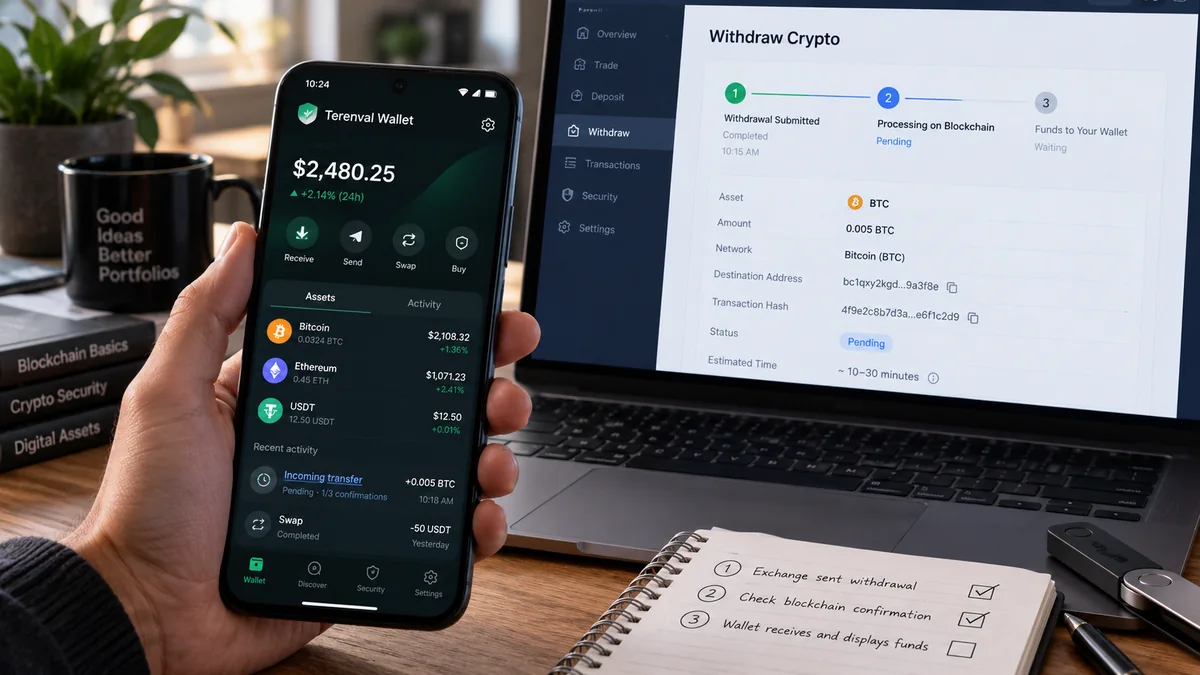
If a crypto withdrawal is stuck or pending, first determine whether the exchange has broadcast a transaction, whether the blockchain has confirmed it, and whether the receiving wallet or platform has recognized it. Those are three separate checkpoints. A pending withdrawal without an on-chain transaction ID (TXID) is usually a different problem from a confirmed blockchain transfer that has not appeared in an app. The safest response depends on which checkpoint failed—not on how alarming the word Pending looks.
A withdrawal can be delayed by internal exchange screening, a temporary network or wallet suspension, an unsigned or unbroadcast transaction, network congestion, inadequate transaction fees, confirmation requirements, receiving-platform accounting, an unsupported asset or network, or a display problem. Some of these are routine delays. Others require immediate action. Do not send a second transfer, disclose your seed phrase, pay a stranger to “unlock” coins, or select a different blockchain merely because the first request is taking longer than expected.
Short answer: Open the withdrawal record on the sending exchange. Record the asset, network, destination address, amount, withdrawal status, and any TXID. No TXID? Check the exchange's official status notices and contact its support if the delay exceeds its published guidance. TXID pending on-chain? Inspect the correct network's explorer and let the exchange or a capable transaction owner handle any fee replacement. TXID confirmed with the correct recipient? Check token transfers, the receiving platform's crediting rules, the selected wallet network, and any required memo/tag. If the exchange says Completed but there is no matching successful transfer, escalate with the full evidence—not assumptions.
Our editorial position is that a stuck withdrawal should be treated as a chain-of-custody diagnosis, not a race to find a magical transaction accelerator. The best next action follows the last event you can actually verify. Official guidance from Binance, Coinbase, and Kraken supports distinguishing platform processing, blockchain progress, and recipient crediting. This article combines those documented stages with our own practical troubleshooting framework.
Key Takeaways
- A withdrawal request is not the same as a blockchain transfer. The exchange may still be checking, approving, batching, or preparing it.
- A TXID is a critical evidence boundary, but not a guarantee of success. A transaction hash may identify a pending, failed, replaced, or confirmed transaction; inspect the actual status and asset movement.
- “Pending,” “Processing,” “On hold,” and “Completed” are not universal labels. Interpret them in the sending platform's documented workflow.
- If no on-chain transaction exists, you normally cannot accelerate it from the receiving wallet. The exchange controls its internal withdrawal queue.
- If a Bitcoin transaction is unconfirmed, fee-rate conditions and transaction policy matter. Replace-by-fee (RBF) and child-pays-for-parent (CPFP) have specific prerequisites; neither is a universal button for exchange withdrawals.
- For Ethereum-compatible chains, check the transaction's result and token-transfer records. A successful transaction to a token contract is not automatically evidence that the intended recipient received tokens.
- A confirmed transaction and an exchange credit are different events. The receiving custodian may require additional confirmations, a supported asset/network pair, or a valid memo.
- USDT and USDC are not tied to one blockchain. ERC-20, TRC-20 and other network representations must be checked separately; matching ticker symbols do not ensure compatibility.
- Wrong-network and wrong-address problems do not get fixed by waiting. They require an ownership and recovery assessment, and some transfers cannot be recovered.
- One evidence packet beats repeated generic support messages. Provide the correct TXID or withdrawal ID, network, asset, exact destination and timestamps, while keeping passwords and secret keys private.
- Fraud risk rises when users are anxious. Never pay “release fees” to an unsolicited recovery agent or sign an unfamiliar permit as part of withdrawal troubleshooting.
- Terenval Wallet is a self-custody option, not an exchange's withdrawal processor. Receiving funds to an address you control does not give the wallet control over a centralized exchange's internal queue.
The Three-Checkpoint Method: Find the Actual Point of Failure
We recommend investigating each withdrawal as three handoffs. The framework is an editorial diagnostic tool, not a feature or official terminology of any exchange.
| Checkpoint | Evidence you should have | What the evidence establishes | Who can usually investigate next |
|---|---|---|---|
| A. Exchange processing | Withdrawal record, request ID, approval/security status, possible hold notice | The exchange received the instruction, but may not have sent anything on-chain | Sending exchange |
| B. Blockchain settlement | Network-specific TXID and explorer result | Whether a transaction was broadcast, included, successful, replaced, or still waiting | Sending exchange or transaction signer for fee issues; network observers for verification |
| C. Recipient recognition | Correct chain, output/token event, receiving address, required confirmations, deposit or wallet balance | Whether the intended receiver can show or credit the transferred asset | Receiving exchange for custodial deposits; wallet-side checks for self-custody |
The rule: do not troubleshoot Checkpoint C until you have evidence for Checkpoint B, and do not assume B exists merely because Checkpoint A displays a green status. Conversely, do not keep asking the sending exchange to “rebroadcast” a transaction after you have independently verified that the correct asset was settled on-chain to the correct destination. Escalate to the recipient in that case.
Why this framework matters
A transaction can be correct at one checkpoint yet incomplete at the next. For example, an exchange may legitimately label an outgoing transfer Completed when it has fulfilled its own sending obligation. The recipient can still wait for confirmations or fail to match a deposit because of a missing memo or unsupported network. The two parties are describing different records. An app balance is a view of data; it is not the sole record of the blockchain transfer.
The first five facts to collect
Before taking any action, write down the exact asset, blockchain network, destination address, platform status and on-chain TXID (if issued). Add the amount, timestamp in UTC or a stated time zone, confirmation count, and memo/tag when applicable. Do not share a full screenshot that unnecessarily exposes personal information or account identifiers in public forums.
A 60-Second Decision Tree for a Stuck Crypto Withdrawal
| What you see | Most useful next check | Do not do this |
|---|---|---|
| Pending/Processing; no TXID | Sending exchange's withdrawal history, notifications, maintenance/status page, official support | Pay an alleged blockchain miner to process a transfer that has not been broadcast |
| On hold/Under review | Security, identity, compliance or withdrawal-protection messages; official support ticket | Follow unsolicited links in email or social media to bypass checks |
| TXID exists; explorer says Pending/Unconfirmed | Correct chain, fee situation, age, replacements, and exchange support | Send the same amount again just because confirmations are slow |
| TXID exists; explorer says Failed/Reverted | Whether the intended asset transfer actually occurred; notify the sender/exchange | Assume the recipient has the funds because a hash exists |
| TXID confirmed; different address/network/token | Stop, document the exact mismatch, assess who controls the destination | Try random bridges, imports or “recovery contracts” |
| TXID confirmed; correct recipient is another exchange | Confirmation rules, memo/tag, supported asset and network, deposit status | Assume on-chain settlement guarantees an immediate custodial credit |
| TXID confirmed; correct recipient is your wallet | Selected network, verified token contract, token-transfer event and current address | Enter a seed phrase on a web “asset finder” |
| Exchange says Completed; explorer has no matching transfer | Verify the hash and selected chain; request a correct TXID/proof of execution | Treat an internal reference number as definitive on-chain proof |
This table is deliberately ordered to prevent destructive actions. Observation comes before intervention. An unwanted replacement transfer may confirm in addition to the original if the two transactions are distinct; a bad recovery transaction can turn a display issue into real loss.
What Does “Withdrawal Pending” Mean on a Crypto Exchange?
Pending is an interface status, not an Ethereum or Bitcoin consensus state. It may mean the request has been accepted but has not passed internal checks, has entered a payment processor, has been broadcast but not confirmed, or is visible to a receiving institution that has not credited it. Each exchange defines its own status transitions.
For instance, the Kraken withdrawal-status documentation distinguishes Initiated, Pending, Sending, Success, On hold, and Failed in the referenced interface. In that documentation, Sending indicates broadcast and waiting for blockchain confirmation, whereas On hold calls for staff review. Its cancellation options depend on the stage, and a request to cancel is not necessarily successful. Other Kraken interfaces may differ.
Binance's withdrawal help directs users to inspect the withdrawal history and TXID, distinguishing Processing from Completed. Coinbase's send/receive troubleshooting separately advises looking at pending or completed status and opening the block explorer. Use the definitions provided by the service where you initiated the transfer, not a generic label list from another exchange.
Common exchange statuses and their limits
| Label you might encounter | Possible meaning | What the label alone does not prove |
|---|---|---|
| Initiated / Submitted | Instruction recorded | That a transaction has been signed or broadcast |
| Pending / Processing | Waiting in one of several processing stages | That the delay is caused by blockchain congestion |
| Awaiting approval / Under review | Security or operational action pending | That you can solve it by changing gas settings |
| Sending / Broadcasting | Exchange attempting or reporting blockchain transmission | That transaction has already been confirmed |
| Completed / Success | Platform considers its defined stage complete | That every receiving app or exchange has credited the funds |
| Failed / Rejected / Canceled | Request or operation did not complete as intended | That every associated fee or balance hold has already been reversed |
Important: these are descriptive possibilities, not a claim that every exchange supports all labels. Always check the exact withdrawal record and the platform's current definitions.
Step 1: Inspect the Sending Exchange Before You Touch Your Wallet
Sign in by navigating directly to the exchange's official website or application—not a link from a stranger. Open withdrawal history, select the exact asset and transaction, and review its details. Common clues include a security-hold notice, required identity step, network maintenance announcement, and whether a TXID is available.
Check whether the exchange account shows a reversible pending request or whether the withdrawal is already executed. A cancel option, if shown, should be used only when you understand its stage-specific limitations. Do not submit a second transfer until you have confirmed what happened to the first.
Why can an exchange delay a transfer before broadcast?
A centralized platform may perform anti-fraud, account-security and compliance reviews; it may apply withdrawal address restrictions, waits after certain account changes, technical wallet maintenance, hot-wallet liquidity management, or planned blockchain network upgrades. Binance documents temporary withdrawal suspension and maintenance-related causes. These are operational possibilities, not evidence that any specific user's request is under investigation.
What if the exchange shows no TXID?
A missing TXID is a strong reason to start with the sender's support rather than a block-explorer “rescue.” In some systems a hash is assigned before a transaction confirms; in others the interface may lag or show an internal reference instead. No visible hash does not prove nothing was broadcast, but it does mean you lack sufficient public proof. Ask support whether the transaction was broadcast, on which network, and for its actual hash. Provide the withdrawal request ID.
Binance's withdrawal FAQ includes its own escalation guidance for transactions with no TXID after a stated period. Treat such times as platform-specific and changeable, never a universal rule across Binance, Coinbase, Kraken or regional services.
Step 2: Check the TXID on the Correct Blockchain Explorer
Once you have a TXID, open the explorer for the network actually used by the sender. Do not search a TRON transfer on Ethereum or an Arbitrum transfer on Base just because all of them may carry USDT or use superficially familiar addresses. Follow the exchange's explorer link when it is available, then independently check the URL and network name.
On an appropriate explorer, inspect the status, block number or confirmation information, originating address, recipient, asset transfer events, contract address, timestamp and amount. Ethereum.org's block-explorer guide explains how the chain's transaction details can be inspected. Binance's transaction-status guide illustrates why a successful, failed, or replaced transaction requires a different next step.
A transaction hash is not an exchange withdrawal ID
An exchange withdrawal ID identifies a record in the platform's internal system. A blockchain TXID/hash identifies a transaction in a blockchain context. The two are not interchangeable. A reference code that cannot be found on the appropriate explorer may be an internal ID, a replaced hash, a hash that is not propagated to that explorer, or a sign of an incorrect network selection.
Why a green “Success” may still mislead
For a direct native-coin transfer, the transaction's destination and value are often straightforward. For ERC-20 tokens, the transaction's To field may point to a token contract, while the token-transfer event names the actual token recipient and amount. A successful interaction with a contract does not, by itself, prove the intended token reached the expected address. Confirm the transfer logs or the current token balance on the correct chain.
Likewise, not all assets represented as “USD Coin” or “Tether” are the same token contract. Verify issuer or exchange-supported contract identifiers from official sources. A ticker and icon are insufficient evidence of the asset's identity.
Step 3: Distinguish an Unconfirmed Transaction from a Failed One
An unconfirmed transaction may be waiting in a mempool or pending-transaction pool for inclusion; visibility varies between explorers, networks and nodes. An included but failed/reverted EVM transaction has been processed, may have consumed gas, and generally did not deliver the intended contract-state change. A replaced transaction has a different hash, and the original hash may never be mined. A confirmed success means a chain recorded the operation—but the recipient or asset still needs inspection.
Ethereum's transaction lifecycle separates submission, transaction pools, inclusion and subsequent finality. It also explains how the nonce orders transactions for an externally owned account. Some networks and rollups expose additional notions of inclusion, settlement or finality; do not treat an explorer's simple Success label as an identical guarantee across every network.
If the explorer says “Failed”
Identify the asset transfer that actually occurred, if any. On an EVM chain, a reverted token transfer usually has not moved the tokens as intended, although network fees may have been paid; contract-level outcomes and transaction traces can be more complex. If a centralized exchange initiated the operation, the exchange is the first place to request reconciliation or a new withdrawal attempt. Do not assume the receiving wallet can reverse or reimburse a failed sender-side transfer.
If the explorer says “Dropped,” “Replaced” or “Not found”
Check whether the original transaction was replaced and whether the exchange provides a new hash. “Not found” on one explorer can also reflect a wrong network, indexing delay, failure to propagate, or an internal ID mistaken for a TXID. Search the sending address's recent transactions on the correct network if you are comfortable doing so, or ask the exchange to confirm the new transaction hash. Do not infer that the coins returned or that another transfer is safe to send solely because one explorer cannot find a hash.
Step 4: What to Do If the Blockchain Transaction Is Confirmed but Funds Are Missing
At this point, the question changes. You are not primarily asking “Why has the exchange not sent it?” You are asking “Did the intended receiving address obtain the intended asset on the intended network, and why is the receiving interface not showing or crediting it?” These are different investigations.
Case A: The destination is your self-custody wallet
First match the exact receiving address to the address you control. Then verify the correct network and the actual asset contract or native coin in an independent explorer. If the asset appears on-chain, inspect whether the wallet is displaying that chain, whether a token must be added, whether an address or account is different from the one being viewed, and whether the application's indexer is behind. MetaMask's missing-balance guidance provides a similar distinction between explorer evidence and interface display.
A missing visible balance is not automatically lost crypto. But switching network views or importing a verified token only changes what the wallet displays. It does not bridge assets, move coins to another chain or cure an address ownership error. Never type your seed phrase into an explorer, suspicious website or “wallet synchronization” form.
Case B: The destination is another centralized exchange
The receiving exchange may require a specific number of confirmations and may credit deposits only for selected asset/network pairs. A memo, tag or payment identifier may be necessary on some deposit routes. Even a fully confirmed transfer can remain uncategorized or uncredited if a deposit policy was not satisfied. Contact the receiving exchange with the TXID, chain, amount, destination and memo if applicable. Kraken's deposit-status documentation distinguishes confirming, credited, successful and held deposit states; requirements depend on the asset.
Case C: The explorer shows a different destination
Stop. Do not try to “pull back” the transfer with gas or a wallet setting. Confirm whether the discrepancy comes from an exchange using an intermediate payout contract, an unsupported token, an accidental address paste, address poisoning, or a truly wrong recipient. The actual destination might be visible inside token transfer events rather than in the transaction-level To field. If the funds really reached an address you do not control, a blockchain explorer cannot give you its private key or cancel the payment. Recovery may depend on the recipient's cooperation or be impossible.
Why a Bitcoin Withdrawal Can Remain Unconfirmed
Bitcoin does not use a central account balance that the exchange can simply edit after it broadcasts a withdrawal. A published Bitcoin transaction spends previous unspent transaction outputs (UTXOs), creates new outputs and offers a fee. Miners choose which valid transactions to include, subject to their block construction policies. An unconfirmed transaction may be competing with other transactions for limited block space.
Two variables matter most for an ordinary fee-related delay: the transaction's effective fee rate, typically expressed in satoshis per virtual byte (sat/vB), and current block-space demand. The amount of BTC being transferred is not itself the fee rate. A transaction using many small UTXOs can be larger than one using a single UTXO for a similar payment. For background, see our guide to Bitcoin UTXOs and fees.
Can you speed up a Bitcoin withdrawal from an exchange?
Not necessarily. The exchange usually controls the private keys and constructs or signs its own withdrawal transactions. If its interface does not provide a fee-bump feature, your personal receiving wallet generally cannot replace the exchange's transaction. Contact the sending exchange with the original TXID and ask whether it supports a fee-bump or transaction replacement. Never pay a third-party site merely because it advertises a “miner priority queue.”
Replace-by-fee (RBF): helpful, but not a universal solution
Under replace-by-fee policies, an unconfirmed Bitcoin transaction can sometimes be replaced by another transaction spending overlapping inputs and paying a higher fee subject to node-policy rules. This is commonly initiated by a wallet that can construct and sign the replacement. The recipient's possession of an address does not give it authority to rewrite a custodial sender's inputs. Whether a given transaction can be replaced depends on the participating software and network-policy conditions, not simply on a checkbox labelled RBF.
Child-pays-for-parent (CPFP): when an output can be spent
Child-pays-for-parent allows an eligible unconfirmed output to be spent by a new transaction offering a fee high enough to incentivize miners to include the parent and child. This requires control of a usable output, wallet support, sufficient value and compatible relay/mining conditions. For a deposit to a self-custody wallet, it may be technically possible in some cases. It is not a guarantee, and it may be inappropriate or unavailable for a deposit to a centralized exchange that controls the receiving address. CPFP also cannot repair a pre-broadcast exchange hold, because no on-chain parent exists to spend.
Worked example: why “just pay a bigger fee” may not be actionable
Hypothetical teaching example—not live network data: a BTC withdrawal has a TXID, remains unconfirmed, and was broadcast by Exchange A at a low fee rate. The recipient controls its destination address but not Exchange A's spending keys. The recipient cannot simply increase the fee on the original transaction from a standard receive screen. The practical order is (1) verify the transaction is genuinely unconfirmed, (2) check whether it was replaced, (3) ask Exchange A about its fee-management policy, and (4) only evaluate a qualified CPFP path if the receiving wallet actually controls an eligible unconfirmed output and supports the operation. This sequence may prevent fees paid to a fake accelerator or accidental double payment.
Ethereum, Base, Arbitrum and Other EVM Networks: Pending Is Not Always “Low Gas”
Ethereum-style transactions have a nonce and fee fields. A transaction submitted with an insufficient competitive fee can remain pending; earlier unconfirmed transactions from the same signing account may affect later transaction processing. Ethereum.org explains nonce and transaction lifecycle mechanics. Some exchanges have internal batching, gas estimation and broadcasting policies that you cannot alter as a withdrawal recipient.
If you are the self-custodial sender and your wallet provides a supported Speed up or Cancel feature, a replacement transaction with the same nonce and appropriate higher fee settings may be possible before confirmation. MetaMask documents supported pending-transaction operations. However, a user withdrawing from Binance, Coinbase or another custodian typically does not control the originating exchange address or its nonce. Do not follow a self-custody guide's custom-nonce steps for an exchange-owned address.
Can you cancel a pending Ethereum withdrawal?
There is no universal “undo” operation. An exchange may allow cancellation before broadcast; after the transaction has been accepted on-chain, cancellation usually requires an eligible replacement by whoever controls the sender, and success is not guaranteed. A confirmed transaction cannot be reversed through a wallet button. If an interface shows a cancel action, read its stage-specific conditions first.
L2 and rollup nuance: different clocks
On Ethereum rollups such as Base or Arbitrum, a transfer can have different stages of L2 execution, L1 data posting or settlement/finality, depending on the system and transaction route. For an ordinary exchange withdrawal delivered to an L2 address, start with the actual L2 transaction and receiving address; do not wait for an irrelevant L1 bridge-withdrawal window unless you actually initiated a cross-chain withdrawal requiring that process. The word “final” may describe different events in an exchange interface, rollup explorer and protocol specification.
USDT or USDC Withdrawal Pending: Identify the Network Before the Token
USDT and USDC may be offered on multiple blockchains. Exchanges sometimes present options such as Ethereum (ERC-20), TRON (TRC-20), BNB Smart Chain, Base, Arbitrum or other supported networks; availability differs by platform and region. A balance labelled USDT does not specify the network. Neither does USDC necessarily identify a single token contract or issuer-backed representation across chains.
| Withdrawal route | What to verify in the exchange | What to inspect on-chain | Common false assumption |
|---|---|---|---|
| USDT on Ethereum (ERC-20) | Ethereum network selected; correct receiving address | Ethereum transaction and relevant token transfer | “My wallet can display USDT, so every USDT network works” |
| USDT on TRON (TRC-20) | TRON network supported by recipient | TRON transaction result and TRC-20 transfer | “TRC-20 and ERC-20 are just two names for the same route” |
| USDT on BNB Smart Chain | BSC selected; contract and recipient compatible | BSC explorer and token transfer | “The 0x address means Ethereum Mainnet was used” |
| USDC on Base or Arbitrum | Exact L2 network; expected USDC contract/variant | Corresponding L2 explorer, token transfer and balance | “Every token with ticker USDC is automatically interchangeable” |
| USDT/USDC to another exchange | Supported asset/network combination and any deposit requirements | Correct chain plus recipient's published crediting rules | “One confirmation guarantees an instant credit everywhere” |
For a confirmed EVM stablecoin transfer, read the token transfer record rather than focusing only on the outer transaction address. For TRON, read both the transaction's execution result and its token-transfer information; a chain transaction can be included yet a contract execution may fail. Binance's cross-chain transaction-check guide explicitly distinguishes confirmation status from execution result in its network examples.
What if an exchange offers a cheaper network?
A lower advertised withdrawal fee is not a recovery strategy. Choose a route only after verifying that the exact receiving platform supports the asset on that specific chain, and that you control the right receiving account. The cheapest offered network can be the most expensive mistake if it sends funds where the intended recipient cannot credit them. For more, read How to Choose the Correct Network When Withdrawing Crypto from an Exchange.
Memo, Destination Tag and Payment ID: A Confirmed Deposit May Still Be Uncredited
Some deposit systems use a shared blockchain receiving address plus an account-specific identifier. Examples may include a memo, destination tag or payment ID, depending on the asset and receiving platform. The identifier allows a custodian to attribute an incoming transaction to the correct customer. A valid blockchain transfer to the custodian's address is not proof that the custodian can automatically identify your account without the required memo.
If a memo or tag was omitted or entered incorrectly, do not make a second identical transfer “with the right memo” before the first is investigated. Open a ticket with the receiving service and provide the correct on-chain reference, amount, address, sending platform, asset and information about the required identifier. Whether recovery is offered, how long it takes and whether a fee applies are entirely recipient-specific.
Memo is not the same as a network
A wrong network changes where the asset exists. A missing memo may leave the asset on the correct chain and at a custodian-controlled address but not assigned to an internal account. These problems need different evidence and have different recovery possibilities. Our wrong-network recovery guide explains why access to a destination's signing key matters.
Why a Crypto Exchange May Hold a Withdrawal for Security
A legitimate withdrawal might be delayed because the exchange is protecting an account after unusual activity, a password or security-setting change, a new device, a newly approved destination, verification requests, risk checks or a temporary systems issue. It can also impose restrictions related to the user's jurisdiction or account status. None of these reasons can be conclusively diagnosed from a generic Pending label.
If a notice says On hold, use the exchange's existing authenticated support channel. Do not provide a seed phrase, remote-desktop access, 2FA codes or complete credential set. Your recovery phrase is for control of your own non-custodial wallet—it is never a sensible way for an exchange to verify ownership of its custodial withdrawal transaction.
A hold is not a blockchain fee problem
An operational hold exists before the network can process the withdrawal or inside the exchange's own workflow. Paying a higher Bitcoin miner fee cannot make a compliance review finish sooner. Likewise, sending ETH for “gas” to an unrelated address does not authorize the exchange to release a withdrawal. If support requests a legitimate, documented fee or account procedure, verify it inside the platform's authenticated interface and published terms rather than through a third-party message.
Who Should You Contact? A Responsibility Matrix
| Verified situation | First accountable party | Supporting evidence | What to ask for |
|---|---|---|---|
| Withdrawal pending and no on-chain proof | Sending exchange | Withdrawal ID, status, timestamp, asset/network | “Was this broadcast? What is the transaction hash or hold reason?” |
| Broadcast TXID unconfirmed | Sending exchange if custodial signer | TXID, selected chain, explorer link, elapsed time | “Can you confirm a replacement or supported fee bump?” |
| Confirmed transfer to your own address, no wallet display | Wallet-side diagnosis, then wallet provider if needed | Address, correct explorer, token contract, transfer log | “Is this chain/token supported and why is it not displayed?” |
| Confirmed transfer to another exchange; missing credit | Receiving exchange | Successful transfer, deposit address, memo, confirmations | “Can you locate and reconcile this deposit?” |
| Wrong supported network or incorrect destination | Recipient/controller, where identifiable | Exact chain/contract/recipient | “Do you control this address and offer an official recovery process?” |
| Failed transaction signed by sending exchange | Sending exchange | Reverted/failed result and withdrawal record | “When will your internal withdrawal state be reconciled?” |
| Suspicious phishing or stolen credentials | Exchange security team and secure account process | Dates, suspicious contacts, withdrawal details | “Please secure my account and review unauthorized instructions.” |
Do not send every issue to every party at once. A precise ticket to the party that controls the missing step is usually more actionable than repeated accusations that “the blockchain lost my coins.” That is our operational recommendation, not a guarantee about support response times.
The Terenval Withdrawal Evidence Packet: Copy This Before Opening a Ticket
This is our own minimal-evidence template designed to reduce avoidable back-and-forth. It includes identifiers a support agent can use without collecting secrets. Fill only the items relevant to your issue.
| Evidence field | Example of what to write (illustrative only) |
|---|---|
| Sending platform | “Exchange A, spot account” |
| Withdrawal request / order ID | “The ID shown in my withdrawal history” |
| Asset and exact network | “USDT via Ethereum ERC-20” |
| Requested amount and network fee | “As shown in the withdrawal record; no estimates” |
| Destination public address | “The address pasted into the request, verified separately” |
| TXID and explorer link | “Exact hash or ‘not issued’—never invent a hash” |
| Current platform status | “Processing / Completed / On hold / Failed” |
| Current blockchain status | “Not found / Unconfirmed / Confirmed success / Failed” |
| Block number / confirmations | “As shown by the correct network explorer” |
| Memo/tag if required | “Entered / missing / different from deposit instructions” |
| Times and elapsed interval | “Withdrawal requested at [time zone]; most recent check at [time zone]” |
| Recipient-side observation | “Self-custody wallet balance missing / recipient exchange deposit not credited” |
| Steps already taken | “Checked official status, explorer and deposit instructions; no repeat transfer” |
A concise message to exchange support
Hello. I initiated a withdrawal of [asset] using [network] on [date and time with time zone]. Withdrawal ID: [ID]. My account currently shows [exact status]. The transaction hash is [TXID or ‘not provided’]; the matching explorer reports [status, confirmations, result]. The intended destination is [public address] and the receiving side reports [exact observation]. Please confirm whether the transaction was broadcast, whether any review or network maintenance is blocking it, and which next action you recommend. I can provide a redacted screenshot through the official support channel.
This template is meant to be edited, not pasted with placeholders. Never send private keys, seed words, passwords, device backup codes or secret API credentials. A verified support agent does not need them to read public blockchain evidence.
Our “Confidence Ladder”: What Each Piece of Evidence Actually Proves
We recommend ranking observations by what they can and cannot establish, rather than treating every screenshot as equally reliable.
| Evidence | Strength for diagnosing transfer stage | Limitation |
|---|---|---|
| Email “Your withdrawal was requested” | Indicates a request or notification occurred | Does not establish broadcast or successful settlement |
| Exchange history displays “Completed” | Strong for the exchange's own workflow | Definition depends on exchange and may not establish recipient credit |
| Verifiable TXID on correct network, unconfirmed | Strong evidence of a known broadcast transaction | Not proof of eventual inclusion or final delivery |
| Confirmed successful transaction and matching native/token transfer | Strong evidence of blockchain movement to the observed address | May not prove deposit-account allocation or that intended user controls destination |
| Correct asset visible in recipient exchange ledger | Strong evidence of custodial account credit | Different from self-custody control; withdrawal eligibility may have other rules |
| Current correct-chain address balance in an independent explorer | Strong evidence of on-chain asset state | Does not prove your wallet imported the correct keys or that a token is safe/valuable |
Editorial inference: this hierarchy can prevent two common mistakes: blaming blockchain congestion when the exchange has never broadcast, and blaming the sender when the recipient has already received a successful on-chain transfer but has not credited its internal balance. It is a troubleshooting method, not a third-party guarantee or an audit of any exchange.
How Long Should You Wait Before Escalating?
There is no honest one-size-fits-all timeout for crypto withdrawals. Time depends on the exchange, asset, chain, confirmation policy, service condition and individual account controls. A “normal” duration for a supported network is not proof that your particular transaction is safe or unsafe.
Use a stage-based escalation rule, not a fake universal clock:
- Before broadcast: compare elapsed time with the sending exchange's current documented SLA or withdrawal notice. If the account is explicitly on hold, follow the official review route instead of waiting for blockchain confirmations.
- Pending on-chain: check the chain's current state, whether the transaction remains visible, whether it was replaced, and whether the custodian can intervene. Do not mistake time spent since your exchange request for time spent in the mempool.
- Confirmed but uncredited: compare confirmed block count and network/asset requirements with the recipient's deposit policy. Escalate to the receiving service if its criteria appear satisfied or the deposit requires manual identification.
- Potential compromise, wrong destination or unsupported asset: act promptly to secure access and preserve evidence; don't delay merely to pass an arbitrary timer.
For context only, Coinbase's current troubleshooting provides its own initial waiting recommendation and tells users where to check confirmations. Binance provides a separate support threshold for absent TXIDs. Neither should be generalized into “all Bitcoin withdrawals take X minutes.”
Seven Worked Withdrawal Cases: Same Symptom, Different Answer
The following scenarios are constructed educational examples, not measured Terenval transactions, exchange incidents or published empirical case studies. They show why root-cause classification matters more than a payment's face value.
Case 1: USDT withdrawal displays Processing, with no TXID
A user requests USDT from a centralized exchange to a known address. Thirty minutes later the exchange shows Processing and no on-chain reference. Correct diagnosis: the request is at least not verifiably broadcast. Read the sending platform's notices, verify the selected network, avoid a duplicate request and ask support for a hash or reason once its guidance says to escalate. Changing token visibility in a receiving wallet cannot progress the exchange's internal queue.
Case 2: BTC withdrawal has TXID, but zero confirmations
The Bitcoin explorer shows the TXID is unconfirmed. The recipient wants to “send a few more satoshis to the exchange.” Correct diagnosis: investigate the existing transaction, fee market and transaction-replacement support. A separate payment to a stranger is not an RBF replacement. If the exchange signed the original, the recipient normally cannot sign its replacement. CPFP is an advanced conditional option only when an appropriate output is controlled and the wallet supports it.
Case 3: ETH withdrawal is successful, but the wallet shows no ETH
The explorer confirms the transfer, but the address displayed in the wallet differs from the withdrawal destination by one or more characters. Correct diagnosis: ownership/address mismatch. Refreshing the interface or importing a token cannot turn one address into another. Preserve evidence and contact the relevant receiving party if it controls the destination; otherwise recovery may be impossible.
Case 4: USDC sent to Base, but the user is looking on Ethereum Mainnet
The appropriate Base explorer shows a successful matching token transfer. The user views only Ethereum Mainnet in a wallet app. Correct diagnosis: network display mismatch, assuming the recipient controls the same corresponding address and the correct token. Configure the supported chain and asset display using official wallet guidance; no additional bridge should be initiated just to make a transfer “appear.” If the intended recipient is an exchange that does not support Base deposits for that asset, the situation is materially different.
Case 5: XRP or another memo-based asset reaches a deposit address, but the exchange credits nothing
The correct chain confirms movement to a deposit address controlled by the receiving exchange, but the required destination tag is missing. Correct diagnosis: internal deposit attribution problem. The recipient controls the account-mapping process; contact that exchange through its official support channel with the TXID and missing-tag details. There is no blockchain refund button.
Case 6: On-chain token transaction failed while the exchange UI still says Pending
The explorer records a reverted contract execution and no intended transfer to the receiver. Correct diagnosis: sending-platform reconciliation is needed. The wallet did not receive the missing token. Ask the sending exchange to resolve the internal withdrawal state and explain whether or when a corrected attempt is possible. Do not blindly resubmit your withdrawal.
Case 7: “Support” DMs offer instant release for a fee
An account claiming to be a Binance or Coinbase employee sends a link to an unlock page and requests wallet recovery words or a “gas deposit.” Correct diagnosis: possible phishing/social-engineering attempt. Close the conversation, use an independently opened official help center and secure the account. A support scam can cause a real loss even when the original withdrawal was merely slow.
When a Withdrawn Asset Appears Missing in Terenval Wallet
For a user withdrawing to Terenval Wallet, first confirm that the specific asset and blockchain network are supported in the installed product version and that the receiving address belongs to the intended account. Compare the exact public address and relevant chain on an independent explorer. Then check whether the app is displaying the correct network and recognized asset.
Self-custody changes who controls signing keys; it does not eliminate exchange-side processing. Terenval cannot force a centralized sender to sign an unbroadcast transaction, bypass its compliance hold, guarantee a particular confirmation time or recover a transfer to an address the user does not control. Avoid assuming a particular token-import, custom-RPC, Bitcoin coin-control, fee-bump or recovery feature exists without checking the current interface and official documentation.
A practical self-custody receiving checklist
- Verify the actual chain and asset supported before requesting withdrawal.
- Copy the destination address from the intended wallet account, and independently compare it when pasted into the exchange.
- For higher-value transfers, consider a small test withdrawal if the expected costs and platform rules make one practical.
- Save the withdrawal ID and TXID in a private record; public addresses and hashes can be shared with verified support where relevant, but seed phrases cannot.
- If the explorer confirms the correct transfer, inspect wallet display and network selection before attempting any new transaction.
- If the wallet uses a recovery phrase, preserve it offline; no legitimate balance-display fix requires entering it into an unfamiliar website.
Our preference is to teach a user how to verify settlement independently rather than present any wallet as a magical recovery service. That is more protective and more useful long after a particular exchange interface changes.
Common Mistakes That Turn a Delay into a Loss
| Mistake | Why it is dangerous | Safer alternative |
|---|---|---|
| Sending the same withdrawal again without investigating | Both transfers may eventually complete | Resolve the first request's actual state first |
| Switching networks in the exchange just to avoid a queue | May send assets on an unsupported chain | Confirm destination support before changing anything |
| Paying a “recovery agent” via a DM | Often a scam or irrelevant to the transaction | Use official sender/recipient support and public chain evidence |
| Entering recovery words into a TXID checker | Exposes full signing control over the wallet | Use explorers that require only public hashes/addresses |
Treating an Ethereum To contract address as the token recipient |
Misreads token-transfer mechanics | Inspect token events and actual recipient balances |
| Believing one missing explorer entry proves a transfer was canceled | Wrong chain, replacement or indexing issues can mislead | Verify network, internal ID vs TXID, and replacements |
| Treating a green exchange status as guaranteed recipient credit | Internal accounting and confirmation policies can differ | Trace all three checkpoints |
| Using RBF instructions on an exchange-owned sender address | The customer does not hold the original signing keys | Ask the custodian about supported replacement procedures |
| Publicly posting unredacted support screenshots | May reveal sensitive profile, security or transaction context | Share a minimum evidence set privately through verified channels |
Frequently Asked Questions
1. Why is my crypto exchange withdrawal still pending?
The exchange may be processing internal checks, preparing a broadcast, waiting for blockchain confirmations, or reconciling a receiving-system issue. First look for a TXID. Without verified on-chain evidence, do not assume congestion is the cause. Check the sending exchange's current withdrawal record and notices.
2. How do I know whether my withdrawal was actually sent?
Look for an authentic blockchain transaction hash in the sending exchange's withdrawal details, then open it on the correct network's explorer. Confirm the status, transfer type and recipient. A withdrawal reference number or success email alone is not proof of broadcast and settlement.
3. What if my exchange withdrawal has no TXID?
Check your withdrawal history, notifications and official status page. If the delay exceeds your exchange's own published guidance, ask support whether the transfer was broadcast and request the correct network and TXID. You cannot usually fee-bump an unbroadcast custodial request from a receiving wallet.
4. Can a pending crypto withdrawal be canceled?
Possibly before broadcast, depending on the platform and status. Once a transaction is on-chain, a reversal is not guaranteed and generally requires specific sender-side capabilities while it remains unconfirmed. A confirmed successful transfer cannot normally be canceled. See the sending platform's actual cancellation rules.
5. Is a pending withdrawal the same as an unconfirmed transaction?
No. A pending withdrawal is a platform status; an unconfirmed transaction is a blockchain state. A platform may show Pending before it broadcasts anything, or while a broadcast transaction is awaiting confirmation. Distinguish the two with a genuine TXID.
6. Why does Binance show Processing for my withdrawal?
In Binance's documented workflow, Processing indicates that the withdrawal has not yet reached its defined completed stage. Review the exact withdrawal, selected chain, security notices and whether a TXID exists. Follow Binance's withdrawal guidance, not an unrelated service's interpretation of the label.
7. What if Binance says Completed but the crypto is not in my wallet?
Open Binance's TXID in the correct explorer. Verify successful asset transfer, actual destination and network. If the on-chain transaction is correct, inspect the wallet's supported chain, selected account and token visibility. If sending to another exchange, check its deposit requirements and contact its support.
8. Why is my Coinbase crypto send pending?
Coinbase documents several possible reasons, including network synchronization issues and insufficient confirmations. Open the transaction in Coinbase, use its explorer link, and review the current Coinbase troubleshooting guidance. Do not interpret every pending send as a fault that you can repair by transmitting more crypto.
9. What does Kraken “On hold” mean?
Kraken's withdrawal-status explanation describes On hold as requiring a manual review by its support staff in the referenced interface. Use an authenticated Kraken support channel. The status does not, by itself, mean that a miner fee is too low.
10. How long can a Bitcoin withdrawal remain unconfirmed?
There is no guaranteed confirmation deadline. Fee rate, transaction policy, network demand, propagation and potential replacement can affect its progress. Check the real TXID and fee conditions. The estimated interval between Bitcoin blocks is not a promise that a particular transaction will be included in the next one.
11. Can I speed up a pending Bitcoin exchange withdrawal?
Sometimes the sending exchange can replace or manage its own transaction. A recipient generally cannot sign a replacement for an exchange-owned input. CPFP may be possible in specific circumstances when you control an appropriate unconfirmed output and a capable wallet supports it, but it is neither universal nor guaranteed.
12. Does paying more gas fix a withdrawal that has no TXID?
No. Gas or miner fees are blockchain execution/inclusion costs. If the exchange has not broadcast the withdrawal, sending an unrelated gas payment will not make its internal queue process faster. Confirm the actual transaction state before considering any fee-related remedy.
13. What does “zero confirmations” mean?
It commonly means the transaction has not yet been included in a block recognized by the source being consulted. Some explorers show an unconfirmed transaction immediately; others may lag or not see it. Zero confirmations alone does not determine whether the transaction is invalid, canceled or permanently lost.
14. Can an exchange withdrawal be pending because of KYC or security checks?
Yes, platform-specific identity, account-security or compliance requirements can delay withdrawals. The exchange's authenticated notices should establish whether such a requirement applies to your account. Never upload documents to an unsolicited “recovery” portal or send a recovery phrase to anyone claiming to be compliance staff.
15. What if a blockchain explorer says “transaction not found”?
First check that you have a true blockchain hash, rather than an exchange order reference, and are using the correct chain. Then consider an indexing delay, non-propagation, or a replaced transaction. Ask the sending exchange for an updated TXID if necessary. Do not conclude that it is safe to repeat the payment just from a single failed explorer lookup.
16. What if the transaction is confirmed but I have not received USDT?
Verify whether the sender used Ethereum, TRON, BSC or another chain; check the exact token-transfer record and destination. For a self-custody wallet, confirm network support and asset visibility. For a receiving exchange, check that it credits that specific asset/network pair and required memo/tag, if any.
17. What if USDC is on Base but my wallet shows Ethereum?
Assets on Base are on Base, not Ethereum Mainnet, even if both interfaces look similar. Verify the transaction and correct token contract on Base, confirm that the target wallet account controls the destination and that the wallet supports displaying Base assets. Switching networks does not move or bridge any funds.
18. Why can a confirmed ERC-20 transaction show the token contract as “To”?
A token transfer usually invokes a smart contract. The transaction-level To field can therefore be the token contract, while the intended recipient is recorded in token-transfer events. Check the token-transfer event and relevant address balance before deciding whether the actual beneficiary was wrong.
19. Does “Success” on Etherscan mean my receiving exchange must credit the deposit?
No. It means the chain recorded a successful transaction execution under that network's rules. The receiving exchange may still need the correct token transfer, supported network, memo and confirmation threshold. If all receiving conditions are met but no credit appears, open a recipient-side support ticket with the hash and deposit details.
20. Can the sending exchange reverse crypto after network confirmation?
A normal successful blockchain transfer generally cannot be reversed unilaterally by the exchange. If the recipient or another party controls the destination, a new cooperative return transfer may be possible; if nobody can authorize that return, recovery may not be possible. Internal credits, reimbursements and customer-service policies are separate matters.
21. Is a missing memo or destination tag the same as sending to the wrong address?
No. A payment may have reached the correct custodial receiving address but lack the information needed to associate it with your exchange account. The receiving custodian is the appropriate recovery contact. Whether it can identify and credit the deposit is service-specific, and no guarantee is appropriate.
22. How many confirmations do exchanges require?
Requirements depend on the asset, blockchain and receiving platform and may change. Some platforms have multiple crediting stages. Check the recipient's current deposit policy rather than relying on a fixed number from a third-party blog or a different asset.
23. Does a withdrawal “Completed” status guarantee the correct network was used?
No. It reports completion according to the sender's workflow. You must independently verify the actual blockchain, destination and asset. An outgoing transfer may have completed on one network while the recipient expected a different one. A correct ticker and successful send do not make networks interchangeable.
24. Can a wallet app fix an exchange withdrawal that is awaiting approval?
Not generally. The sending exchange controls its own approval queue and custodial signing process. The receiving wallet can help you verify an address or observe a completed transfer, but cannot ordinarily bypass exchange security or compliance checks.
25. Will reinstalling my wallet make pending crypto arrive faster?
No. Reinstalling a wallet does not accelerate blockchain confirmation or exchange processing and can introduce key-backup risk. Before any device or account change, verify the on-chain state and ensure you understand and securely possess the legitimate recovery method. A user-interface refresh may address a stale display, not an unbroadcast payment.
26. Can a pending withdrawal disappear and then reappear?
Platform interfaces and explorer indexes can update, and an unconfirmed transaction may be dropped or replaced in some networks. Verify the withdrawal record and the latest actual hash; never infer irrecoverable loss or a successful refund merely because one screen changed. Ask the sending service to reconcile uncertain states.
27. Why is an exchange withdrawal fee different from the on-chain fee?
An exchange may set a customer-facing withdrawal fee using its own pricing and batching policies, while an on-chain transaction has a network fee determined by execution or transaction size and fee conditions. The two amounts need not match. Check the exchange's fee disclosure rather than assuming its customer fee buys a specific priority.
28. Can a recipient speed up the sender's stuck Ethereum transaction?
A normal recipient does not control the sender's EVM nonce or signing key. A sender-owned wallet may provide a supported replacement mechanism, but a custodian controls its own transaction. Be wary of services asking the recipient to fund an unrelated account in order to alter an already-signed exchange transaction.
29. Is a test transfer a good idea?
A small test can reduce address/network mistakes before a high-value withdrawal, provided the expected fees, minimum withdrawal limits, deposit requirements and risks are acceptable. It does not fix a transfer already pending. Avoid making a second test or full transfer as a response to an unresolved first request.
30. Can a recovery agent retrieve crypto sent to an unsupported network?
No third party has a universal blockchain recovery capability. Whether recovery is possible depends on the destination address's controller, signing keys, token/network support and any custodial recovery service. Upfront payments, requests for seed phrases, surprise remote-access tools or promises of guaranteed restoration are serious warning signs.
31. What details should I give exchange support?
Provide the withdrawal/order ID, asset, exact network, amount, time with time zone, destination public address, TXID if available, current platform status and explorer outcome. Mention any missing memo and what the receiving service reports. Do not disclose passwords, secret recovery words, private keys, 2FA codes or sensitive API credentials.
32. What should I do if someone offers to “release” my funds for a fee?
Stop communicating and use independently verified official help channels. Do not send crypto to unlock a pending transfer, sign a strange approval or enter wallet recovery words. Report suspicious messages using the relevant platform's reporting process. A real delayed withdrawal and a simultaneous social-engineering scam can occur together.
33. Should I use a bridge when my withdrawal is stuck?
Not merely because it is stuck. A bridge is a separate cross-chain transaction, not a universal repair for an exchange hold or unconfirmed original transaction. Only consider it after you have conclusively established control of the asset on the source chain, reviewed the destination and bridge risks, and independently verified the route.
34. How can I prevent the next crypto withdrawal from getting stuck or misdirected?
Before sending, confirm asset, network, destination, memo/tag and current withdrawal conditions; use verified address-book controls where appropriate. Retain transaction evidence, allow for platform-specific holds and confirmations, and do not trust generic speed promises. For larger transfers, consider a practical test transaction and a deliberate recipient-check workflow.
Final Checklist: Verify, Classify, Escalate
- [ ] I opened the sending exchange directly through its legitimate app or website.
- [ ] I recorded the exact asset, network, address, amount, timestamp and platform status.
- [ ] I distinguished an exchange withdrawal ID from a real blockchain TXID.
- [ ] If a TXID exists, I checked the correct blockchain, status and actual token/native transfer.
- [ ] If a transaction is confirmed, I checked the recipient and any deposit confirmations, memo or token-support conditions.
- [ ] I identified which party controls the unresolved stage before opening a support ticket.
- [ ] I did not send duplicate funds, pay a recovery stranger or enter wallet secret keys into a website.
- [ ] I collected a concise evidence packet and used the official, authenticated support channel.
Related Terenval Wallet Guides
- How to Choose the Correct Network When Withdrawing Crypto from an Exchange
- How to Recover Crypto Sent to the Wrong Network
- What Is a Crypto Exchange Withdrawal Address Whitelist?
- What Is a Bitcoin UTXO and How Does It Affect Transaction Fees?
- What Is a Blockchain Explorer and How Do You Use One?
- What Is a Crypto Wallet and What Does It Store?
Read more practical explainers in Terenval Answers and explore the official Terenval Wallet application. A self-custody wallet can help you control your own receiving keys when using a supported chain; it does not replace verification of an exchange's withdrawal record.
Primary and Authoritative Sources
- Binance — Why Hasn't My Withdrawal Arrived?
- Binance — How to Check Cryptocurrency Transaction Status on Blockchain?
- Binance — How to Withdraw Crypto from Binance
- Binance — Temporary Withdrawal Suspensions
- Binance — Wallet Maintenance and Withdrawal Suspensions
- Coinbase — Send and Receive Troubleshooting
- Coinbase — Pending Crypto Transactions
- Kraken — Cryptocurrency Withdrawal Statuses
- Kraken — Cryptocurrency Deposit Statuses
- Ethereum.org — Transactions
- Ethereum.org — Block Explorers
- Bitcoin Optech — Replace-by-Fee
- Bitcoin Optech — Child Pays for Parent
- MetaMask — Speed Up or Cancel a Pending Transaction
- MetaMask — Missing Token or Incorrect Balance
- Terenval Wallet — Official Application
Editorial methodology and disclosure (28 October 2026): This independently structured educational guide combines the cited primary documentation with the Terenval Editorial Team's own three-checkpoint framework, responsibility matrix, evidence-confidence ladder, and hypothetical worked scenarios. These are analytical tools, not proprietary measurements or reports of incidents personally investigated by the authors. We have not tested a live exchange withdrawal for this article and do not claim that the illustrated delays, fees or cases are a statistical sample. Withdrawal stages, product menus, confirmation policies and support requirements can change. Always verify the current rules in your sending and receiving services. Terenval Wallet is mentioned as an application option; no unsupported fee-bumping, recovery, WalletConnect or exchange-integration capability is implied. This is educational information, not individualized financial, legal or security advice.