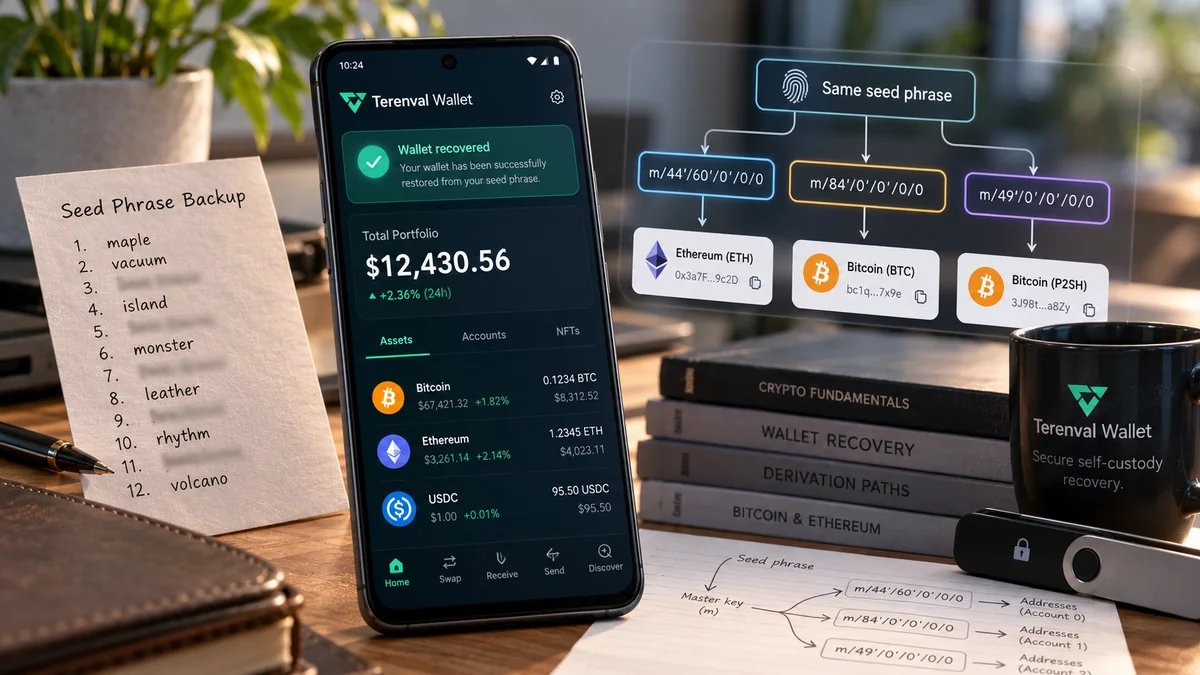
A wallet derivation path is the sequence of numbered branches a hierarchical deterministic (HD) crypto wallet uses to generate a specific private key, public address or account from its underlying seed. A common Ethereum example is m/44'/60'/0'/0/0; a common Bitcoin native SegWit example is m/84'/0'/0'/0/0. Those paths select different branches of a key tree. Restoring the same recovery phrase in a wallet that looks along the wrong branch can result in different addresses and a balance that appears to be zero.
This is a wallet discovery or compatibility problem, not necessarily a loss of blockchain funds. Your coins and tokens remain associated with their addresses on their actual networks. The urgent question is whether you can reproduce the specific signing keys and wallet structure that controlled those addresses.
Short answer: A derivation path is the address-generation route used by an HD wallet. When a restored wallet shows different addresses or missing cryptocurrency, verify the original wallet's path convention, Bitcoin script type, account and address index, and any BIP-39 passphrase. Compare the resulting public address against a trusted address or blockchain record. A path mismatch can be fixable in compatible software, but a wrong seed, unknown passphrase, separately imported private key or unsupported smart-contract account requires a different approach. Never enter your seed phrase into an online “derivation path checker.”
This guide explains how paths work, why wallet recovery can fail even when recovery words are correct, and how to investigate the problem without turning a display issue into a security incident.
Key Takeaways
- One BIP-39 mnemonic can generate many accounts. A derivation path specifies which branch to use; the recovery words alone do not label every account in every wallet.
- BIP-39, BIP-32 and BIP-44 solve different problems. BIP-39 converts mnemonic words and an optional passphrase into seed material; BIP-32 derives hierarchical keys; BIP-44 proposes a common account structure.
- A correct seed with the wrong path can show another, empty account. If the correct public address can be reproduced safely, the original funds may still be accessible.
- Bitcoin has multiple familiar derivation families. Legacy
m/44', nested SegWitm/49', native SegWitm/84'and single-key Taprootm/86'are not interchangeable address-discovery branches. - The same phrase may yield multiple Ethereum accounts. Changing the final address index or using another wallet-specific account convention can select a different
0xaddress. - A passphrase is not a path. An optional BIP-39 passphrase changes the seed before path derivation; an incorrect passphrase cannot be repaired by changing path numbers.
- A network change is not a key-path change. One Ethereum-style address can have balances on Ethereum, Base or Arbitrum; selecting the wrong chain may hide tokens without changing the derived address.
- Restored wallets do not always restore separately imported accounts. A key imported from another seed or a connected hardware wallet may require its own recovery mechanism.
- Bitcoin wallet scanning has limits. An address gap or unscanned account can prevent a wallet from discovering older transaction history even when keys exist.
- Safe verification starts with public information. Wallet names, previously used receiving addresses, transaction hashes and official documentation are useful; passwords and seed phrases are not needed for an initial diagnosis.
- No universal recovery method exists. The right procedure depends on the wallet's actual backup, cryptographic scheme, account type and supported chain.
What Is a Crypto Wallet Derivation Path?
A derivation path is a set of instructions for navigating a tree of cryptographic keys. An HD wallet can create a master key and many related child keys from seed material. Rather than backing up a separate private key for every new Bitcoin address, compatible software can reconstruct the same branches from the same seed and derivation rules.
The path itself is not a password, a recovery phrase, a blockchain address or a location where funds are stored. It is metadata describing key generation. Wallet software combines that metadata with the appropriate seed, algorithms and address format to find an account.
The BIP-32 specification formalizes hierarchical deterministic key generation. BIP-44 standardizes one common way of organizing accounts, coins, receiving addresses and change addresses within that tree.
A simple mental model: one seed, many branches
Imagine a filing cabinet whose master key is generated from your wallet backup. The derivation path tells the wallet which drawer and folder to open. Two applications can start with the same master material but open different folders, so the first address they display differs.
Important limitation of the analogy: the actual structure involves cryptographic key derivation, not a reversible file lookup. Knowing a path does not reveal the private key or let someone spend funds without the required signing material.
Derivation path examples
| Path | Typical interpretation | What it selects |
|---|---|---|
m/44'/60'/0'/0/0 |
Common first Ethereum/EVM address under a BIP-44-style convention | First external address under the first Ethereum account |
m/44'/60'/0'/0/1 |
Next address in that same branch | A different Ethereum signing key and 0x address |
m/44'/60'/1'/0/0 |
Another BIP-44 Ethereum account branch | A different account, not simply a new blockchain network |
m/44'/0'/0'/0/0 |
Bitcoin legacy BIP-44 | First receiving address in a legacy account |
m/49'/0'/0'/0/0 |
Bitcoin nested SegWit BIP-49 | First receiving address in a nested SegWit account |
m/84'/0'/0'/0/0 |
Bitcoin native SegWit BIP-84 | First native SegWit receiving address |
m/86'/0'/0'/0/0 |
Bitcoin single-key Taproot BIP-86 | First Taproot receiving key under that convention |
These are illustrative common conventions, not a declaration that every wallet supports every path. Some wallets, historical versions and account types use different schemes. A full Bitcoin address also depends on script and address encoding, not merely the path text.
How to Read a BIP-44 Derivation Path: m/44'/60'/0'/0/0
The generic BIP-44 pattern is:
m / purpose' / coin_type' / account' / change / address_index
Each component has a distinct role:
| Segment | Example | Meaning | Recovery implication |
|---|---|---|---|
m |
m |
Master/root of the hierarchical tree | Refers to the root derived from the wallet's seed |
purpose' |
44' |
Identifies the derivation scheme | Using 84' rather than 44' may choose a different Bitcoin address family |
coin_type' |
60' |
Coin-specific key branch (Ethereum uses registered value 60) | Using the wrong coin type selects different keys |
account' |
0' |
Account subtree under the scheme | Account 1 is different from account 0 |
change |
0 |
In BIP-44, 0 is external/receiving and 1 internal/change |
Missing Bitcoin change history can affect detected funds |
address_index |
0 |
Number of the child address in the selected chain | Address index 1 is not address index 0 |
For Bitcoin mainnet, the registered coin type is 0'. For Ethereum, it is 60'. These values come from the SLIP-44 registry; they are not the blockchain's network ID or Ethereum's transaction chain ID.
What do the apostrophe and h mean in a path?
An apostrophe (') marks hardened derivation. Some tools use h or H for the same purpose. Thus 44' and 44h commonly express the same hardened index; neither means a quotation mark was accidentally added.
Hardened and non-hardened child keys are derived differently. In BIP-32, public-only derivation can work for certain non-hardened branches, but a hardened child cannot be derived solely from its parent's extended public key. The distinction matters for wallet backups and watch-only setups, and is not something to alter randomly during recovery.
Account index versus address index
These two numbers are easy to confuse. In m/44'/60'/0'/0/5, the 0' before the last two components is the account index; the final 5 identifies an address within that account's external chain. Changing an earlier hardened account component and changing the final non-hardened address component produce different branches.
For Ethereum in particular, software may present multiple addresses as independent “accounts” even when its internal path convention advances the final index. The account label in a user interface is not a universal statement about which BIP-44 component changed.
How BIP-39, BIP-32 and BIP-44 Work Together
The concepts are often described as though they are one standard. They are not.
| Standard or mechanism | Main job | What it does not determine alone |
|---|---|---|
| BIP-39 | Maps a mnemonic sentence plus optional passphrase to seed bytes | Which wallet accounts, paths or networks the user interface scans |
| BIP-32 | Defines HD private/public key derivation with chain codes | Which coin or output-script convention an application selects |
| BIP-43 | Recommends using a hardened purpose field for application-specific subtrees | The full structure of each application |
| BIP-44 | Defines purpose / coin / account / change / index hierarchy |
Support for every script type or all possible wallet conventions |
| BIP-49, BIP-84, BIP-86 | Define paths associated with particular Bitcoin spending/address families | Automatic discovery in wallets that do not support those families |
| Wallet application | Chooses paths, accounts, networks, scanners and visible balances | Guaranteed interoperability with every other app |
A simplified, conceptual flow is:
Recovery words + optional BIP-39 passphrase
                    |
                    v
             BIP-39 seed
                    |
                    v
             BIP-32 root
                    |
                    v
     Selected derivation path + key rules
                    |
                    v
      Child key -> public key -> address
                    |
                    v
       Supported-chain balance discovery
Why this matters: seeing a zero balance is a statement about what a particular app has found or displayed, not proof that the seed has no funds. Conversely, successfully deriving the expected address does not automatically prove that every associated network or token has been scanned.
Does a 12-word versus 24-word phrase change the path?
Not by itself. Both can be used as valid BIP-39 mnemonics and can feed compatible HD derivation. The path is selected separately. A 24-word phrase is not inherently associated with BIP-84, and a 12-word phrase is not inherently associated with Ethereum.
Why is the optional passphrase a separate recovery variable?
BIP-39 permits an additional passphrase, sometimes described as a “25th word,” even though it can be an arbitrary string and is not an extra mnemonic word in the original word list. Its exact content changes the derived seed. A different passphrase—including an empty passphrase—produces a different wallet. Trezor's passphrase guide specifically warns that a typo can open an apparently empty wallet.
Do not respond to a missing balance by randomly guessing or publishing possible passphrases. If a passphrase is unknown, path adjustment does not recreate the original seed.
Why Does the Derivation Path Matter When Recovering a Wallet?
Because recovery software must reproduce the correct key branch and account discovery procedure, not merely accept a set of words. Different wallets can correctly implement relevant cryptographic standards and still differ in defaults, supported script types or how many accounts they automatically display.
Four different things may occur after importing a valid recovery phrase:
- Expected address appears, expected funds appear. The wallet likely found the relevant account and chain balance.
- Expected address appears, but funds are absent from the UI. Check the blockchain network, token contract, account selection and indexing service; the path may already be correct.
- A different address appears. Investigate the phrase, optional passphrase, derivation scheme, account index and imported-account history.
- Some assets appear but others do not. The wallet may have discovered one coin or address family while missing another, or may not show tokens on all supported networks.
The distinction prevents a harmful recovery habit: entering the same seed into many untrusted applications hoping one will show a positive balance.
Wallet Recovery Decision Table: Why Is My Crypto Missing?
Use this table before importing or moving anything.
| Symptom | A plausible explanation | First safe check | Do not assume |
|---|---|---|---|
Restored wallet has different first 0x address |
Different seed/passphrase, EVM derivation path or original account origin | Compare public address, original app and account convention | “The blockchain lost my ETH” |
Same 0x address, ETH visible but token missing |
Wrong EVM network, unsupported token view, stale indexer or different contract | Find address/contract on the actual chain explorer | “The derivation path must be wrong” |
Bitcoin restored as bc1q..., old wallet used 3... |
New wallet chose native SegWit; original may have used nested SegWit | Identify original output type and account path | “All addresses derived from this phrase are identical” |
Bitcoin Taproot bc1p... history is missing |
New wallet may not scan BIP-86 or original Taproot scheme | Confirm Taproot account/script support | “Trying more Ethereum paths will help” |
| Wallet finds some early BTC history, misses a later receive | Account/address discovery or gap-limit issue | Check original addresses and supported rescan options | “No current balance means no earlier transactions” |
| Password works, wallet displays another account | App password unlocks local software; it does not choose the original seed | Identify backup, account selection and derivation settings | “Password equals seed phrase” |
| Same seed opens a completely different hidden wallet | Optional BIP-39 passphrase differs | Check whether a passphrase wallet was used | “Change the final path number to fix it” |
| Originally imported private-key account is absent | Imported key is not necessarily derived from the main phrase | Review original account's documented origin and secure backups | “Every account came from the one phrase” |
| Hardware wallet address missing from software wallet | Hardware account uses its own seed and/or different path | Connect signer through supported official integration | “Typing hardware seed into a web tool is required” |
| Solana address differs after restoring in an EVM wallet | Different derivation/cryptography and chain support | Use chain-specific official recovery documentation | “Every blockchain uses the same EVM path” |
| Smart-contract wallet address not restored | Contract deployment and signer/policy metadata may be necessary | Identify smart-account provider, chain and owner keys | “Any 0x address is a normal EOA” |
A missing displayed balance is not evidence that the coins can be recovered in every case. The ability to spend still depends on possessing the correct signing authority and using compatible software.
Common Bitcoin Derivation Paths: BIP-44 vs BIP-49 vs BIP-84 vs BIP-86
Bitcoin is where path mismatches most visibly intersect with address and output-script formats. The same BIP-39 seed may support several Bitcoin account branches, each of which is found by wallets using different conventions.
| Bitcoin account family | Common first receiving path | Typical mainnet address clue | Standard | Recovery consideration |
|---|---|---|---|---|
| Legacy P2PKH | m/44'/0'/0'/0/0 |
Often starts 1 |
BIP-44 | A SegWit-only scan may not find legacy history |
| Nested SegWit P2SH-P2WPKH | m/49'/0'/0'/0/0 |
Often starts 3 |
BIP-49 | 3 alone is not proof of BIP-49; other scripts also use P2SH |
| Native SegWit P2WPKH | m/84'/0'/0'/0/0 |
Starts bc1q |
BIP-84 | A legacy-only wallet can miss this branch |
| Single-key Taproot P2TR | m/86'/0'/0'/0/0 |
Starts bc1p |
BIP-86 | Taproot requires compatible script support and discovery |
Address prefixes are diagnostic clues, not sufficient proof of the exact seed, derivation path, account index or ownership. Some address forms cover multiple script constructions.
Why BIP-84 Bitcoin can appear empty in a BIP-44 wallet
Suppose your previous app derived receiving addresses under m/84'/0'/0'/0/i. A replacement app scans only m/44'/0'/0'/0/i. Both may be functioning correctly under their supported standards, but they are deriving different public keys and outputs. The new app may show no matching historical deposits.
A compatible wallet that supports the original native SegWit account and discovery rules may find the same on-chain UTXOs. No transfer or blockchain reversal is required merely to display funds from the original keys.
Receiving and change addresses both matter
Under the BIP-44-style hierarchy, external/receive addresses commonly use /0/i and change addresses use /1/i. Bitcoin transactions may send unspent value back to a change output that belongs to your wallet. A recovery that checks only one manually remembered receiving address—or scans only the external branch without the correct account configuration—can produce an incomplete picture.
What about xpub, ypub and zpub?
Extended public keys enable address discovery without revealing the signing private keys, but they are still sensitive wallet metadata because they can expose future addresses and transaction relationships. Some Bitcoin wallet formats use prefixes such as ypub or zpub to signal script-related conventions; the prefix alone is not a complete recovery specification. Use official wallet documentation and, when supported, validated descriptors rather than editing prefixes or converting keys on an unknown website.
Never publish an extended private key (xprv, yprv, zprv and related formats). Even an extended public key should not be shared casually or entered into a third-party service without understanding the privacy implications.
Bitcoin Account Discovery, Gap Limits and “Missing” Addresses
An HD wallet cannot realistically display every possible derived address. It typically checks plausible sequences and stops once its discovery rules say unused space has been found.
BIP-44 describes an address gap limit of 20 for its external chain: after 20 consecutive unused addresses, a conforming discovery procedure assumes no relevant activity lies further along that sequence. The key word is unused, as determined by transaction history—not necessarily “currently has a zero balance.” Specific wallets may implement different scanners and controls.
Illustrative gap-limit failure
Imagine a wallet created address indexes 0 through 35, but addresses 5 through 29 were never used while index 30 received Bitcoin. A scanner that stops after 20 consecutive unused addresses could stop before reaching index 30. The correct key may exist, but automatic history discovery may not find it.
This is a conceptual example of a scanning limit, not a recommendation to generate many fresh addresses during troubleshooting. A supported wallet may provide a rescan, increased gap limit or account-discovery method; use its verified official process.
Why account indexes matter too
Wallet software may search account 0 before account 1, and some BIP-44 discovery procedures rely on earlier account activity. Funds under an unusual account index may be missed if the replacement wallet does not enumerate that branch. Likewise, an older account might appear empty now while historical transactions exist; activity history and current balance are different tests.
Descriptors: the missing layer in more advanced Bitcoin recovery
A Bitcoin output script descriptor can specify what scripts or addresses a wallet should track, together with relevant key origins and derivation information. This is often a richer recovery record than a mnemonic and a guessed path, particularly for multisignature or nonstandard script setups. Bitcoin Optech's descriptor overview explains the role of this metadata.
For a multisignature wallet, you may need cosigner public keys, thresholds, script policy and derivation origins in addition to the relevant seeds. Possessing one phrase does not automatically reconstruct an unrelated multi-party wallet policy.
Ethereum and EVM Derivation Paths: Why the Same Seed Can Show Different 0x Addresses
Ethereum accounts often use a BIP-44-derived hierarchy with registered coin type 60'. One common sequence starts with:
m/44'/60'/0'/0/0   first derived address
m/44'/60'/0'/0/1   next derived address
m/44'/60'/0'/0/2   next derived address
Another BIP-44-style arrangement changes the hardened account index:
m/44'/60'/0'/0/0   account 0, first address
m/44'/60'/1'/0/0   account 1, first address
These are not equivalent ways to name the same sequence. Different components change, and the resulting keys differ. Hardware integrations and legacy wallet products have historically implemented more than one convention. Ledger's developer documentation, for example, exposes an explicit derivation-path input and illustrates 44'/60'/0'/0/0 for Ethereum address generation. See Ledger's Ethereum signer reference.
MetaMask: restoration does not mean every possible account appears immediately
MetaMask's official derivation-path guidance says that seed-phrase import uses its supported default BIP-44 path convention rather than arbitrary paths typed in by the user. Its missing-accounts article explains that some accounts may need to be re-added in their original order after restoration.
For example, if an older MetaMask setup used a later derived account, a restored app may initially display only the first account. Creating or selecting subsequent accounts through the official interface can reveal the expected address, provided it was derived from that same recovery phrase and compatible scheme.
Crucial distinction: an account imported separately using a private key or JSON file, or connected from a hardware wallet, is not necessarily derived from the MetaMask recovery phrase. MetaMask's documentation warns that such accounts may need their original independent import or connection process.
Same Ethereum address, different EVM network: not a path problem
Suppose the expected 0x address appears correctly, but a deposit exists on Base while the app currently shows Ethereum Mainnet. Under a conventional externally owned account, the same private key and public address can be usable across compatible EVM networks, but the chains maintain separate state. Changing networks or choosing the right token view—not changing the derivation path—may reveal the balance.
For this distinct scenario, see Why Does the Same Ethereum Address Work on Multiple EVM Networks? and How to Recover Crypto Sent to the Wrong Network.
ETH visible, ERC-20 token missing: check the token contract
Some wallet interfaces do not automatically display every ERC-20 token or bridged representation. Check the actual network, account address, exact token contract and transfer events in a reputable block explorer. The transaction-level To address can point to the token contract rather than the ultimate token recipient, so inspect decoded token-transfer events when necessary.
Do not add a look-alike token contract merely because its symbol matches. Displaying a token does not transfer it to another network or establish that it is genuine.
Do Solana, Tron and Other Networks Use the Same Derivation Paths?
No. HD recovery is a family of conventions, not a guarantee that a BIP-39 phrase maps to identical keys across unrelated blockchains.
Solana commonly uses coin type 501' and Ed25519-based derivation workflows, with choices that differ by wallet and hardware integration. Official Solana's mnemonic-restoration cookbook demonstrates Ed25519-derived account paths such as m/44'/501'/0'/0'. A Solana address should not be expected to appear just because software supports an Ethereum m/44'/60'/... branch.
Tron, EVM chains and Bitcoin also have different address representations, network rules or derivation conventions. Similar cryptographic primitives or a visually convertible representation do not establish that the receiving wallet, exchange or recovery software can access funds in another ecosystem.
Why the chain type matters for recovery
The requirements may include the mnemonic system, underlying curve, hierarchical derivation algorithm, account path, address encoding and blockchain-specific account or transaction-discovery logic. If an application does not support the original coin or account system, a matching seed by itself is not evidence that the app will show the original balance.
Does changing a derivation path move coins between networks?
No. Deriving another key changes which account address you are inspecting or controlling. It does not broadcast a transaction, convert a token, bridge assets or alter existing on-chain balances.
What If the Original Wallet Was a Smart-Contract Wallet?
Not every 0x address is a normal externally owned account generated directly by a seed-derived private key. A smart-contract account may be controlled by one or more owners, a threshold policy, a factory deployment and on-chain configuration. The account's address can depend on contract deployment and other parameters, not simply on an HD leaf key.
Recovering a signing key might be necessary but insufficient to reconstruct or operate the smart-account address. Confirm the wallet provider, chain, owner keys, contract version and any recovery guardians or policies using that provider's authenticated documentation. Do not try to “fix” a smart-contract-wallet address by guessing standard MetaMask path indexes.
The same broader principle applies to Bitcoin multisignature policies: a mnemonic alone may not contain the full external account metadata.
How to Recover a Wallet With the Correct Seed Phrase but Wrong Derivation Path
The safest route is an evidence-led, public-address matching workflow. Begin with low-risk observations. Move toward secret-bearing restoration only when necessary and only within trusted, appropriate software.
Step 1: Pause transfers and protect existing access
Do not send new funds to an unfamiliar restored address to “test” it. If the original wallet still works, do not delete, reset or overwrite it before confirming secure backups and documenting its public account information. Updating an app or reconnecting a hardware signer is not the same as proving the backup can reproduce every account.
Step 2: Collect non-secret recovery clues
Record privately or locally:
- Original wallet/app name, approximate version and whether it was software, hardware or a smart account.
- Intended blockchain and asset: Bitcoin, Ethereum, Base, Arbitrum, Solana or another network.
- A trusted previously used public receiving address or verified transaction hash, if available.
- The Bitcoin address family or account type if you know it (legacy, nested SegWit, native SegWit, Taproot).
- Whether a separate BIP-39 passphrase, device-specific PIN or hardware wallet was involved.
- Which account number, wallet label or network was selected previously.
- Whether missing funds belonged to an imported key, connected hardware account or external seed.
A transaction hash, receive address and account notes are enough to begin diagnosis; never put your recovery words into a support ticket or chat.
Step 3: Verify the known address on its actual blockchain
Use the correct network's explorer to determine whether the expected address has recorded transactions or assets. For Bitcoin, inspect UTXOs and transaction history. For EVM networks, inspect the address on the actual chain and verify relevant token-contract events.
If the original address has funds but the restored wallet displays another address, focus on key origin, phrase, passphrase and derivation. If the original address matches but the UI is empty, focus on supported chains, token views and synchronization.
Step 4: Identify the original derivation convention from reliable sources
Use the source wallet's official documentation, old account metadata or a known descriptor/backup record. Do not take path recommendations from an unsolicited direct message or a “guaranteed crypto recovery” site.
For Bitcoin, start by checking known address/script family and documented account index. For Ethereum, determine whether the source was a standard software account, separately imported address or hardware-account integration. Do not assume another provider's default path applies.
Step 5: Check account enumeration in the official wallet interface
Some wallets offer a documented Add account, Discover accounts, Rescan or Advanced account selection workflow. Use supported controls rather than altering raw wallet storage or executing unreviewed code. For example, MetaMask describes manually re-adding accounts after restoring a phrase to find later accounts generated from it.
Step 6: If a passphrase wallet was used, confirm the exact passphrase offline
A BIP-39 passphrase changes the seed itself. If you used a passphrase-enabled hardware wallet, follow the manufacturer's secure recovery procedure. An incorrect passphrase may produce a perfectly valid but unrelated empty wallet. A derivation-path change cannot compensate for unknown passphrase material.
Step 7: Compare the recovered public address with the historical address
A useful recovery checkpoint is an exact match of the entire expected public address for the correct network/account. Matching only the first and last characters is insufficient. An address match is evidence that you've located the expected account key path, but transaction history, tokens, smart-account permissions and available signing methods still require separate checks.
Step 8: Validate balances and transaction history without sending funds
Check the appropriate explorer and supported wallet view. For Bitcoin, include relevant receive/change branches, output-script types and account-scanning considerations. For EVM, check the account on each chain where assets may actually exist. Do not pay to “unlock” a balance shown only by an unfamiliar recovery page.
Step 9: Only if necessary, use a trusted supported recovery method
If the app cannot reproduce the original key path, consult the original wallet provider or the hardware manufacturer's documented compatibility procedure. A different reputable wallet can sometimes use the same seed with a supported path, but importing a hardware-wallet seed into a general-purpose device may materially weaken its security. Prefer supported hardware connections or watch-only diagnostics when possible.
Never import secret material into an online derivation-path calculator, unknown browser extension, AI chat, social-media support flow or random recovery script. If a past seed may already be compromised, obtaining account visibility does not make that seed safe again.
Step 10: After restoring access, document a future-proof backup plan
Keep the required recovery words and any optional passphrase in appropriately protected backups. Record non-secret metadata—wallet name, account family, relevant derivation paths, public addresses, hardware signer and network support—separately. Confirm that official recovery procedures reproduce the expected public addresses before relying on the backup.
Recovery success is not measured by whether an app says “wallet restored.” It is measured by whether the expected account addresses and correct signing authority can be independently established.
Worked Recovery Examples: Four Different Problems
The following are illustrative scenarios, not real user funds, test wallets or instructions to expose recovery material.
Example A: Bitcoin balance disappears after moving to a different wallet
A user originally received Bitcoin at addresses beginning with bc1q under a native SegWit account. The replacement app, after mnemonic restoration, shows only a legacy receiving address beginning with 1 and no history.
Analysis: the original receiving branch may have followed BIP-84 (m/84'/0'/0'/0/i), while the new app discovered only the BIP-44 legacy branch. A wallet with correct native SegWit path/script support may rediscover the old UTXOs. First compare known public receiving addresses; do not make a “recovery transfer” to the new address just because it appears empty.
Example B: MetaMask restores Account 1, but an older account is missing
A user restores the original MetaMask Secret Recovery Phrase, sees the first Ethereum address and no balance, but recalls holding assets in a later MetaMask-created account.
Analysis: the first restored account may be correct, while the later derived account has not yet been enumerated. MetaMask's official recovery guidance describes re-adding accounts in their original sequence. Verify the expected 0x address on the relevant EVM chain rather than assuming that the displayed Account 1 represents every address from the phrase.
Example C: Trezor recovery words are right, but the hidden wallet appears empty
A user restores a known Trezor mnemonic without the passphrase originally used for a hidden wallet. The wallet opens, but the historic public account address is absent.
Analysis: the passphrase is part of BIP-39 seed generation, before any path is followed. Recreating a specific derivation path with the wrong passphrase still accesses a different key tree. Use Trezor's official passphrase-wallet recovery process; do not treat arbitrary path scans as the solution.
Example D: Ethereum address matches, but USDC is “gone”
A restored EVM wallet shows the exact old 0x address on Ethereum Mainnet, with zero USDC there. The known deposit TXID, however, is on Base.
Analysis: the key path may already be correct. The assets, token contract and transaction belong to Base, so the relevant next step is supported-network and asset display verification. This is not evidence that the app derived the wrong Ethereum private key. See How to Recover Crypto Sent to the Wrong Network.
Is It Safe to Use an Online Derivation Path Finder or Seed Checker?
Do not enter a real recovery phrase, private key, extended private key or BIP-39 passphrase into an untrusted website, chatbot or remote support tool. A site promising to locate funds by testing hundreds of paths can simply steal the seed. Derivation is computationally deterministic, so anyone with a valid exposed seed and passphrase may be able to reproduce its keys and move supported assets.
Safer diagnostic information
- Public receiving address: useful for comparing the expected destination with a wallet-generated address; it is not a password.
- Transaction hash: publicly identifies a confirmed transaction or output on its actual network.
- Known account/path metadata: usually non-secret, but may reveal account organization and should be handled with privacy in mind.
- Extended public key (
xpuband variants): cannot ordinarily spend on its own, but may expose many addresses and compromise financial privacy; not something to publish broadly. - Output script descriptor: may encode public keys, derivation origins and wallet policy. Some descriptors are watch-only; others can contain private data, so inspect before sharing.
Do not mistake “public” for “free of privacy risk.” A public address may link transactions, while an extended public key can reveal a whole family of addresses.
What a legitimate support team can ask for
A real support workflow may ask for the app version, supported coin, public address, TXID, screenshots with secrets redacted, and how the account was originally created. It should never require your full recovery phrase, private key or passphrase for an initial case assessment.
How Derivation Paths Relate to Hardware Wallets and Cold Storage
Hardware wallets derive and use signing keys inside a dedicated security boundary. A software interface may connect to the device and request a particular public address or signature for a given path; the device seed should remain protected.
When moving from one interface to another, compatible derivation settings can matter. For example, one application may show a different Ethereum hardware-account sequence from another because each selects a different derivation convention. Resolve that mismatch through documented device integration, not by exposing the hardware backup to an arbitrary browser tool.
Three points to record before migrating an account
- Original account type and path family—especially Bitcoin script type or Ethereum hardware-wallet account convention.
- A trusted public account address and relevant chain—so the restored software can be checked independently.
- Whether the account uses a hidden-wallet passphrase or multisig policy—because seed words alone may not represent the complete recovery requirement.
Never assume that knowing the original path is enough to recover a wallet when the original seed, passphrase, owner key or multisignature policy is missing.
Using Terenval Wallet With a Correctly Restored Self-Custody Account
If you use an Android self-custody wallet such as Terenval Wallet, derivation-path knowledge is particularly useful when moving between wallet applications, importing an existing account or investigating an unexpected zero balance.
However, there are two separate questions:
- Can the installed Terenval Wallet version restore or display the particular account, coin, derivation path and network? Confirm this against its current official capabilities before importing anything.
- Does the account actually hold assets on the selected blockchain? Check the exact receiving address, real network and verified token/UTXO records independently.
Terenval Wallet should not be described as a universal recovery tool, a custom-path scanner or a guarantee that any seed from any wallet will reproduce the same addresses. The safe user workflow is to verify network and account compatibility, protect the seed, restore or create an account only in the official application, and compare the entire public receiving address before transferring assets.
A practical Terenval-oriented self-custody checklist
- Review the wallet's current product overview and security information.
- Identify the original account's chain, address, derivation convention and whether a separate passphrase/imported key is involved.
- Do not use the recovery flow unless the installed wallet officially supports the intended source-account type; otherwise use the original wallet's trusted recovery method.
- Once an account is available, check its public receiving address against a known trusted record.
- Verify the correct network, asset contract and account selection before receiving coins.
- Keep your recovery material offline or otherwise strongly secured and never submit it to an exchange, an article page or a third-party “path finder.”
Want to understand self-custody before moving funds from an exchange? Explore Terenval Wallet for Android, read What Is a Crypto Wallet and What Does It Store?, and confirm supported networks and recovery features in your actual installed release.
Terenval is a wallet option—not a guarantee of compatibility with every Bitcoin, EVM, Solana, hardware or smart-account derivation system.
How to Prevent Derivation Path Problems Before You Need Recovery
A recovery phrase is a vital backup, but future interoperability improves when you keep a small record of recovery metadata.
Recommended recovery record
| Record item | Why it helps | Sensitive handling |
|---|---|---|
| Original wallet name and version family | Identifies likely supported recovery methods | Usually not secret |
| Asset and blockchain network | Separates path problems from chain-display problems | Public or moderately private |
| Account type / Bitcoin script family | Helps identify BIP-44, 49, 84 or 86 discovery | Generally non-secret |
| Account index and relevant derivation path | Helps reproduce the exact signing branch | Keep private as account metadata |
| Known public address | Enables exact verification of restored account | Public but transaction-linkable |
| BIP-39 passphrase usage (yes/no) | Reminds you that another factor was used | Never store the passphrase casually with the mnemonic |
| Hardware signer, multisig or smart-account details | Prevents falsely treating the setup as a simple single-seed account | May include sensitive policy or device data |
| Descriptor or xpub for Bitcoin setups | Can support account discovery where applicable | Privacy-sensitive; protect and inspect before sharing |
| Recovery-phrase backup | Required for seed-based restoration | Critical secret: offline or otherwise strongly secured |
Before switching wallet software
Verify the old public receiving address in the original application, identify its account type, protect the backup, and check the destination application's official import limitations. Ideally test recovery compatibility before retiring access to the original wallet. A “successful import” message is not sufficient validation if the resulting account address differs.
Avoid unnecessary seed reuse
Using one mnemonic across multiple incompatible apps increases exposure and confusion. A new wallet may offer a fresh account for a reason. If you choose to migrate to a new seed, understand that this requires real on-chain transfers, fees and careful verification—not merely selecting a different derivation path.
Derivation Path Recovery Troubleshooting Matrix
| Problem | Technical layer to investigate | Safe next action |
|---|---|---|
| Phrase rejected as invalid | Mnemonic language/order/checksum/format | Recheck the protected original backup offline; do not share it |
| Phrase accepted but completely different wallet appears | BIP-39 passphrase, mnemonic origin and root | Confirm correct wallet backup and hidden-wallet settings |
Bitcoin 1... shown instead of former bc1q... |
Purpose/script family | Check BIP-44 vs BIP-84 support and trusted historical address |
Old Bitcoin 3... transactions not found |
P2SH script and possible BIP-49 path | Identify whether it was nested SegWit; verify source wallet |
Old Bitcoin bc1p... transactions not found |
Taproot script and BIP-86 compatibility | Use supported Taproot discovery; don't infer from prefix alone |
| Later BTC deposits absent after many unused addresses | Gap-limit/account discovery | Review scanner/rescan controls in official documentation |
| Second or third Ethereum account absent | EVM account/address index | Follow the original wallet's official add/discover-account process |
| MetaMask imported private-key account missing | Separate imported-key origin | Recover with its own legitimate backup and official import procedure |
| Address matches but token does not | Chain, contract, token display, indexer | Verify balance in the correct chain explorer |
| Wallet is a smart-account address | Deployment/policy/owner-key configuration | Use the specific smart-account recovery instructions |
| Multisig account missing | Cosigner keys, threshold, wallet policy, descriptors | Consult original multisig setup and protected records |
| Unknown BIP-39 passphrase | Seed generation, not derivation path | No path setting can recreate missing passphrase material |
Before You Restore a Crypto Wallet: Final Security Checklist
- [ ] I have identified the original wallet application or signer and the intended blockchain.
- [ ] I can reference a trusted public receiving address or TXID without revealing secrets.
- [ ] I understand whether the account was created from the main recovery phrase or separately imported.
- [ ] I know whether I used an optional BIP-39 passphrase or a hidden wallet.
- [ ] For Bitcoin, I identified the original address/script family where possible.
- [ ] I checked whether my replacement wallet supports the relevant derivation convention.
- [ ] I understand that
account'andaddress_indexare not interchangeable path levels. - [ ] I checked whether the missing balance is actually on another network or token contract.
- [ ] I used official account discovery, re-add or rescan functions where appropriate.
- [ ] I compared the entire resulting public account address to a trusted record.
- [ ] I did not send test deposits to an unfamiliar replacement address.
- [ ] I did not enter a seed, passphrase, xprv or private key into an online calculator or stranger's support chat.
- [ ] I kept my original, working wallet available until backups and restoration were verified.
- [ ] I documented non-secret recovery metadata for future migrations.
Rule of thumb: First establish the original address, then the wallet's key-generation path, and only then its balance-display behavior. Do not troubleshoot by exposing the seed.
Frequently Asked Questions
What is a wallet derivation path?
A derivation path is the numbered sequence an HD wallet follows from its root to generate an account or child key. A common structure is m/purpose'/coin_type'/account'/change/address_index, but not all wallets use exactly the same profile. The seed and compatible rules are required to reproduce the account.
Why does a wallet derivation path matter for recovery?
Because a recovery phrase can generate many different addresses. A wallet scanning a different account path or Bitcoin address family may show an empty account even when the original address still has funds. Recovery requires the correct key origin and compatible account discovery.
Can the same seed phrase produce different wallet addresses?
Yes. Different derivation paths, account indexes and optionally a different BIP-39 passphrase can produce different addresses. A seed is the starting material for a hierarchy; it is not a single blockchain address.
What does m/44'/60'/0'/0/0 mean?
It is a common Ethereum/EVM BIP-44-style first-address path. 44' indicates the purpose, 60' the registered Ethereum coin type, 0' the first account, 0 the external chain and the last 0 its first address index. Wallet implementations can differ.
What is the Bitcoin BIP-84 derivation path?
The common first native SegWit receiving address uses m/84'/0'/0'/0/0, with later receive indexes advancing the final component. BIP-84 is associated with P2WPKH and commonly bc1q mainnet addresses; the prefix alone does not prove the exact path.
What is the difference between BIP-44, BIP-49, BIP-84 and BIP-86?
They refer to different commonly used Bitcoin account/address schemes: BIP-44 legacy P2PKH, BIP-49 nested SegWit, BIP-84 native SegWit and BIP-86 single-key Taproot. Their standard purpose values are 44, 49, 84 and 86, respectively, and they must be supported by the recovery software.
Is the apostrophe in 44' important?
Yes. In these path notations it marks a hardened child derivation index. Changing 44' to 44 is not a harmless formatting change. Some interfaces use h instead of an apostrophe for the same hardened notation.
What happens if I use the wrong derivation path?
The wallet typically derives a different child key or account. You may see an unfamiliar receiving address or zero balance. Using the documented original path in compatible software can fix an account-discovery mismatch, but only if the required seed, passphrase and signing authority are available.
Does changing the derivation path move or recover crypto automatically?
No. Changing a path only changes which child key/account is selected. It does not transfer coins, reverse transactions or bridge assets. Recovery may mean regaining access to an existing address, not relocating its funds.
Why does my wallet show zero after entering the correct recovery phrase?
Potential reasons include a wrong account or script path, unrecognized later account, missing optional passphrase, separately imported account, unsupported token, wrong network or an incomplete blockchain scan. First distinguish an address mismatch from a balance-display mismatch.
Can I recover my Bitcoin if the old wallet used a different address type?
Possibly, if the original signing keys are reproducible and compatible software can discover the correct script/path family. For example, a BIP-84 account may not be found by a wallet scanning only legacy BIP-44 addresses. Bitcoin multisig and special scripts may require additional policy metadata.
Can I recover my MetaMask accounts by adding accounts again?
For accounts created from the same original MetaMask Secret Recovery Phrase under its supported convention, MetaMask documents re-adding missing accounts in sequence. Separately imported private-key accounts and hardware-wallet accounts may require independent restoration or reconnection.
Is a derivation path the same as a seed phrase?
No. A recovery phrase contributes to seed generation; a derivation path selects a branch of the derived key tree. A path is not enough to reconstruct private keys without the correct underlying secrets.
What is the difference between a BIP-39 passphrase and a wallet derivation path?
A BIP-39 passphrase modifies seed generation; a derivation path selects descendants from the resulting root. A different passphrase produces a different root. Correcting the path cannot recover an account created with an unknown or mistyped passphrase.
Do 12-word and 24-word wallets use different derivation paths?
Not automatically. Mnemonic length and account path are independent choices. Both 12-word and 24-word BIP-39 backups can be used with multiple supported derivation schemes.
Is the derivation path the same on Ethereum and Base?
An ordinary EVM account can use the same derived signing key and 0x address across compatible networks, but balances and token contracts remain on their respective chains. Path choice and network choice are separate, and not every account or wallet supports all EVM chains.
Does an Ethereum derivation path work for Solana?
Do not assume it does. Solana commonly uses a different coin type and Ed25519 derivation conventions, and wallet implementations may differ. Use official chain- and wallet-specific restoration guidance.
Why is my second Ethereum account missing after restore?
A replacement wallet may display only the initial derived account, may enumerate account indexes differently, or may not have restored a separately imported account. Identify the original account's creation method and use the official account-discovery feature rather than entering the seed in a public tool.
What is a Bitcoin gap limit?
It is a discovery rule that limits how far a wallet scans through consecutive unused derived addresses. BIP-44 describes a gap limit of 20 for external receiving addresses. A large unused gap can make a later used address harder to discover automatically in some implementations.
What is an xpub and can it help find missing Bitcoin?
An extended public key can generate public descendants for appropriate non-hardened branches and support watch-only discovery. It cannot ordinarily sign spending transactions by itself, but can expose many addresses and financial activity. Treat it as privacy-sensitive and avoid untrusted online scanners.
What is a Bitcoin output script descriptor?
A descriptor records how to recognize Bitcoin outputs, combining script structure and key-origin information. It can be especially useful in complex, multisig or nonstandard setups where a seed and guessed path do not fully describe the wallet.
Can a hardware wallet use a different Ethereum derivation path from MetaMask?
Yes. Hardware-device integrations and historical wallet applications can use different account/path conventions. Follow the device manufacturer's and wallet application's documented connection options, keeping the hardware seed protected.
Can I find my derivation path from a blockchain explorer?
Usually not reliably from the address alone. An explorer shows addresses and on-chain activity, not the private key's entire derivation history. An address prefix may offer a Bitcoin script-type clue, but it does not uniquely identify the seed, wallet software, account index or path.
Is it safe to paste my 12-word phrase into a derivation path checker?
No. Untrusted websites and support agents can steal the recovery phrase and use it to derive private keys. Start with public addresses and TXIDs, and restore secrets only inside a trusted, appropriately secured and officially supported recovery environment.
Can Terenval Wallet recover accounts from every other crypto wallet?
No universal claim should be made. Compatibility depends on the installed Terenval Wallet version, the original wallet's derivation scheme, supported networks, account types and backup material. Verify official product support before attempting any import; Terenval is not a universal seed/path recovery scanner.
What should I save now so wallet recovery works later?
Protect the recovery phrase and any passphrase appropriately. Separately note the original wallet name, account type, blockchain, relevant path or descriptor, and a known public address. For multisig or smart accounts, preserve the additional policy and signer information required by the original provider.
Key Terms
- Hierarchical deterministic (HD) wallet: A wallet deriving a tree of keys from common seed material.
- Mnemonic / recovery phrase: Human-readable words used in a supported seed-derivation scheme such as BIP-39.
- BIP-39 passphrase: Optional additional secret that changes the derived seed and therefore all descendant keys.
- Derivation path: The sequence of numbered branches used to reach a particular child key.
- Hardened derivation: A BIP-32 child derivation mode marked with
'orh, with different public-derivation properties. - Purpose: Path component identifying a scheme such as BIP-44, BIP-84 or BIP-86.
- Coin type: Registered path component for a coin family, such as
0'for Bitcoin or60'for Ethereum. - Account index: Path level separating logical account subtrees within a convention.
- Address index: Number selecting an individual derived address inside a branch.
- Change branch: In BIP-44-style Bitcoin accounts, the internal chain commonly used for change outputs.
- Gap limit: A wallet's stopping rule after consecutive unused derived addresses during discovery.
- P2PKH / P2SH / P2WPKH / P2TR: Bitcoin output-script/address families requiring compatible handling.
- Extended public key (
xpub): BIP-32-derived public account material that can reveal many related addresses. - Output script descriptor: Structured description of Bitcoin scripts, key origins and related address-discovery information.
- Externally owned account (EOA): A conventional account whose activity is authorized by a signing key rather than by a deployed smart-account contract.
- Wallet address: Public identifier to which supported blockchain assets can be transferred.
- Non-custodial wallet: A wallet model where the user controls the relevant signing authority and backup responsibilities.
Related Terenval Answers
- Seed Phrase vs Private Key vs Wallet Password: What Is the Difference?
- What Is a Crypto Wallet and What Does It Store?
- Why Does the Same Ethereum Address Work on Multiple EVM Networks?
- What Is a Blockchain Explorer and How Do You Use One?
- How to Recover Crypto Sent to the Wrong Network
- How to Choose the Correct Network When Withdrawing Crypto From an Exchange
For more wallet education and safe-recovery guidance, explore the Terenval Answers library.
Primary and Authoritative Sources
- BIP-32 — Hierarchical Deterministic Wallets
- BIP-39 — Mnemonic Code for Generating Deterministic Keys
- BIP-43 — Purpose Field for Deterministic Wallets
- BIP-44 — Multi-Account Hierarchy for Deterministic Wallets
- BIP-49 — Derivation for P2WPKH Nested in P2SH
- BIP-84 — Derivation for Native SegWit
- BIP-86 — Derivation for Single-Key Taproot
- SLIP-44 — Registered Coin Types
- MetaMask — Importing Seed Phrases and Derivation Paths
- MetaMask — Recover Missing Accounts
- Trezor — What Is a Passphrase?
- Ledger — Ethereum Signer and Derivation Paths
- Bitcoin Optech — Output Script Descriptors
- Solana — How to Restore a Keypair From a Mnemonic
- Terenval Wallet — Official Product Overview
- Terenval Wallet — Security and Non-Custodial Design
Editorial note (22 October 2026): This article separates technical standards from product-specific recovery behavior. The BIP and SLIP specifications define key and account conventions; MetaMask, Trezor, Ledger and Solana documentation supports the identified product examples and may change as software evolves. The worked cases are hypothetical, not evidence that a particular recovery attempt succeeded. No mnemonic, private key or secret passphrase is requested. Terenval Wallet is mentioned as an Android self-custody option with a promotional install link; this article does not claim it supports arbitrary custom paths, every coin or hardware signer, or guaranteed recovery. Validate the actual installed wallet's capabilities before importing keys or moving funds. This educational content is not individualized financial or security advice.