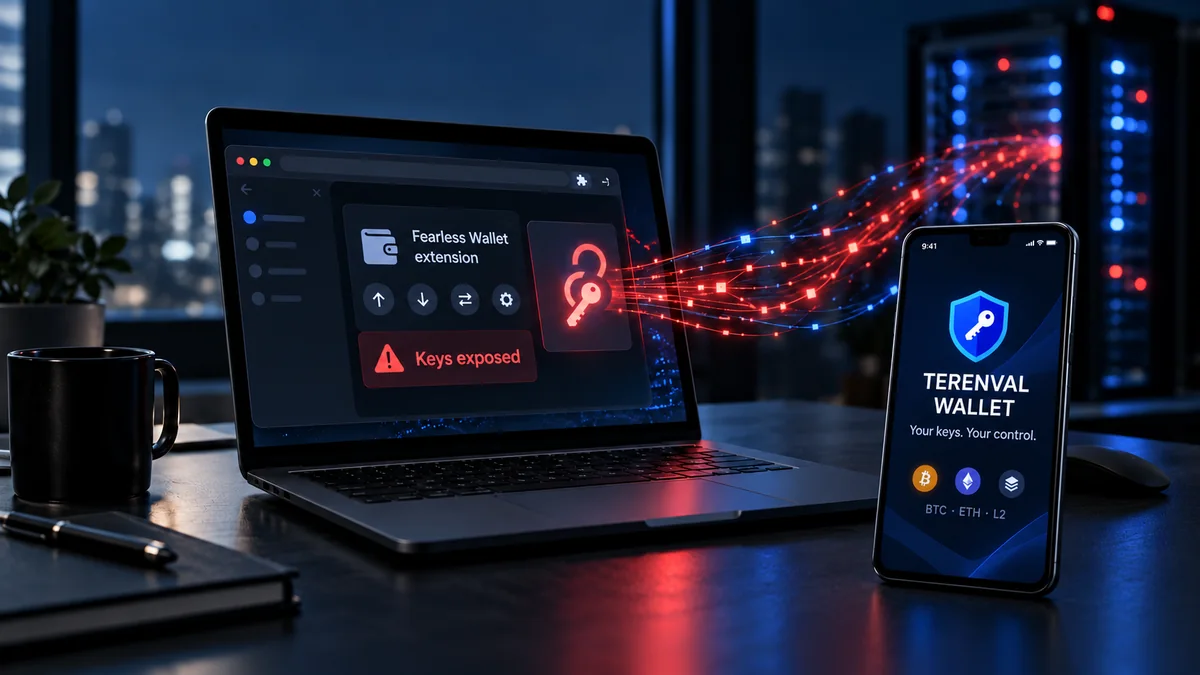
Users of the Fearless Wallet browser extension should move assets controlled by keys that were in the extension to accounts generated with new recovery material. In an October 21, 2026, security notice, the Polkadot Community Foundation said four versions contained code that sent sensitive wallet material to an external server when an affected wallet was unlocked.
The warning applies to people who used the browser extension at any time since February 2025, even if their balances currently look normal. The foundation reported eight users with unauthorized transactions totaling 17,286 DOT as of its notice. That figure is reported losses, not a count of every person whose keys could have been exposed.
Direct answer: Fearless Wallet browser-extension versions 3.0.1, 3.0.3, 3.0.4 and 3.0.5 contained code capable of disclosing account secrets. A password change, extension removal or import of the same phrase into a different wallet does not revoke an exposed key. Create new keys in a separate, trusted wallet that supports the assets and networks involved, then move the assets to the new addresses.
At a glance
| Question | Confirmed information as of October 22, 2026 |
|---|---|
| Which product? | The third-party Fearless Wallet browser extension, not the Polkadot blockchain |
| Which versions? | 3.0.1, 3.0.3, 3.0.4 and 3.0.5, according to the foundation |
| Exposure window | Code was intermittently active from February 2025 through October 10, 2026; installed copies can still contain a remotely controlled trigger |
| What could be exposed? | Private keys, recovery phrases or password-protected keystore material, depending on account type |
| Reported unauthorized transactions | Eight users; 17,286 DOT in the foundation's October 21 notice |
| Firefox? | The extension used the same code; historical packages were not recovered for the technical review, so users should treat keys as compromised |
| Mobile app? | The Android and iOS versions reviewed by the foundation did not contain this code; keys also used in the browser extension remain exposed |
What happened
The Polkadot Community Foundation's notice says the offending code entered the extension's public source on February 19, 2025, as part of a change titled “TON ecosystem.” When an affected wallet was unlocked, the code could send its account secrets to a server operated by the attacker. The foundation identified versions 3.0.1, 3.0.3, 3.0.4 and 3.0.5 as containing the offending code.
A technical analysis linked in the notice traces the behavior through the public extension code. Depending on the account, the material collected could include a recovery phrase or a keystore file together with its password. In versions 3.0.3 to 3.0.5, the analysis describes a remotely controlled on/off switch. Its being off at one point does not undo any earlier disclosure, and an installed copy retaining the code could become active again.
The same analysis notes an important distinction: version 3.0.2 contained related source code, but the path that would call it was not active in that release. The foundation's precautionary guidance nonetheless covers anyone who used the browser extension since February 2025, because a user may have run more than one version over time.
The foundation attributed unauthorized transactions reported by eight users to this exploit, totaling 17,286 DOT when it published the notice. These are reported cases, not a final forensic accounting of all possible exposure or losses. It did not claim that the Polkadot protocol itself was breached.
Who should act?
Anyone who created, imported or unlocked an account in the Fearless Wallet browser extension since February 2025 should treat every account held there as potentially compromised. This includes people who later stopped using the extension or imported the same recovery phrase into a different application. The account remains controlled by the underlying secret, irrespective of which app currently displays it.
The foundation says the reviewed Fearless iOS and Android apps did not contain the offending code. Using only a reviewed mobile app is a different exposure case. But if its phrase or private key was ever imported into the browser extension, that same secret should still be treated as compromised. For the Firefox extension, the foundation advises the same precaution even though the technical review could not recover the old published packages.
Why it matters
This incident is about key disclosure through wallet software, not an exploit of Polkadot consensus or proof that other wallets contain the same code. Once someone else has the cryptographic secret that controls an account, they may be able to sign a transfer without the original owner's device or current app password.
That is why changing a local password cannot make an already exposed phrase safe. Read Terenval's explanation of seed phrases, private keys and wallet passwords for the security difference. A private key grants signing authority for the associated account; a seed phrase can recreate multiple keys under compatible derivation rules.
The risk can extend beyond DOT if the same recovery material was used for accounts on other chains. Exposure depends on the account setup and the material present in the extension, so users should inventory every asset controlled by the affected keys without assuming that a clean DOT balance proves other assets are safe.
What crypto users should know
- Create genuinely new keys in a separate, well-maintained wallet that supports the affected networks. Verify the wallet through its established official channels. Never type the old phrase into a website offering a “security check.”
- Transfer movable assets from each potentially compromised old address to the corresponding new address. Check every chain and account tied to the old material. Where possible, avoid unlocking the affected extension again; the foundation says that this could trigger the code in some installed versions.
- Account for staked or locked assets. Unbonding, nomination-pool exits and governance locks can delay a transfer. Review the foundation's specific guidance before attempting a recovery procedure. Never share a key with anyone offering help.
- Remove the affected extension after migration. Deleting it earlier does not remove copies of keys that may already have been sent elsewhere.
- Preserve evidence if funds moved without permission: record public addresses, transaction hashes, dates and amounts. Ignore unsolicited “recovery agents”; the foundation says legitimate help does not require disclosure of private keys.
Importing an old phrase into a newly installed wallet only changes the software displaying the same compromised accounts. Asset migration requires new recovery material and a transfer on the relevant network. Terenval's non-custodial wallet security guide explains the general principle, but Terenval Wallet does not offer Polkadot/DOT support; affected DOT holders need a suitable Polkadot-compatible wallet for their new accounts.
Does an empty account mean my key was not leaked?
No. A zero balance does not show whether the key was disclosed. The foundation's recommendation applies to accounts held in the browser extension even when no unauthorized transaction is visible.
Is installing a newer version enough?
No. Removing or updating software cannot retract a secret already sent to someone else. Generate new keys and move assets to the new accounts.
Was the Fearless mobile app compromised too?
The reviewed Android and iOS versions did not contain the code described in this notice. A mobile account is still at risk if its recovery phrase or private key was also entered into the affected browser extension.
Were 17,286 DOT stolen from every affected user?
No. The foundation reported unauthorized transactions from eight users totaling 17,286 DOT as of October 21. That is neither a per-user amount nor an estimate of all potentially exposed accounts.
Does this mean Polkadot or unrelated wallets are unsafe?
The published finding concerns the Fearless Wallet browser extension and secrets entered into it. It does not establish a Polkadot protocol vulnerability or the presence of this code in unrelated wallet apps.
Related Glossary
Related Answers
Related News
- Coldcard Warns of Phishing Post on Official X Account — a separate incident involving misleading wallet-security instructions, not the Fearless extension code.
Terenval Wallet
Terenval Wallet publishes practical guides to recovery material and self-custody security. Its mobile wallet supports Bitcoin, Ethereum and supported EVM/L2 networks. This report does not establish that Terenval's software was affected, and Terenval is not a destination for migrating Polkadot/DOT assets.
Sources
- Polkadot Community Foundation — security notice, October 21, 2026.
- Technical analysis of the extension code, linked from the foundation's notice; reviewed October 22, 2026.
- Reported unauthorized transactions, linked from the foundation's notice; reviewed October 22, 2026.
- Fearless Wallet browser-extension source repository, linked from the foundation's notice.
Editorial context
This draft was prepared from the sources above on October 22, 2026. The eight-user and 17,286-DOT figures reflect the foundation's October 21 notice and may change as more reports are investigated. Before publication, the Terenval editorial team should check for updated official instructions and any revised loss totals. No individual author or technical reviewer is claimed for this draft.