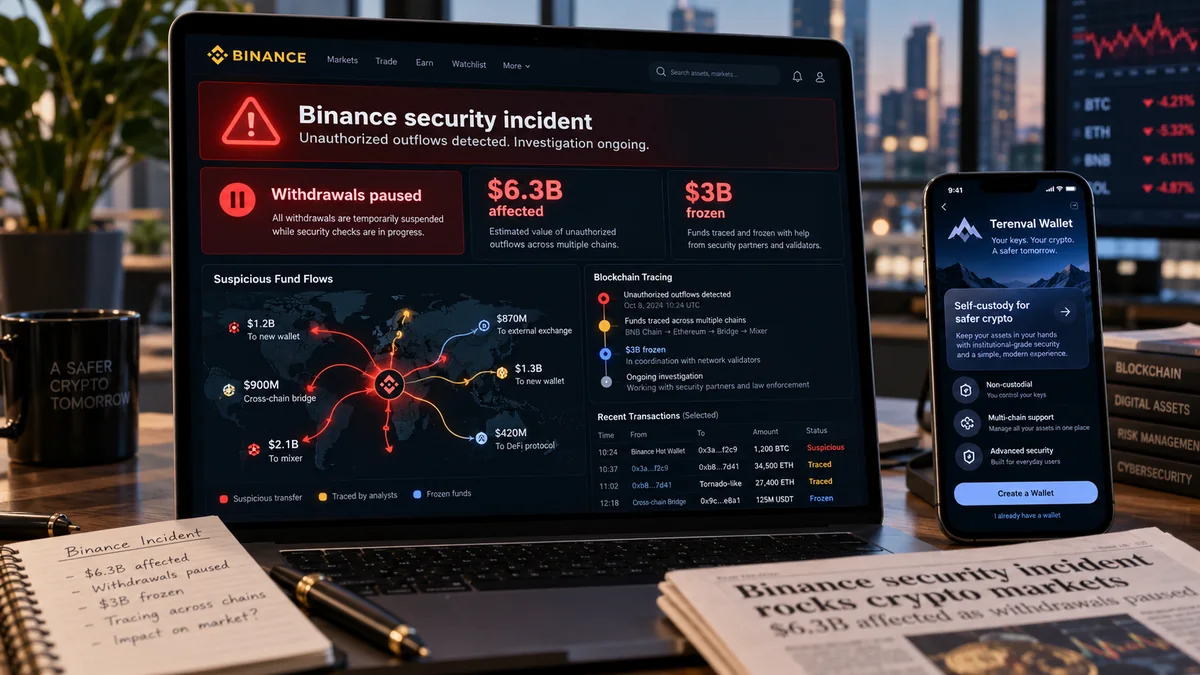
Binance says a major security incident may have affected approximately $6.3 billion in crypto assets, and it has temporarily paused deposits and withdrawals. The exchange says about $3 billion has been frozen, customer funds will be covered, and the investigation is continuing. The estimated impact is not the same as a confirmed final unrecoverable loss.
What happened
Direct summary: On October 29–30, 2026, Binance disclosed a suspected compromise involving unauthorized transfers from exchange-controlled wallets. In its October 30 update, the company put the estimated total impact at about $6.3 billion, said approximately $3 billion had been frozen on-chain, and temporarily suspended deposits and withdrawals while conducting security checks. Binance says its preliminary investigation points to a compromised employee laptop and that it has found no evidence of leaked wallet private keys.
The incident emerged on October 29 as blockchain analysts identified unusually large outflows from wallets associated with Binance. Early reports gave differing totals because analysts were observing different wallets, networks, asset prices and stages of the response. Binance subsequently published its higher estimated-impact figure. That number is the company's current estimate, not a completed independent audit or a final calculation of net losses.
Binance's verified news account says an attacker may have compromised a DevOps engineer's laptop, accessed a service container and submitted unauthorized withdrawal transactions. That is a preliminary explanation. It does not establish whether the attack involved stolen signing authority, manipulated signing workflows, compromised infrastructure, or some combination. A full post-incident report has been promised but was not yet available at the time of writing.
At a glance
| Question | Status as of October 30, 2026 |
|---|---|
| Which platform is affected? | Binance, a centralized cryptocurrency exchange |
| When was the incident identified? | October 29, with major updates October 30 |
| Estimated total impact | Approximately $6.3 billion, according to Binance |
| Amount frozen | Approximately $3 billion on-chain, according to Binance; subject to change |
| Deposits and withdrawals | Temporarily suspended for security checks in the latest official update |
| Preliminary attack path | Possible compromised DevOps laptop and access to a service container |
| Private keys leaked? | Binance says it has no evidence of a wallet private-key leak |
| Customer reimbursement | Binance says it will cover losses using company resources and its SAFU fund |
| Suspected attacker | TRM Labs attributes the activity to North Korea's TraderTraitor group; attribution is an intelligence assessment, not a judicial finding |
What the exchange has confirmed — and what remains uncertain
The most consequential distinction is between assets moved without authorization, assets frozen after the transfers, and losses that cannot ultimately be recovered. Those categories should not be added together or treated as interchangeable. A frozen stablecoin balance may be prevented from moving, but freezing does not automatically return it to Binance or restore a customer's ability to withdraw. Recovery may require issuer action, legal processes or further operational steps.
Binance has said it will bear the losses and that customer funds are safe. It also says it is working with law enforcement, token issuers and blockchain intelligence firms. The company plans to publish updated proof-of-reserves information after remediation. These are meaningful commitments, but they are not yet proof that withdrawals have resumed, that all reserves have been restored, or that every asset has been recovered.
Tether and Circle were among the stablecoin issuers reported to have frozen addresses linked to the incident. Reuters and Associated Press reported freezes of more than $1.5 billion in USDT and more than $800 million in USDC, respectively, while Binance later reported a larger total of approximately $3 billion frozen across affected assets. The figures are snapshots from a developing response, not competing final recovery totals.
Independent blockchain analysis has raised a separate concern about reserve coverage. CoinDesk compared drained wallet addresses with Binance's October 1 proof-of-reserves data and calculated that some reported asset backing could have fallen below 100% if the exchange had not already replaced the missing assets. That is an analytical estimate based on an earlier reserve snapshot, not a current verified reserve ratio. Binance's promised updated report will be important for assessing the post-incident position.
What is an exchange hot wallet?
A hot wallet is a wallet whose signing infrastructure is connected to systems that can process transactions online. Exchanges use hot wallets to handle deposits, withdrawals and liquidity movements quickly. That convenience also creates operational risk: if an attacker compromises a privileged system, transaction approval process or signing workflow, they may be able to move assets controlled by the exchange.
This is different from compromising Bitcoin's or Ethereum's underlying consensus rules. In a custodial wallet, the provider controls the signing arrangements for customer assets. A self-custody user instead controls the credentials needed to authorize their own transfers, as explained in Terenval Answers' comparison of custodial and non-custodial wallets. Each arrangement has different failure modes.
Some on-chain researchers have also identified activity involving EIP-7702 authorization, an Ethereum feature that can delegate account execution to contract code. Blockchain records can show a delegation and subsequent transfers; they do not by themselves prove how the required authorization was obtained or who compromised the relevant system. It would therefore be premature to describe EIP-7702 itself as a broken Ethereum protocol or to present one transaction-level mechanism as the complete explanation for the multi-chain incident.
Why it matters
The reported scale would make this one of the most consequential security incidents in cryptocurrency exchange history if the estimates hold. More importantly for ordinary users, it illustrates how custodial counterparty risk can emerge even when the blockchain holding an asset is operating normally.
An exchange balance is a claim administered through the platform's internal systems. Customers may be unable to move funds during a security suspension even if their account screen still displays a balance. A temporary withdrawal halt is not necessarily evidence of customer insolvency or permanent loss, but it is an immediate access restriction that users should take seriously.
The incident also demonstrates a distinction between centrally issued stablecoins and assets without an issuer-controlled freeze function. Issuers of USDT and USDC can restrict certain token balances under their contractual and technical arrangements. That can help contain theft, but it also introduces issuer and legal dependencies. The stablecoin glossary explains why tokens designed to track the dollar can still carry operational and counterparty risks.
What crypto users should know
Check official service status before initiating transfers. Binance's latest confirmed update says deposits and withdrawals are suspended. Do not send assets to an exchange deposit address on the assumption that normal crediting has resumed. Wait for an explicit official notice and verify the status of the exact asset and network you intend to use.
Do not assume your personal wallet was compromised. The reported incident concerns Binance-controlled infrastructure. There is no evidence in the cited reports that simply holding BTC, ETH or stablecoins in an unrelated self-custody wallet exposes its seed phrase or private key. If you use an exchange account, follow its authenticated security and service notices rather than speculative social-media instructions.
Watch for fake recovery and withdrawal messages. Large incidents attract impostors claiming to offer early withdrawals, refunds or emergency account verification. Never enter a seed phrase, export a private key, sign an unfamiliar transaction or pay a supposed release fee to recover exchange funds. Terenval's explanation of phishing describes common attempts to steal credentials through deceptive messages.
Plan withdrawals carefully after service restoration. If you later decide to move assets to self-custody, first verify the destination address and blockchain network, understand fees and minimums, and use a test transaction when practical. Terenval Answers provides a guide to withdrawing crypto from an exchange to a self-custody wallet and a separate checklist for sending crypto safely between wallets. Neither guide overrides the exchange's current restrictions.
Keep a record of your position. Save account statements, balance records, support case numbers and any official incident updates. Avoid making decisions solely on changing estimates of the stolen or frozen amount. The practical questions are when services resume, whether customer balances remain fully available, and what independent evidence supports the exchange's remediation claims.
Can Binance customers withdraw cryptocurrency now?
Not according to the latest official update reviewed for this article. Binance says deposits and withdrawals are temporarily suspended for security checks. This status can change quickly. Customers should verify the current status directly through authenticated official channels before acting.
Did Binance confirm that $6.3 billion was permanently lost?
No. Binance reported an estimated total impact of approximately $6.3 billion and said roughly $3 billion had already been frozen. The final recoverable and unrecoverable amounts are not yet established in the reviewed sources.
Were Binance wallet private keys stolen?
Binance says its initial investigation has found no evidence of a private-key leak. That does not establish the complete attack mechanism; the investigation and promised technical report are still pending.
Impact on Bitcoin, Ethereum, Layer 2 and DeFi
Bitcoin: The incident does not indicate a flaw in Bitcoin's consensus or a breach of ordinary Bitcoin self-custody wallets. Large exchange incidents can nevertheless affect market confidence, liquidity and the availability of trading or withdrawal services. Short-term price changes should not be confused with a protocol security failure.
Ethereum: Researchers observed substantial Ethereum-based transfers and have discussed EIP-7702 delegations in the attack sequence. That warrants examination of transaction-signing controls and delegation permissions, not an unsupported claim that Ethereum itself was hacked. The exchange's explanation of a potentially compromised service container remains preliminary.
Layer 2 and other networks: Investigators reported suspicious flows across several blockchains. A multi-chain incident can involve separate wallets and operational systems; it does not mean each underlying chain was independently compromised. Users should verify any network-specific deposit or withdrawal suspension instead of assuming a platform-wide notice gives identical details for every token.
DeFi: Reports indicate that some assets moved through decentralized trading and lending protocols after leaving the exchange. Those protocols may execute valid on-chain transactions without knowing the assets' prior custody history. The movement of funds through DeFi does not by itself establish that a particular protocol was exploited. It does, however, complicate tracing and recovery, especially when stolen assets are swapped or used as collateral.
Who was responsible?
On October 30, TRM Labs attributed the activity to TraderTraitor, a North Korean hacking unit, according to Reuters. TRM said its assessment had high confidence and referred to on-chain and off-chain intelligence. Other researchers also pointed toward North Korean operators. This is a serious attribution by a specialist firm, but it remains an investigative assessment, not a completed public forensic report from Binance or a court determination. The article does not assume the attribution is conclusively proven.
Related content suggestions
Readers assessing exchange exposure can begin with Terenval Answers' custody model comparison. For those considering a transfer after withdrawals reopen, the guide to safe exchange-to-wallet withdrawals provides practical network and address checks. These are educational resources, not instructions to move assets during a suspension.
Sources
- Binance News, October 30, 2026: Official update on the security investigation, approximately $6.3 billion estimated impact, roughly $3 billion frozen, service suspension and preliminary cause. https://www.binance.com/en/square/post/10-30-2026-binance-suspends-deposits-and-withdrawals-during-security-investigation-382683663031259
- Associated Press, October 30, 2026: Independent reporting on the company's statement, freeze activity and operational response. https://apnews.com/article/39cda8ceb8095e036334a18549d3d20d
- Reuters, October 30, 2026: TRM Labs' attribution to TraderTraitor and the reported cross-chain scale. https://www.reuters.com/legal/government/blockchain-analysis-firm-trm-says-north-korea-behind-binance-crypto-theft-2026-10-30/
- Reuters, October 29–30, 2026: Early freeze estimates and the company's response, republished by Euronext. https://live.euronext.com/en/financial-news/binance-says-254-billion-assets-frozen-it-probes-security-incident
- CoinDesk, October 29, 2026: Reporting on suspected outflows, issuer freezes, market response and the initial incident explanation. https://www.coindesk.com/business/2026/10/29/potential-multi-billion-binance-hack-hitting-crypto-markets
- CoinDesk, October 29–30, 2026: Analysis of the relationship between affected wallets and the earlier proof-of-reserves snapshot. https://www.coindesk.com/business/2026/10/30/binance-hack-drained-wallets-backing-customer-assets-reserve-data-shows
Editorial context
Information cutoff: October 30, 2026, approximately 05:00 UTC. This is a developing security incident. The $6.3 billion impact, approximately $3 billion frozen, preliminary laptop-compromise hypothesis, withdrawal suspension, and loss-coverage commitment are attributed to Binance's then-current statements. They must not be presented as a final forensic accounting or evidence that customer withdrawals have already resumed. The TraderTraitor attribution is credited to TRM Labs via Reuters and is not independently proven by this publication. Estimates based on Binance's earlier reserve snapshot are explicitly labeled as estimates. The article offers general security information, not investment, legal or individualized financial advice. Neutral editorial coverage is separate from any Terenval Wallet promotion.