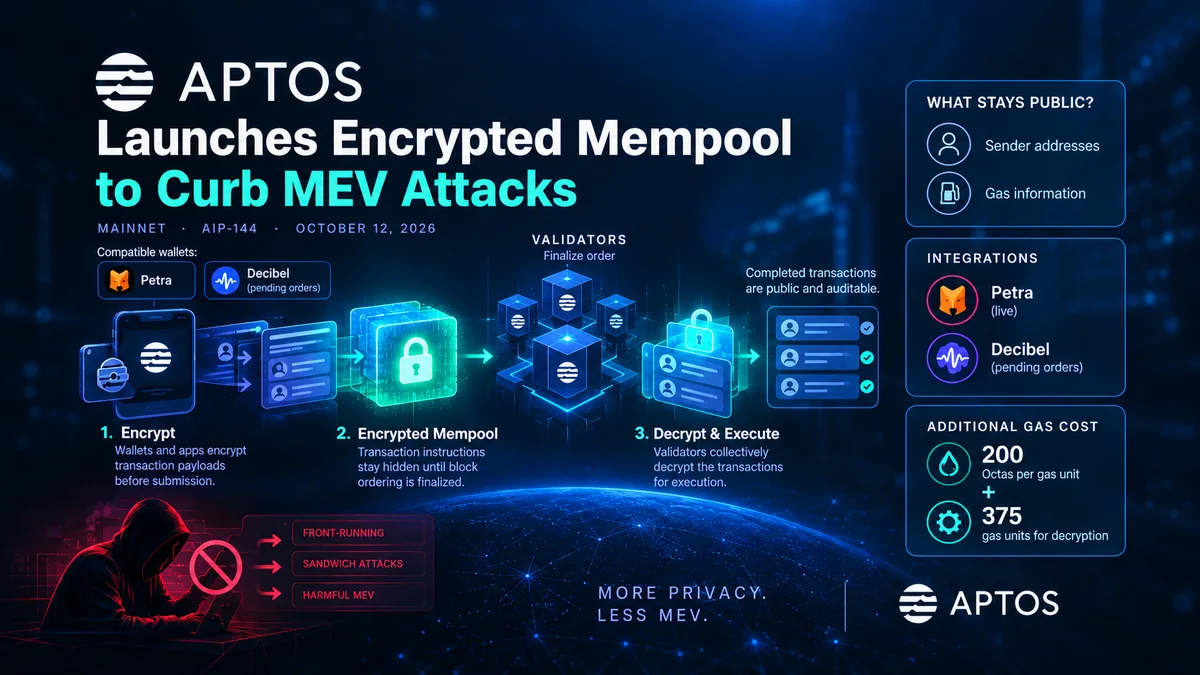
Aptos has brought an optional encrypted mempool to mainnet, giving traders a way to conceal pending transaction instructions until their order in a block is fixed. Announced on October 12, 2026, the feature targets the advance visibility that bots can exploit for front-running and sandwich attacks. It does not make completed transactions private.
What happened
The Layer 1 blockchain confirmed the rollout in its mainnet announcement. The system is specified in Aptos Improvement Proposal 144 (AIP-144) and lets compatible wallets and applications encrypt the executable payload before sending a transaction to the network.
What does Aptos Encrypted Mempool do? It hides a pending transaction's function call and arguments while validators determine transaction order. Once consensus finalizes the block, validators collectively decrypt the payload for execution. The sender address and gas information remain visible, and executed transaction details become public onchain.
Encryption is optional for each transaction. Aptos identifies Petra as the first wallet to offer the choice during signing and says Decibel, an Aptos-based perpetual futures exchange, plans to use it for order confidentiality. That planned integration should not be read as confirmation that every Decibel order already uses encryption.
Cointelegraph and crypto.news reported the launch on October 13. The distinction for users is straightforward: mainnet availability creates an option, while wallet and application support determine whether a particular transaction uses it.
Aptos encrypted mempool at a glance
| Detail | Status as of October 14, 2026 |
|---|---|
| Mainnet announcement | October 12, 2026 |
| Technical specification | AIP-144 |
| Activation | Opt in separately for each transaction |
| Hidden before ordering is finalized | Executable payload: function call and arguments |
| Visible during submission | Sender address and gas information |
| After execution | Transaction details are publicly auditable |
| Named wallet integration | Petra |
| Planned trading integration | Decibel |
| Minimum encrypted gas price | 200 Octas per gas unit |
| Additional decryption charge | 375 gas units per encrypted transaction |
Why pending transactions attract trading bots
A mempool holds transactions waiting to be included in blocks. When transaction instructions are readable before execution, observers may learn what another trader intends to buy or sell before that trade settles.
Front-running involves placing a transaction ahead of a targeted transaction. A sandwich attack commonly places one trade before a user's swap and another after it, profiting from the resulting price movement while worsening the user's execution. Both are associated with maximal extractable value (MEV), the value obtainable through transaction inclusion, exclusion or ordering.
For users of a decentralized exchange, hiding a pending instruction can remove information used to arrange those trades. It does not remove ordinary slippage, which can also arise from market movement or limited liquidity.
How the encryption works
The AIP-144 specification describes threshold encryption integrated with Aptos consensus. The validator set generates an encryption key for each epoch; a compatible client uses that key to encrypt the payload locally.
Processing follows four stages:
- The wallet or application encrypts the transaction payload before submission.
- Validators receive the encrypted transaction and agree on its position in a block.
- After consensus finalizes the block, validators provide the decryption shares needed to reveal the payload.
- The network executes the transaction and records its outcome on the public ledger.
No individual validator can decrypt a pending payload alone under the design's security assumptions. Ordering and decryption use the existing validator set rather than a separate decryption committee. The AIP also specifies a one-time cryptographic setup; describing the system as validator-based should not imply it is free of cryptographic or implementation assumptions.
Aptos reports approximately 20 milliseconds of extra latency per block in a 50-node benchmark against its production AptosBFT implementation. This is a reported test result, not a promised delay for every transaction. A published ZKSecurity audit covers the cryptography and consensus integration; its stated scope excludes gas metering.
Fees and developer support
According to Aptos developer documentation, encrypted submissions have a minimum gas-unit price of 200 Octas, twice the stated network base minimum. Decryption adds 375 gas units on top of the gas consumed by the payload.
These are two different fee components. A gas-unit price is the price paid for each unit of computation; a gas-unit charge increases the amount of computation billed. Neither number alone is the transaction's total fee, and the higher minimum does not mean every encrypted transaction costs exactly twice an ordinary one.
Aptos says its TypeScript SDK supports encrypted transactions from version 7.0.0 onward. Existing Move contracts do not need to be rewritten solely for encrypted submission, although wallets and applications must implement the compatible flow.
There is also a privacy trap for developers: direct simulation of encrypted payloads is unsupported. The documentation discourages simulating a plaintext copy immediately before submitting its encrypted counterpart, because observers could correlate the two and infer the hidden instructions.
Why it matters
The launch gives Aptos DeFi applications a protocol-level way to limit disclosure of trading intent before settlement. The potential benefit is narrower than permanent privacy: transaction instructions remain confidential during the period when their ordering is being decided.
That distinction matters commercially. A trader needs acceptable execution, not merely an encrypted submission. In an automated market maker, pool depth, price movement and swap limits still affect the result. Encryption cannot repair thin liquidity or a vulnerable smart contract.
The rollout therefore establishes a new capability, rather than proving an ecosystem-wide reduction in harmful MEV. Assessing its effectiveness will require adoption data and measured execution outcomes, including whether users gain enough protection to justify the added fees.
What crypto users should know
Before signing, confirm that the specific wallet and application support encrypted submission. Sending a transaction on Aptos does not automatically enable the feature. Review the encryption choice, network, destination, trade parameters and fee estimate in the signing flow.
For swaps, keep an appropriate minimum received amount or slippage limit. For any contract interaction, examine what the signature authorizes. Encryption does not stop a malicious application from requesting a harmful transaction; Terenval's guide to securing a non-custodial crypto wallet covers the separate signing and recovery safeguards.
Are encrypted Aptos transactions anonymous?
No. The first version conceals the executable payload while pending. Sender addresses and gas information remain visible, and transaction details become public after execution.
Does encrypted submission eliminate sandwich attacks and all MEV?
It targets attacks that depend on reading pending instructions before ordering is finalized. The launch does not establish that all sandwich attacks, ordering manipulation or other MEV have been eliminated.
Do Aptos holders need to migrate their tokens?
The announcement describes an optional transaction-submission feature, not a mandatory token migration. Using it does not require giving anyone a seed phrase or private key.
Impact on Aptos, DeFi and other blockchains
The direct effect is on Aptos wallets and applications that implement encrypted submission. It does not establish a change to APT token supply or a predictable effect on APT's price.
Bitcoin, Ethereum and Ethereum Layer 2 networks are not upgraded by this rollout. Their transaction-processing rules and privacy mechanisms remain separate. For cross-chain users, protection must be checked on the network and application where each transaction is submitted.
The next milestones to watch are broader wallet support, confirmed use by trading venues such as Decibel, and independent evidence on fees, reliability and harmful MEV outcomes. Until those results are available, the launch should be assessed as infrastructure progress with practical limits.
Related Glossary
- DeFi — the financial applications affected by transaction-ordering risks.
- Decentralized exchange — where swaps can expose price-sensitive trading intent.
- Slippage — why final execution can differ from an expected price.
- Automated market maker — how pool-based exchange pricing works.
Related Answers
- How to secure a non-custodial crypto wallet — signing, recovery and account-security practices.
Related News
Follow Terenval News for further blockchain, wallet and DeFi coverage.
Terenval Wallet
Explore Terenval Wallet and its educational resources to better understand wallet security and blockchain transactions.
Sources
- Aptos Network — Encrypted Mempool, Now on Aptos Mainnet, October 12, 2026. Primary launch announcement, integrations and benchmark.
- Aptos Improvement Proposal 144 — Encrypted Mempool. Primary specification for encrypted submission and consensus integration.
- Aptos Documentation — Encrypted Mempool. Primary documentation for fees, SDK support and simulation limits.
- ZKSecurity — Audit of Aptos Encrypted Mempool. Independent technical audit with defined scope.
- Cointelegraph — Aptos Rolls Out Encrypted Mempool to Curb Frontrunning, Sandwich Attacks, October 13, 2026. Independent launch coverage.
- crypto.news — Aptos Launches Encrypted Mempool: How Does It Work?, October 13, 2026. Independent reporting on deployment and integration.
Editorial context
Source material checked on October 14, 2026. This article separates the announced mainnet deployment from intended benefits, reported benchmarks and future adoption. It does not independently measure MEV reduction or verify every wallet integration. Fees and SDK requirements reflect the linked documentation at the time of review. The linked audit is not presented as a guarantee that the system is vulnerability-free. Terenval links provide educational context; this report does not announce encrypted-mempool support in Terenval Wallet.