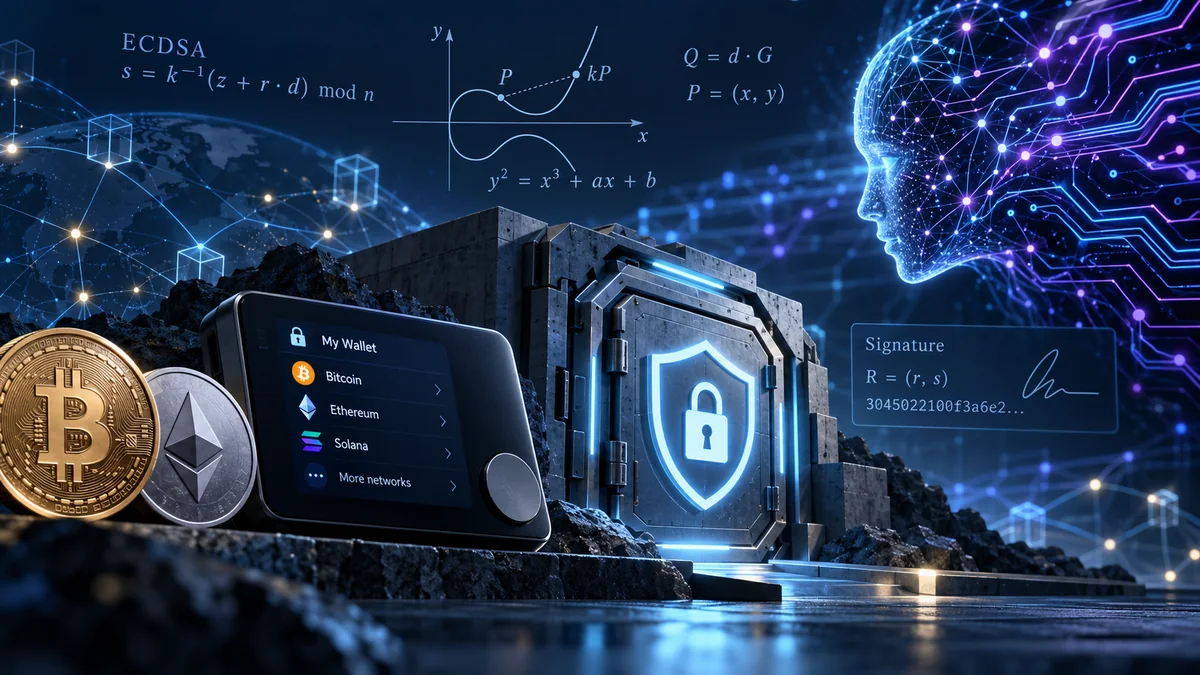
A new debate over AI and crypto wallet security has reached one of the most sensitive parts of the cryptocurrency ecosystem: the mathematics protecting private keys.
Ethereum researcher Justin Drake has urged the industry to prepare for a precautionary “bunker mode” in case AI-assisted mathematical research eventually produces new attacks against elliptic-curve cryptography. Ethereum co-founder Vitalik Buterin agrees that the risk deserves serious study, but he has warned against rushing users into wallet migrations.
The most important point is also the simplest:
There is no publicly demonstrated attack that can currently recover Bitcoin or Ethereum private keys from public keys. No confirmed break of Bitcoin, Ethereum or ECDSA was announced. The discussion is about future risk, cryptographic contingency planning and how the industry should react if the threat model changes.
AI and crypto wallet security: what happened?
On October 7, 2026, Ethereum Foundation researcher Justin Drake called on the blockchain industry to begin planning for what he described as “bunker mode.”
His concern is not that Bitcoin or Ethereum have already been hacked. Instead, Drake argued that rapid progress in AI-assisted mathematics could increase the chance of an unexpected mathematical breakthrough against cryptographic assumptions that have remained secure for decades.
One possible defensive approach would be to reduce unnecessary exposure of public keys where a blockchain's address design makes that possible. For sophisticated holders and infrastructure providers, that could mean identifying which keys have already been exposed, limiting key reuse and preparing carefully tested migration plans before an emergency exists.
Vitalik Buterin responded that AI-driven advances in mathematics are worth taking seriously. At the same time, he cautioned against panic and against moving funds hastily, because rushed wallet migrations can create their own security failures.
Other cryptographers disputed the urgency. Yehuda Lindell, head of cryptography at Coinbase, said there is no evidence that the underlying hardness assumptions behind elliptic-curve cryptography have been weakened.
That disagreement is the real story: the crypto industry is debating how early it should prepare for a hypothetical cryptographic threat that has not been demonstrated in practice.
At a glance
| Question | What is known |
|---|---|
| What triggered the debate? | Public comments by Ethereum researchers on October 7, 2026 |
| Main concern | AI-assisted mathematical research could potentially discover new attacks on elliptic-curve cryptography |
| Has ECDSA been broken? | No publicly demonstrated break |
| Has Bitcoin or Ethereum wallet cryptography been broken? | No |
| Justin Drake's position | Prepare calmly for a possible “bunker mode” and reduce unnecessary public-key exposure where possible |
| Vitalik Buterin's position | Take the risk seriously, but do not rush users into migrations |
| Other cryptographers | Some dispute the urgency and say there is no evidence of weakened elliptic-curve assumptions |
| What should typical users do now? | Do not panic, do not expose recovery phrases, and wait for verified technical evidence and protocol guidance |
What is 'bunker mode' in crypto?
“Bunker mode” is an informal security concept, not an Ethereum upgrade, a newly discovered exploit or a standard wallet feature.
The idea is to reduce the amount of cryptographic information that would be useful to an attacker if a new mathematical attack against public-key cryptography ever became practical.
On some blockchains and address types, an address initially exposes a hash derived from a public key rather than the full public key itself. The public key may become visible later, for example when funds are spent or a transaction is signed.
In that specific threat model, an unused address whose public key has not yet been revealed could offer an additional layer of protection against an attack that requires the public key as input.
But this is not a universal rule across crypto networks.
Different blockchains expose keys in different ways. Bitcoin output types behave differently from Ethereum externally owned accounts. Solana commonly uses the public key itself as the account address. Smart-contract wallets and multisignature systems introduce additional authorization rules.
That means “move everything to a fresh wallet” is not a safe universal recommendation.
Can AI break Bitcoin or Ethereum cryptography?
There is currently no public evidence that AI can break the cryptography protecting Bitcoin or Ethereum wallets.
The warning is about a different possibility: AI systems may accelerate mathematical research enough to help humans discover new algorithms, proofs or cryptanalytic techniques faster than expected.
That is fundamentally different from a demonstrated wallet exploit.
For a claim of a real cryptographic break to be credible, researchers would need to provide a reproducible method, a clear threat model, realistic computational requirements and independent verification.
None of that has been publicly demonstrated for Bitcoin or Ethereum private-key recovery in this debate.
The discussion should therefore be understood as risk planning under uncertainty, not as evidence that private keys are currently being extracted from wallets.
How ECDSA protects crypto wallets
The Elliptic Curve Digital Signature Algorithm (ECDSA) allows a user to prove that a transaction was authorized by the holder of a private key without revealing that private key.
Ethereum externally owned accounts use ECDSA on the secp256k1 elliptic curve. Bitcoin has historically used ECDSA for many transaction types, while newer Bitcoin Taproot outputs use Schnorr signatures instead.
Under current classical computing assumptions, deriving a properly generated private key from its corresponding public key is considered computationally infeasible.
A sufficiently powerful quantum computer is expected to threaten many public-key cryptographic systems. Drake's warning adds a separate possibility: an unexpected classical mathematical breakthrough, potentially accelerated by AI, that weakens assumptions earlier than the industry expects.
That remains hypothetical.
An AI model producing new mathematics is not, by itself, evidence that ECDSA, Schnorr signatures, Ed25519 or another deployed signature system has been broken.
The U.S. National Institute of Standards and Technology documents ECDSA and other signature methods in its Digital Signature Standard.
Why the new AI mathematics release attracted attention
On October 6, OpenAI published a public repository containing mathematical manuscripts and supporting proof artifacts generated with an internal model.
The OpenAI mathematics repository notes that the material has different levels of verification and that some unformalized results may contain issues.
Drake cited the pace of AI-generated mathematical work as a reason to reconsider assumptions about how quickly new cryptographic ideas—or new attacks—could emerge.
The key distinction is important for both users and investors:
A rapid increase in AI-assisted mathematical research is not the same thing as a published cryptanalytic break of a live blockchain signature scheme.
The former may change how security teams think about long-term risk. The latter would require immediate technical evidence and protocol-level response.
Why it matters
Crypto wallets depend on cryptographic authorization. If an attacker could efficiently derive private keys from exposed public keys, the consequences for affected addresses could be severe.
That is why advance planning matters even when the probability or timing of a breakthrough is uncertain.
Wallet developers, exchanges, custodians, blockchain teams and DeFi protocols may eventually need migration strategies that account for:
- which public keys are already exposed;
- which signature algorithms each network uses;
- how users can migrate without losing funds;
- how smart-contract wallets and multisig systems would upgrade;
- compatibility with exchanges, bridges and hardware wallets;
- transaction size and fee implications of alternative signature systems;
- protection against phishing during any future migration.
At the same time, security warnings can create immediate risks even when the underlying cryptographic threat remains hypothetical.
A rushed transfer to the wrong network, an untested smart contract, a malicious “AI-proof wallet” website or a fake migration tool can cause irreversible losses without any breakthrough in cryptography.
Terenval's wallet security overview covers the basic safeguards that remain important regardless of which signature algorithm a blockchain uses.
What crypto users should know
For most users, the current debate does not justify an emergency migration.
A safer response is to separate proven security practices from speculative forecasts.
1. Do not panic-move funds
There is no demonstrated attack that requires every Bitcoin or Ethereum holder to move assets immediately. Buterin specifically warned against rushed migrations.
2. Never enter a seed phrase into an 'AI-safe' migration website
A website claiming to convert a wallet into an “AI-proof,” “quantum-safe” or “bunker mode” wallet should never need your recovery phrase.
Terenval's support and anti-impersonation guidance explains why legitimate wallet support does not need access to those secrets.
3. Do not assume that every blockchain exposes keys in the same way
Bitcoin, Ethereum, Solana and smart-contract wallets use different account and signature models. Advice that is valid for one network may be misleading on another.
4. Large holders should review migration plans before an emergency
Institutions, custodians, DAOs and users with unusually large or complex positions may reasonably audit key exposure, address reuse, multisig dependencies and recovery procedures before any urgent threat appears.
5. Watch for reproducible evidence, not dramatic timelines
The developments that matter most are peer-reviewed or independently verified cryptographic results, formal protocol proposals and clear migration guidance from the networks involved.
What 'bunker mode' could mean for Bitcoin
Bitcoin's public-key exposure depends on the output type.
In traditional P2PKH and P2WPKH outputs, the blockchain initially commits to a hash of the public key, and the public key is typically revealed when the output is spent.
Bitcoin Taproot works differently: its x-only output public key is visible in the output itself.
Older and specialized script types may behave differently again.
As a result, the advice to “use a fresh Bitcoin address” is not universally sufficient. The output type, spending history and whether the public key is already visible all matter.
No Bitcoin consensus change or emergency migration was announced as part of this debate.
What it could mean for Ethereum
A standard Ethereum externally owned account is derived from a hash of the public key.
Before the account signs an outgoing transaction, the public key is not directly stored as the account address. Once the account signs a normal ECDSA transaction, the signature contains enough information for the public key to be recovered.
That means a fresh, never-used Ethereum account can have a different public-key exposure profile from an account that has already signed transactions.
However, address rotation is not a complete solution.
Ethereum smart-contract wallets, multisig arrangements and account-abstraction systems can use different authorization models. Assets may also be controlled by contracts whose owner keys, upgrade keys or governance permissions have their own exposure.
What it could mean for Ethereum Layer 2 networks
Many Ethereum Layer 2 networks use Ethereum-compatible accounts and signing methods, but migration can be operationally more complicated.
Users may have assets spread across bridges, smart-contract wallets, DeFi protocols and withdrawal systems. Sequencer and bridge infrastructure can introduce additional dependencies.
That is why users should not move L2 assets solely because a social-media post claims that all EVM addresses face the same immediate risk.
Any future migration would need network-specific guidance.
What it could mean for DeFi
DeFi adds additional authorization layers beyond a wallet's basic private key.
These can include:
- token allowances;
- smart-contract ownership;
- multisignature governance;
- protocol upgrade keys;
- delegated permissions;
- bridge contracts;
- protocol-specific withdrawal processes.
Even if a user rotates an account key, existing approvals or smart-contract dependencies may remain.
For DeFi protocols, the responsible response is to identify the exact cryptographic assumptions they rely on and test migration mechanisms before asking users to take action.
What about Solana and other networks?
Solana's common Ed25519 account model is different from Ethereum's ECDSA account model.
A Solana address is normally the public key itself. Generating a fresh Solana address therefore does not hide the public key in the same way that some hash-derived address formats can.
That does not mean Solana has a confirmed cryptographic vulnerability.
It means that any future response to an AI-assisted cryptographic threat would have to be tailored to each network's actual signature scheme, address design and transaction model.
Is this an AI threat or a quantum-computing threat?
They are related only in the sense that both could force the crypto industry to reconsider long-standing cryptographic assumptions.
The better-known risk comes from sufficiently powerful quantum computers, which are expected to threaten several public-key cryptographic systems.
The current debate is different.
Drake's concern is that AI-assisted mathematical discovery could potentially uncover a new classical shortcut before quantum hardware becomes capable enough to pose the expected threat.
No such shortcut has been demonstrated against Bitcoin or Ethereum wallet signatures.
What happens next?
The most important signals to watch are not sensational predictions but reproducible cryptographic evidence and concrete protocol proposals.
A credible claim that a major wallet signature scheme has been broken would need:
- a documented attack method;
- a clearly defined threat model;
- realistic computational requirements;
- independent verification;
- an explanation of which networks, address types or users are affected.
Likewise, a proposal to migrate to safer signatures would need to address wallet compatibility, hardware support, transaction size, fees, smart-contract behavior and how users can move assets without exposing themselves to operational mistakes or phishing.
For now, the strongest verified conclusion is that the crypto industry is debating whether it should accelerate contingency planning for future cryptographic risks.
The public record does not establish that AI can currently recover Bitcoin or Ethereum private keys from public keys.
Editorial review
Reviewed by: Terenval Editorial Team
Review date: October 9, 2026
This article reports on a debated and hypothetical future security risk. No confirmed compromise of Bitcoin, Ethereum or ECDSA has been demonstrated. The article distinguishes current verified facts from forward-looking cryptographic concerns and reflects the cited public statements and technical sources available at publication time.
Sources
- Justin Drake, public statement on “bunker mode,” October 7, 2026.
- Vitalik Buterin, response cautioning against rushed migrations, October 7, 2026.
- Yehuda Lindell, response on the lack of evidence for weakened elliptic-curve assumptions.
- OpenAI, mathematical manuscripts and supporting proof artifacts.
- NIST, FIPS 186-5 Digital Signature Standard.
- The Block, “Crypto industry split over Justin Drake's AI warning,” October 8, 2026.
- CoinDesk, “Bitcoin and ether holders urged to prepare ‘bunker mode,’” October 8, 2026.
- Decrypt, “Will AI Break Crypto Encryption?” October 8, 2026.