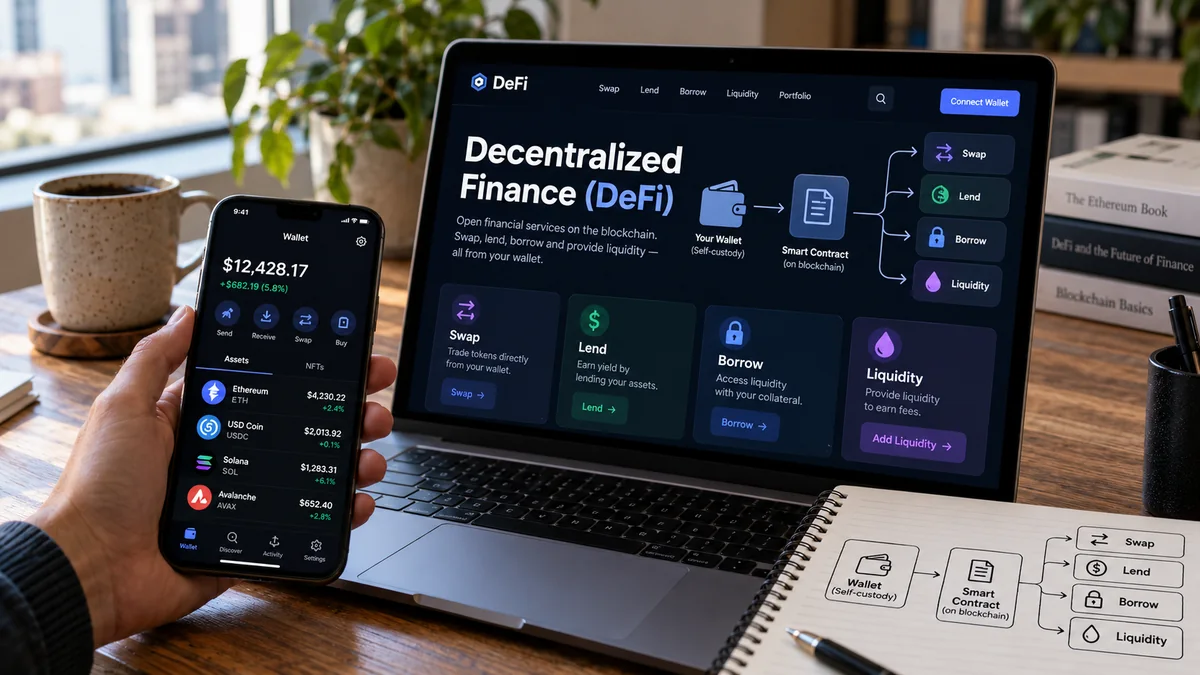
DeFi, short for decentralized finance, is a category of blockchain-based financial applications that use smart contracts to provide services such as trading, lending, borrowing, and liquidity provision without requiring a traditional bank or broker to process every transaction.
Instead of opening an account with a financial institution and asking that institution to execute an operation for you, a DeFi user typically connects a crypto wallet to an application, reviews the requested action, and signs a blockchain transaction. Smart contracts then execute the rules of the protocol on-chain.
DeFi does not mean that every part of the system is completely decentralized or risk-free. Protocol governance, user interfaces, oracles, stablecoins, bridges, developers, and other infrastructure can still introduce dependencies and points of failure.
Short answer: DeFi is financial software built on blockchains. A user normally interacts with DeFi through a crypto wallet, while smart contracts handle functions such as token swaps, collateralized loans, lending markets, and liquidity pools.
Key Takeaways
- DeFi means decentralized finance: financial applications built on blockchains and smart contracts.
- Users usually interact through self-custody wallets rather than depositing all funds with a traditional financial intermediary.
- Smart contracts execute protocol rules, such as swapping tokens, calculating collateral requirements, distributing interest, or liquidating undercollateralized positions.
- Common DeFi activities include decentralized trading, lending, borrowing, liquidity provision, stablecoin use, derivatives, and yield strategies.
- DeFi is composable: one protocol can integrate assets or functions from another protocol, allowing applications to work together.
- DeFi is not automatically safe or fully decentralized. Smart-contract bugs, malicious approvals, oracle failures, liquidation, low liquidity, governance concentration, bridges, and scams can all cause losses.
- A wallet connection alone usually does not move funds. A transaction, token approval, signature, or another explicit authorization is normally required before a protocol can act on a user's assets.
What Does DeFi Mean?
DeFi stands for decentralized finance.
The term describes financial products and services that operate primarily through blockchain networks and programmable smart contracts rather than through the internal databases and processes of a traditional bank, brokerage, or centralized exchange.
Ethereum.org's DeFi overview describes DeFi as an open financial system built around cryptocurrencies and smart contracts. The important idea is not that humans disappear from finance, but that many financial rules can be expressed and executed by software on a public blockchain.
Examples include:
- exchanging one token for another on a decentralized exchange;
- supplying assets to a lending market;
- borrowing against crypto collateral;
- providing assets to a liquidity pool;
- using stablecoins for settlement;
- accessing derivatives or other on-chain markets;
- combining multiple protocols into a larger financial strategy.
For a shorter definition, see the Terenval glossary entry: What is DeFi?.
How Does DeFi Work?
Most DeFi systems combine several layers:
- A blockchain that records transactions and the state of accounts and smart contracts.
- Digital assets such as ETH, stablecoins, and other tokens.
- Smart contracts that define and execute the protocol's rules.
- Oracles and other infrastructure that may provide external information such as asset prices.
- Wallets and application interfaces that let users interact with the protocol.
- Economic incentives that encourage liquidity providers, borrowers, traders, validators, governance participants, or other actors to behave in ways the protocol expects.
Ethereum.org presents DeFi as a stack of blockchain infrastructure, assets, protocols, and applications. The Bank for International Settlements also analyzes DeFi as a layered technical system, emphasizing that risks can arise at several different layers rather than from one single component.
A simple DeFi transaction step by step
Suppose a user wants to swap ETH for a stablecoin on a decentralized exchange.
A typical flow looks like this:
- The user opens a DeFi application.
- The user connects a compatible crypto wallet.
- The application reads the public wallet address and relevant blockchain data.
- The user selects the tokens and amount to swap.
- The application prepares a blockchain transaction.
- The wallet displays the transaction for review.
- The user signs and submits the transaction.
- The blockchain processes the transaction.
- The smart contract executes the swap according to its rules.
- The wallet balance and on-chain state update after confirmation.
The exact process differs by protocol, network, wallet, and token.
If an ERC-20 token needs to be spent by a smart contract, the user may first need to grant a token approval. That approval is a separate permission and should be reviewed carefully.
Terenval has a deeper guide on this topic: How Do You Revoke Token Approvals After Using a dApp?.
What Is a DeFi Protocol?
A DeFi protocol is the set of smart contracts, rules, and economic mechanisms that provide a financial function on a blockchain.
For example, a lending protocol may define:
- which assets users can supply;
- which assets can be borrowed;
- collateral requirements;
- interest-rate rules;
- liquidation thresholds;
- protocol fees;
- governance processes.
A decentralized exchange may instead define:
- how liquidity is supplied;
- how token prices are calculated;
- how swaps are executed;
- what fees traders pay;
- how liquidity providers are compensated.
The website or mobile interface is not necessarily the protocol itself. It is often only one way to interact with the underlying smart contracts.
This distinction matters because an interface can be unavailable while the underlying protocol contracts continue to exist on-chain. However, using contracts without a trusted interface can be technically complex and introduces additional risks.
What Is a DeFi App or dApp?
A DeFi app is a decentralized application, or dApp, that provides an interface to one or more blockchain protocols.
A dApp may look similar to a normal website, but important actions are performed through a wallet and blockchain transactions.
The interface can:
- display wallet balances;
- show token prices;
- build transactions;
- estimate fees;
- show collateral ratios;
- display lending or liquidity positions;
- request token approvals;
- connect users to smart contracts.
The wallet remains an important security boundary because it is where the user reviews and authorizes requests.
If you want to understand how wallet connections work, read What Is WalletConnect and How Does It Connect a Wallet to a dApp?.
What Can You Do With DeFi?
DeFi covers many different financial functions. The most common categories include decentralized exchanges, lending and borrowing, liquidity provision, stablecoins, derivatives, and automated strategies.
1. Swap Tokens on a Decentralized Exchange
A decentralized exchange (DEX) allows users to trade crypto assets using smart contracts.
Unlike a centralized exchange, a DEX typically does not require the user to deposit assets into an exchange-controlled account before every trade. Instead, the user signs a transaction from a wallet and interacts with the exchange protocol.
Many DEXs use automated market makers (AMMs) rather than a traditional order book.
Uniswap is one of the best-known examples. Its early protocol design uses pools of token reserves and a mathematical pricing mechanism to enable on-chain swaps. The Uniswap v2 whitepaper documents this automated liquidity model.
A DEX transaction can involve:
- liquidity pools;
- trading fees;
- slippage;
- price impact;
- routing across multiple pools;
- token approvals;
- blockchain gas fees.
These concepts deserve their own Answers pages because each represents a distinct search intent.
2. Lend Crypto Assets
DeFi lending protocols allow users to supply assets to a liquidity market.
Other participants may borrow from that pool, and suppliers can receive interest generated by borrowing activity, subject to the protocol's rules and risks.
For example, Aave's documentation describes a non-custodial liquidity protocol in which users can supply assets and borrowers can access liquidity against collateral.
The important point is that the return does not appear from nowhere.
Yield can come from:
- interest paid by borrowers;
- trading fees;
- protocol incentives;
- token emissions;
- other economic activity.
Before pursuing a yield, users should understand where that yield comes from and what risks generate it.
3. Borrow Against Crypto Collateral
Many DeFi loans are overcollateralized.
A borrower may deposit crypto worth more than the value of the asset being borrowed.
For example, a user might deposit one asset as collateral and borrow a stablecoin without selling the original asset.
The protocol continuously monitors the value of the position.
If the collateral value falls too far relative to the debt, the position may become eligible for liquidation.
This is fundamentally different from an unsecured consumer loan based mainly on income history or a credit score.
Learn the underlying concept in the Terenval glossary: What is collateral?.
4. Provide Liquidity
A liquidity provider supplies assets that a protocol can use to facilitate trading, lending, or another function.
On an AMM-based decentralized exchange, users may deposit token pairs into a liquidity pool.
In return, liquidity providers may receive:
- a share of trading fees;
- protocol incentives;
- other rewards.
But liquidity provision creates risks.
Depending on the protocol, these can include:
- impermanent loss or loss-versus-rebalancing;
- smart-contract risk;
- token price risk;
- low liquidity;
- malicious or low-quality tokens;
- oracle problems;
- governance changes.
A high advertised annual percentage yield does not tell you how much risk is involved.
5. Use Stablecoins
Stablecoins are a major part of many DeFi markets because they provide an on-chain asset designed to track a relatively stable reference value, often the U.S. dollar.
They can be used for:
- trading pairs;
- borrowing;
- lending;
- collateral;
- liquidity pools;
- payments;
- settlement.
However, a stablecoin introduces its own risks in addition to the risks of the DeFi protocol using it.
Those can include reserve, issuer, redemption, smart-contract, liquidity, and depeg risk.
For a full explanation, read What Is a Stablecoin?.
6. Trade Derivatives and Other On-Chain Markets
Some DeFi applications provide more complex financial products, including:
- perpetual futures;
- options;
- synthetic assets;
- prediction markets;
- structured products;
- leveraged positions.
These products can be significantly riskier than a simple token transfer or spot swap because leverage, liquidation, funding rates, oracle design, and market liquidity can interact.
Beginners should not assume that a decentralized interface makes a complex financial product easier or safer.
How Do Smart Contracts Power DeFi?
A smart contract is a program deployed to a blockchain.
It can receive transactions, hold or control digital assets according to its code, update state, and execute predefined logic.
In DeFi, smart contracts can perform functions that would otherwise require financial infrastructure or intermediaries.
For example, a smart contract can:
- calculate how many tokens a swap should return;
- track deposits and loans;
- calculate interest;
- enforce collateral requirements;
- distribute fees;
- execute liquidations;
- issue liquidity or receipt tokens;
- coordinate governance rules.
This automation is one of DeFi's main strengths, but it is also one of its central risks.
If a smart contract contains a vulnerability or behaves differently from what a user expects, blockchain transactions can be difficult or impossible to reverse.
Before interacting with an unfamiliar protocol, see Terenval's guide: How Do You Evaluate Smart Contract Risk Before Using a DeFi App?.
Why Does DeFi Use Crypto Wallets?
A crypto wallet is the user's interface for controlling blockchain accounts and authorizing transactions.
In a typical self-custody DeFi workflow, the wallet:
- holds or controls the keys used to authorize transactions;
- displays the account address;
- shows transaction requests;
- signs transactions;
- may sign off-chain messages;
- interacts with dApps through a browser, mobile app, or connection protocol.
The wallet does not make a DeFi protocol trustworthy.
It only provides a way to interact with the protocol.
A malicious website can still present a dangerous transaction or approval request to a legitimate wallet. Users must review what they are signing.
Does Connecting a Wallet Give a DeFi App Access to Your Funds?
Normally, connecting a wallet by itself does not give a dApp unrestricted permission to move all of your assets.
A basic wallet connection usually exposes public information such as the wallet address and allows the app to request actions.
Moving tokens generally requires an additional authorization such as:
- signing a blockchain transaction;
- granting a token approval;
- signing a permit;
- authorizing another specific action.
However, users should never assume that every signature request is harmless.
A malicious approval or transaction can create permission for a contract to move tokens.
This is why wallet prompts should be treated as security-critical actions rather than routine pop-ups.
What Is a Token Approval in DeFi?
Many tokens use an approval system that allows a smart contract to spend a defined amount on behalf of a wallet.
For example, before a DEX can swap a user's ERC-20 token, the user may need to approve the DEX's smart contract to access that token.
Approvals can be:
- limited to a specific amount;
- much larger than the immediate transaction;
- effectively unlimited for that token.
Unlimited approvals can make future interactions easier, but they also increase exposure if the approved contract or spender is compromised.
Users should periodically review and revoke permissions they no longer need.
What Is a Liquidity Pool?
A liquidity pool is a set of crypto assets deposited into a smart contract and made available for a protocol's operations.
Liquidity pools can be used for:
- token swaps;
- lending markets;
- derivatives;
- stablecoin mechanisms;
- other DeFi functions.
In an AMM-based DEX, traders swap against assets held in pools rather than matching directly with another individual trader at the same moment.
The pool's pricing formula and available liquidity help determine the execution price.
What Is an Automated Market Maker?
An automated market maker (AMM) is a protocol mechanism that uses smart contracts and a pricing formula to facilitate trades using pooled liquidity.
Traditional exchanges often rely on order books where buyers and sellers place bids and offers.
An AMM can instead quote prices based on the state of a liquidity pool.
Different AMMs use different formulas and designs.
This is why "DEX" and "AMM" are related terms but are not exact synonyms: a DEX describes the decentralized trading venue, while an AMM is one possible mechanism used to provide and price liquidity.
What Is DeFi Composability?
Composability means that DeFi protocols can often interact with other protocols and tokens as building blocks.
A developer might create an application that:
- accepts a stablecoin;
- deposits it into a lending protocol;
- receives a token representing the deposit;
- uses that token in another protocol.
This ability to combine protocols is sometimes described as financial "money legos."
The BIS identifies composability as an important property of DeFi architecture because protocols can use functionality from other protocols to construct new financial services.
Composability creates innovation, but it also creates dependency risk.
If Protocol B depends on Protocol A, a failure in Protocol A can affect users of Protocol B even if Protocol B's own code works correctly.
What Is the Difference Between DeFi and Traditional Finance?
DeFi and traditional finance can perform similar economic functions, but their infrastructure and trust models differ.
| Feature | DeFi | Traditional finance |
|---|---|---|
| Core infrastructure | Blockchains and smart contracts | Financial institutions and private databases |
| User access | Usually through a crypto wallet and blockchain network | Usually through an account with a regulated institution |
| Settlement | On-chain according to network rules | Through banks, payment systems, brokers, clearing systems |
| Custody | Can be self-custodial or protocol-based | Commonly institutional custody |
| Transparency | Smart-contract code and on-chain activity may be publicly inspectable | Internal systems are usually not publicly inspectable |
| Availability | Blockchain markets can operate continuously | Many markets and banking functions follow operating schedules |
| Identity | Often wallet-based at protocol level, but interfaces may impose requirements | Usually identity-linked |
| Reversibility | Confirmed blockchain transactions are often difficult to reverse | Some payments or institutional actions can be reversed or disputed |
| Main risks | Smart contracts, keys, oracles, liquidity, liquidation, governance, bridges | Institution, credit, operational, market, legal, settlement risks |
| Regulation | Varies substantially by protocol and jurisdiction | Generally built around established regulated institutions |
The comparison should not be simplified into "DeFi has no intermediaries" and "traditional finance has intermediaries."
DeFi replaces some forms of intermediation with software and blockchain infrastructure, but other dependencies remain.
What Is the Difference Between DeFi and CeFi?
CeFi means centralized finance in the crypto context.
A centralized exchange or crypto lending company may provide crypto-related financial services while controlling accounts, order execution, custody, or internal balances through centralized infrastructure.
Typical differences are:
| DeFi | CeFi |
|---|---|
| User may interact directly with smart contracts | User interacts with a centralized company |
| Self-custody is common | Platform custody is common |
| Transactions can be visible on-chain | Much activity occurs in internal databases |
| Protocol rules may be encoded in contracts | Company policies and systems control operations |
| Wallet signatures authorize many actions | Account login authorizes many actions |
| Smart-contract and wallet risks are important | Company, custody, solvency, and account risks are important |
Neither model is automatically safe.
They simply place trust and operational risk in different places.
Is DeFi Really Decentralized?
Not always, and not equally.
A protocol may be decentralized in one dimension and centralized in another.
Possible areas of concentration include:
- governance token ownership;
- admin keys;
- protocol upgrade permissions;
- frontend hosting;
- oracle providers;
- stablecoin issuers;
- bridge operators;
- development teams;
- multisignature signers;
- sequencers on some scaling networks.
The BIS has described this problem as a "decentralisation illusion": removing a traditional intermediary does not necessarily remove governance, concentration, or control from the system.
Therefore, "decentralized" should be treated as a property to evaluate rather than a binary label.
What Are the Benefits of DeFi?
DeFi can offer several useful properties.
Open access
Many DeFi protocols can be accessed by anyone who has:
- an internet connection;
- a compatible wallet;
- the required blockchain assets;
- enough native token to pay network fees.
A separate bank account may not be required at the protocol level.
However, access can still be affected by local law, frontend restrictions, centralized infrastructure providers, or token issuer policies.
Self-custody
Users can often interact with DeFi while keeping control of their wallet keys.
This reduces reliance on a centralized exchange or custodian for every transaction.
But self-custody also transfers responsibility to the user.
Losing a seed phrase, signing a malicious transaction, or sending funds incorrectly may have irreversible consequences.
Transparency
Public blockchains make many transactions and contract states visible.
Users, developers, researchers, and monitoring systems can often inspect:
- balances;
- transactions;
- smart contracts;
- collateral;
- protocol activity.
Transparency does not mean the system is easy to understand. Complex smart contracts and interconnected protocols can still be difficult to evaluate.
Programmability
Smart contracts can execute rules automatically.
This enables:
- automated trading;
- collateral management;
- lending markets;
- liquidations;
- on-chain settlement;
- programmable financial products.
Composability
Protocols can interact with each other, allowing developers to build new products from existing financial primitives.
This can accelerate innovation but also transmit risk between protocols.
What Are the Main Risks of DeFi?
DeFi can expose users to multiple risks at the same time.
A useful way to evaluate a DeFi position is to ask: What has to keep working for me to get my assets back?
The answer may involve far more than one smart contract.
Smart-Contract Risk
A bug, design flaw, exploit, or unexpected interaction can cause funds to be lost or frozen.
Audits can reduce uncertainty but do not prove that a contract is perfectly safe.
Even well-known protocols can contain vulnerabilities.
Token Approval and Signature Risk
A legitimate wallet can sign a malicious transaction.
Attackers may use:
- fake DeFi websites;
- phishing links;
- malicious approvals;
- deceptive signatures;
- compromised frontends.
The user should verify the domain, contract, asset, amount, network, and requested permission before approving an action.
Oracle Risk
Some protocols need external or aggregated price information to determine:
- collateral values;
- liquidations;
- derivative settlement;
- borrowing capacity.
If a price oracle is manipulated, delayed, or incorrectly configured, the protocol may execute transactions using bad information.
Liquidation Risk
Borrowing against volatile collateral can create liquidation risk.
If the collateral value falls or the borrowed asset rises in value, the user's position may cross a liquidation threshold.
A liquidator can then repay part of the debt and claim collateral according to protocol rules.
Liquidation can occur automatically and rapidly during volatile markets.
Liquidity Risk
A token may have a quoted market price but insufficient liquidity for a large transaction.
Low liquidity can cause:
- high slippage;
- poor execution;
- difficulty exiting a position;
- volatile prices.
Liquidity can also disappear during market stress.
Stablecoin Risk
DeFi frequently depends on stablecoins.
If a stablecoin depegs, loses liquidity, faces redemption problems, or suffers a contract or issuer problem, protocols that use it as collateral or settlement can also be affected.
Read the Terenval guide: What Is a Stablecoin?.
Bridge and Cross-Chain Risk
Using DeFi across multiple networks may require bridges or other cross-chain infrastructure.
A bridge can add:
- smart-contract risk;
- validator or signer risk;
- custody risk;
- wrapped-asset risk;
- message verification risk.
See the Terenval glossary: What is a cross-chain bridge?.
Governance Risk
Some protocols can change parameters through governance.
Changes may affect:
- fees;
- accepted collateral;
- risk limits;
- smart-contract upgrades;
- incentive programs;
- treasury spending.
Users should understand who can propose, approve, or execute important changes.
Frontend Risk
The smart contracts may be legitimate while the website a user visits is fake or compromised.
Bookmark important protocol URLs and avoid relying on advertisements, unsolicited direct messages, or random search results for financial applications.
Network and Gas Risk
A DeFi transaction requires the relevant blockchain to process it.
During congestion:
- gas fees can rise;
- transactions can remain pending;
- urgent collateral management can become more expensive;
- users may fail to adjust positions before liquidation.
Layer 2 networks can reduce transaction costs for many activities, but they introduce their own architecture and operational assumptions.
Regulatory Risk
The legal treatment of DeFi varies by jurisdiction and continues to evolve.
A protocol may be technically accessible while local law, tax rules, sanctions requirements, or service-provider policies still apply to the user.
DeFi should not be interpreted as being outside legal systems simply because smart contracts operate on a blockchain.
Can DeFi Be Hacked?
Yes.
Losses can occur through:
- smart-contract exploits;
- compromised private keys;
- malicious token approvals;
- oracle manipulation;
- bridge exploits;
- frontend compromises;
- governance attacks;
- economic design failures;
- phishing and social engineering.
However, "DeFi was hacked" can describe very different events.
Sometimes a protocol contract contains a vulnerability. In other cases, the protocol itself is intact but a user signs a malicious transaction.
The security model should therefore be evaluated at multiple layers.
How to Evaluate a DeFi Protocol Before Using It
A practical checklist is more useful than relying on a project's popularity or advertised yield.
1. Verify the official application
Use the project's official documentation and verified channels to locate the correct domain.
Be cautious with sponsored search ads and unsolicited links.
2. Understand what the protocol actually does
Do not deposit assets into a protocol if you cannot explain:
- where the assets go;
- what generates returns;
- what could trigger a loss;
- how withdrawals work.
3. Check the smart-contract architecture
Look for information about:
- audits;
- upgradeability;
- admin keys;
- multisignatures;
- bug bounty programs;
- incident history.
An audit is useful evidence, not a guarantee.
4. Understand dependencies
Ask whether the protocol depends on:
- an oracle;
- a bridge;
- a stablecoin;
- another DeFi protocol;
- a centralized custodian;
- a sequencer;
- off-chain infrastructure.
The more dependencies a position has, the more failure paths may exist.
5. Review liquidity
Check whether the relevant market has sufficient liquidity for the size of your transaction.
A displayed token price is not the same as guaranteed execution at that price.
6. Understand collateral and liquidation
If borrowing, know:
- the collateral factor;
- liquidation threshold;
- liquidation penalty;
- interest-rate behavior;
- oracle used by the protocol.
Do not rely only on the current health factor if the collateral is volatile.
7. Review approvals
Prefer limited approvals when practical and revoke old permissions that are no longer needed.
8. Start with a small amount
A small first transaction can help verify:
- the correct network;
- the correct contract;
- the expected wallet behavior;
- fees;
- withdrawal mechanics.
It does not eliminate protocol risk, but it can reduce avoidable operational mistakes.
9. Be skeptical of unusually high yields
High yields often correspond to one or more of:
- high borrowing demand;
- token incentives;
- leverage;
- low liquidity;
- volatile assets;
- smart-contract complexity;
- incentive programs that may end.
Ask what economic activity pays the yield.
Do You Need a Special DeFi Wallet?
Usually, no special category of wallet is required.
You need a wallet that supports:
- the blockchain used by the protocol;
- the relevant token standards;
- transaction signing;
- the connection method used by the dApp.
For Ethereum and EVM-compatible networks, many self-custody wallets can interact with DeFi applications.
The more important question is whether the wallet gives the user enough information to review:
- the network;
- contract;
- token;
- amount;
- gas fee;
- approval;
- transaction details.
Do You Need KYC to Use DeFi?
Not always.
Many on-chain protocols can be interacted with using only a blockchain wallet.
However, this does not mean every DeFi-related service is universally permissionless.
KYC or other restrictions can appear at:
- centralized on-ramps;
- fiat gateways;
- hosted interfaces;
- token issuers;
- regulated service providers;
- jurisdiction-specific access points.
The underlying smart contract and the website that provides access to it can also have different rules.
Is DeFi Anonymous?
Usually not in the ordinary meaning of anonymous.
Public blockchains are often pseudonymous.
An address may not directly display a person's legal name, but transactions and balances can be visible publicly.
If the address becomes linked to an identity through an exchange, merchant, public post, analytics system, or another source, past and future activity may become easier to associate with that identity.
What Is TVL in DeFi?
TVL means total value locked.
It is a commonly used metric intended to estimate the value of assets deposited in a DeFi protocol or group of protocols.
TVL can help describe scale, but it is not a complete measure of quality or safety.
A high TVL does not guarantee:
- secure smart contracts;
- strong governance;
- adequate liquidity in every market;
- sustainable yield;
- low risk.
Different analytics providers may also calculate TVL differently.
What Is Yield Farming?
Yield farming broadly refers to moving or deploying crypto assets across DeFi protocols to earn returns or incentives.
A strategy might involve:
- lending assets;
- supplying liquidity;
- receiving protocol tokens;
- staking receipt or liquidity tokens;
- combining several protocols.
Yield farming can increase complexity quickly.
The user may be exposed to several protocols, tokens, smart contracts, bridges, and market risks at the same time.
The displayed yield should therefore be considered together with the full dependency chain.
Is Staking the Same as DeFi?
Not necessarily.
Native proof-of-stake activity, such as participating in a blockchain's consensus mechanism, is conceptually different from DeFi lending or liquidity provision.
However, staking-related assets can become part of DeFi.
For example, liquid staking tokens may be:
- traded on DEXs;
- used as collateral;
- deposited in lending protocols;
- included in liquidity pools.
This is another example of DeFi composability.
Is DeFi Only on Ethereum?
No.
Ethereum played a major role in the development of smart-contract DeFi, and a large DeFi ecosystem continues to operate on Ethereum and Ethereum Layer 2 networks.
But DeFi applications also exist on other smart-contract blockchains.
The important factors are not only the brand of the network but also:
- security model;
- liquidity;
- decentralization;
- transaction fees;
- bridge dependencies;
- wallet compatibility;
- protocol quality.
A DeFi application deployed on several networks can also have different liquidity and risk conditions on each network.
Does DeFi Replace Banks?
DeFi can reproduce or redesign some financial functions, but it does not currently replace every function performed by banks and the wider financial system.
Banks provide services involving:
- deposits;
- credit assessment;
- regulated payments;
- fraud controls;
- legal identity;
- customer support;
- deposit insurance in eligible jurisdictions;
- connections to central-bank money;
- business and consumer lending.
DeFi provides a different architecture for certain activities, particularly crypto-native trading, collateralized lending, liquidity, and programmable settlement.
A more accurate description is that DeFi experiments with alternative financial infrastructure, not that it has already made traditional finance obsolete.
Why Is DeFi Important?
DeFi demonstrates that financial rules can be implemented as open, programmable software on shared blockchain infrastructure.
Its importance comes from several ideas working together:
self-custody → smart contracts → open protocols → on-chain liquidity → composability
That architecture allows developers to build new applications without creating an entire financial system from scratch.
At the same time, the BIS emphasizes that programmability and composability also create technological and economic complexity. A DeFi product may depend on multiple contracts and protocols, making risk difficult to understand even when individual components are transparent.
DeFi's long-term significance therefore depends not only on what protocols can automate, but on whether those systems can remain secure, liquid, understandable, and resilient.
DeFi FAQ
What is DeFi in simple terms?
DeFi is financial software that runs on blockchains. Users can connect a crypto wallet to applications that let them trade, lend, borrow, or provide liquidity, while smart contracts execute the protocol's rules.
What does DeFi stand for?
DeFi stands for decentralized finance.
How does DeFi work?
DeFi uses blockchains, smart contracts, crypto assets, wallets, and economic incentives. A user signs a transaction with a wallet, the blockchain processes it, and smart contracts execute the requested financial action according to their code.
What is an example of DeFi?
A decentralized exchange is a common example. A user can connect a wallet and swap tokens through a smart contract rather than first depositing the assets into a centralized exchange account.
Decentralized lending protocols are another example: users can supply assets to liquidity markets and borrowers can borrow against collateral.
Is DeFi the same as crypto?
No.
Crypto is a broader category that includes blockchain networks, native assets, tokens, wallets, payments, NFTs, infrastructure, and more.
DeFi specifically refers to blockchain-based financial applications and protocols.
Is Bitcoin DeFi?
Bitcoin itself is a decentralized digital asset and payment network, but Bitcoin is not usually described as a DeFi protocol.
DeFi generally refers to programmable financial applications built with smart contracts.
Applications can still build financial services involving Bitcoin or tokenized representations of Bitcoin.
Is a decentralized exchange DeFi?
Yes. DEXs are one of the major categories of DeFi because they enable on-chain trading through smart contracts.
Are stablecoins part of DeFi?
Stablecoins are crypto assets rather than DeFi protocols, but they are widely used throughout DeFi for trading, lending, borrowing, liquidity, collateral, and settlement.
Can you lose money in DeFi?
Yes.
Losses can result from token price movements, liquidation, smart-contract exploits, malicious approvals, phishing, oracle problems, bridge failures, depegs, low liquidity, governance changes, or economic design failures.
Is DeFi safe?
DeFi is not uniformly safe or unsafe.
Risk depends on the blockchain, protocol, smart contracts, assets, liquidity, governance, dependencies, wallet behavior, and user actions.
A long operating history or audit can provide useful information but cannot eliminate risk.
Can a DeFi app take money from my wallet just because I connect it?
A normal wallet connection usually does not by itself authorize unrestricted asset transfers.
A user generally needs to sign a transaction, grant an approval, sign a permit, or otherwise authorize an action.
However, malicious websites can request dangerous permissions, so every signing request should be reviewed.
Do I need ETH to use DeFi?
If you use DeFi directly on Ethereum, ETH is generally required to pay network gas fees.
Other networks use their own native assets for transaction fees.
Why are stablecoins important in DeFi?
Stablecoins provide an on-chain asset designed to track a more stable reference value, usually a fiat currency such as the U.S. dollar. This makes them useful for settlement, trading pairs, loans, liquidity, and collateral.
What is the biggest DeFi risk?
There is no single biggest risk for every protocol.
A useful approach is to identify the entire dependency chain: smart contracts, wallet permissions, collateral, liquidity, oracles, stablecoins, bridges, governance, and the underlying blockchain can all matter.
Is DeFi fully decentralized?
Not necessarily.
Some protocols are highly decentralized in certain areas but still depend on concentrated governance, admin keys, frontends, oracles, stablecoin issuers, bridge operators, or other infrastructure.
What is the difference between DeFi and a centralized exchange?
A centralized exchange typically maintains user accounts and may custody assets in its own infrastructure. A DeFi protocol usually lets a wallet interact directly with smart contracts on a blockchain.
The two models have different trust assumptions and different risks.
Related Terenval Reading
- What Is a Stablecoin?
- How Do You Evaluate Smart Contract Risk Before Using a DeFi App?
- What Is WalletConnect and How Does It Connect a Wallet to a dApp?
- How Do You Revoke Token Approvals After Using a dApp?
- What is DeFi? — Terenval Crypto Glossary
- What is collateral? — Terenval Crypto Glossary
- What is a cross-chain bridge? — Terenval Crypto Glossary
Sources and Further Reading
- Ethereum.org — Decentralized finance (DeFi)
- Aave — Aave V3 overview
- Aave — DeFi explained
- Uniswap — Uniswap v2 Core whitepaper
- Bank for International Settlements — The Technology of Decentralized Finance
- Bank for International Settlements — Cryptocurrencies and Decentralised Finance: Functions and Financial Stability Implications
- Bank for International Settlements — DeFi Risks and the Decentralisation Illusion
Editorial note: This article is educational and does not constitute investment, legal, tax, or financial advice. DeFi protocols, smart contracts, interfaces, supported networks, risk parameters, and regulatory requirements can change. Verify current protocol documentation and transaction details before interacting with a DeFi application.